
Khalid Yahya Blankinship
Khalid Yahya Blankinship is professor and department chair of religion at Temple University
More About this Author
Khalid Yahya Blankinship is professor and department chair of religion at Temple University
More About this Author
Khalid Yahya Blankinship is professor and department chair of religion at Temple University
More About this Author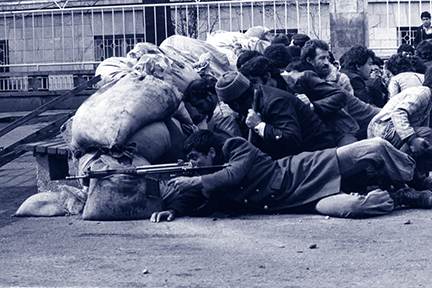
Armed Iranian rebels during the revolution, 1979
Defining the term revolution can be difficult, as it has been appropriated for many purposes, even commercial advertising that promises a “revolution” in one’s life if one adopts a certain product. Here, I propose to go back to the more common usage of the word, meaning “an instance of great change in affairs,” or, more narrowly, the “overthrow of an established political or social system,” meanings that gained particular currency in the English-speaking world from the Glorious Revolution of 1688–89 that overthrew King James II.1 But while the term is early modern (ca. 1500–1800), the concept of revolution is much, much older, dating back to ancient history, and was already notably described and developed by the Greek historian Thucydides in his descriptions of the revolutions in Greek cities as a result of the Peloponnesian War, from the revolt at Corcyra in 427 BCE on. Thucydides paints a very bleak picture of such events,2 but much else can be said about them.
Going back to prehistory, it is presumed that nonliterate tribal communities existed without much specialization, and also that, because they consisted of such a small number of individuals (maybe a few hundred), everyone knew everyone else personally, conditions that led to less hierarchy and classism, and therefore probably less organized internal conflict, than exist in later societies—although even in those conditions there must have been some.3 But as soon as civilization appeared with the invention of writing and other developments, societies became organized in hierarchical systems, complete with complex political arrangements, including kings, such as those that emerged in ancient Iraq and Egypt more than five thousand years ago. These systems already raised the question of governance and authority at the dawn of human history. Who was to govern and why? And what did the rulers owe to the ruled, and vice versa? These are already important themes in ancient texts.
The usual understanding of such ruling systems is that the rulers, their associates, and their helpers were always first of all interested in staying in power. But how were they to do that? Could they claim that they should just rule because they were the rulers, always divinely approved and appointed, or did they need to do more? However much rulers might have wished that simply claiming divine authority, which they normally invoked, would be enough to legitimate their rule, it was not sufficient, so they also had to submit to working for the welfare of the people, because public opinion always mattered. In particular, the opinion of other elites who worked with the rulers mattered because these elites could see that their rulers were mere humans and could potentially rival or overthrow them. So from the very beginning, the public interest had to be a concern of the rulers, a concern that emerges even in some of the earliest texts from Iraq and Egypt.4 The public interest was also a concern of the ancient Hebrew prophets in their denunciations of their kings, and it was obviously a theme noted by Greek and Roman historians when their writings begin from the fifth century BCE onward.5 It is furthermore of great interest that the scholar Michael Hudson has emphasized how ancient kings saw it as one of their major duties to protect their subjects from the rapacity of the rich by regularly canceling outstanding debts.6 And there is no doubt that lawgiving to order and organize society was seen as a major royal duty too, as shown by the famous law codes of Hammurabi of Babylon (r. ca. 1792–1750 BCE) and others.7 The duty of the ruler to establish justice in his realm has also been the standard of conduct for rulers in the Muslim world,8 and one can accept that this has been a general rule for monarchs throughout the world.
Rulers, then, legitimized themselves both by claiming divine authorization and by upholding the public interest. But what happened when the rulers failed adequately to uphold the public interest, such that the confidence of the public in them and often in the whole existing system was lost, revolts broke out, others tried to take over, and the system crumbled, as has also happened repeatedly? In these cases, the ensuing disintegration of the previous legitimate authority would lead more or less swiftly to a cycle of factionalism and violence, which would end eventually, often after prolonged strife and bloodshed, in the emergence of a new elite and new autocracy. Mostly, this has been the story of human politics since the beginning of history. To understand this series of events or developments, it is necessary first to consider the conditions that precede such an upheaval, then the course of the upheaval itself, which normally includes multiple rapidly shifting stages, and finally the consequences of the upheaval. Overall, this process is the main description of what is termed revolution.
While revolutionary upheavals have been common throughout history, they are not the norm in societies most of the time. Whatever kinds of political arrangements may have been experienced by nonliterate peoples,9 it is quite clear that people in most places and times have lived under monarchies, usually but not always hereditary, and that these monarchical regimes have often persisted under the same families for centuries. Disorder under these regimes, for the most part, has been confined to crime and banditry, which might occasionally shade off into actual rebellion.10 So the default condition of civilized life has been, on the whole, peaceful organization under regimes that, through technology, education, and other developments, have gradually become more controlling of and intrusive into the affairs of their individual human subjects, especially over the last two hundred years or so.
However, life also involves constant change, which regimes are sometimes ill prepared to handle, and various threats exist, some from nature, some directly from other humans, and some from the invisible structures organizing the society. Also, sometimes a regime becomes increasingly exploitative, autocratic, or despotic, often in response to the insecurity it feels because of these threats. This autocratic tendency is usually exacerbated by the fact that a regime is never a single, unified actor but rather consists of large numbers of people with various interests, many of whom want to push for their own advancement or enrichment, even if to the detriment of the regime. Given these challenges, the rulers may feel the need to tighten their grip, which can lead to a spiraling conflict that results in a revolution.
A standard explanation of revolutions is that worsening economic conditions make it almost impossible for the people to make ends meet, so, fearing for their survival, they are forced to overthrow the existing system.11 While it cannot be denied that privation motivates some revolutionaries, a countervailing view says that rather, when the people have reached a stage where they have a better understanding of what is being done and find it unjust, they revolt. In either case, pressures build up, leading to a revolutionary explosion.
If we consider four great revolutions of modern times—the French (1789–99), Mexican (1910–20), Russian (1917–21), and Iranian (1978–81)—we will see that they all cast light on this pattern. In each case, the revolution was preceded by the rule of a long-term autocrat: Louis XVI (r. 1774–92) in France, Porfirio Díaz (r. 1876–1911) in Mexico, Nicholas II (r. 1894–1917) in Russia, and Mohammad Reza Pahlavi (r. 1953–79) in Iran.12 The old regimes in France and Russia each had a history going back centuries, which was not true of the parvenu regimes of Díaz and Pahlavi, neither of which had much historical depth. While economic hardship and suffering were motives in France because of the cold winter of 1788–89 and a bad harvest, the leadership of the revolution consisted of more prosperous bourgeois people who were more motivated by the liberalism of the eighteenth-century Enlightenment and the seemingly more liberal British system, not to mention the new American republic.13 Likewise, in Mexico, the revolution was set off when the aging Díaz opened up the system slightly by allowing opposition in a presidential election, which brought out liberal hopes in the elite, while the common people had more immediate material concerns. In Russia, a slowing down of the distribution system owing to the First World War contributed to the initial disorder in the capital, Saint Petersburg (then Petrograd), but there were numerous other popular grievances, especially against the war, which had by then caused almost ten million casualties, not to mention long-standing grievances against the tsarist autocracy. Finally, in Iran, maldistribution of the state income from oil production and dislike of the perceived submissiveness of the shah to the United States were major motivations. Given the great variety of alleged causes, a simple explanation of the reasons underlying these initial revolutionary outbreaks and the details of their later courses is not possible.
Nonetheless, despite the variety of motivations, these revolutions all reflect widespread dissatisfaction with and loss of legitimacy for the old regimes that they overthrew. Another common factor is the tendency of these regimes to rely on repression to prevent revolution. In general, however, repression is merely an admission of defeat, because it implies that all of the usual devices to gain legitimacy have failed. This means that forms of claiming some external or divine authority have grown weak in the face of changing conditions, as exemplified by the rise of republicanism, which undermined the monarchies in France, Russia, and Iran. However, the Díaz regime’s claims to act in the interests of the republic in Mexico similarly failed, so revolutionary opposition cannot be claimed as simply antimonarchical. In all of these revolutions, the biggest loss of legitimacy seems rather to have been connected with the perception that the regime was no longer acting in the public interest or for the public good. While the specific grievances against the regimes were various, they all resulted in the regimes’ loss of credible commitment to benefiting the people.
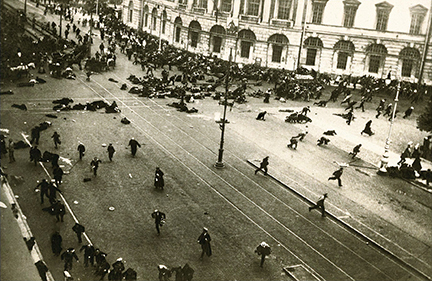
Street demonstrators being fired upon by government forces in Petrograd (Saint Petersburg), 1917
In a very interesting recent book, Daniel Chirot has proposed four stages that revolutions go through.14 His explanation of these stages is quite complex, as one would expect from a subject with so many diverse actors and variables. Yet perhaps the stages can be summarized as follows:
While Chirot labels these as stages, it appears to me that (2) and (3) can actually be conflated and are likely to be simultaneous. I would propose that common to successful revolutions are a liberal stage, a radical stage, and a consolidating stage; in unsuccessful revolutions, the consolidating stage might instead be a counterrevolutionary one. The consistency of revolutionary patterns in history suggests that we are dealing with something like a natural phenomenon of politics rather than something willed and directed by revolutionary actors.
Revolts and revolutions have erupted frequently in history, and many or most have been violently suppressed and did not succeed, as we can witness in the general course of the so-called Arab Spring uprisings (2010–13). Oddly then, when revolutions do succeed, their early success is often rather easy, which helps foment an atmosphere of excitement and optimism. When an initial revolutionary outbreak succeeds in displacing the old regime and its upholders from power, the revolution normally enters a kind of lull, in which people rejoice at the downfall of the old regime but are still in a state of some accord with each other, despite the necessity of jockeying for power, as the fall of the old rulers has inevitably left a power vacuum. Those best placed to fill this vacuum do not come from the lower ranks of society or of the revolutionaries but are people who already know the system. Normally, for a revolution to succeed, at least some members of the former elite must support it. These elites often have reasonable intentions and plans to reform the worst excesses of the preceding system, but the reforms they do implement are insufficient to appease the popular appetite for more, and they are immediately beset by the innumerable and contradictory expectations of the masses who supported the revolution, whose hopes and dreams for an ideal future are inflated and boundless. As a result, the new rulers, whose positions are likely to be provisional and tentative, and thus not well established, flounder in trying to please everyone, or at least as many as possible, and their stage comes to an end as more radical forces, relying on popular disappointment with the “liberal” outcome of the revolution so far, move to take over.
This first stage is clearly demonstrated in the four revolutions by the liberal regimes that first held power in each, that to some extent dominated by Honoré-Gabriel Riqueti, comte de Mirabeau (r. 1789–91), in France and those headed by Francisco Madero (r. 1911–13) in Mexico, Aleksandr Kerensky (r. 1917), in Russia, and Abolhasan Bani-Sadr (r. 1980–81) in Iran. In each case, the liberals in power confronted both reactionary forces trying to bring back the old regime and much larger and stronger popular forces demanding more radical reforms. These latter were more problematic because of their internal diversity and disunity, such that all were making demands that contradicted each other and that the revolutionaries in power could not possibly fulfill.
In the case of France, Mirabeau strove to stem the revolution and even cooperated with the king, who had not been deposed but was left in office in the hope of establishing a constitutional monarchy along the lines of Great Britain. Mirabeau died naturally in 1791, escaping the fate that likely would have awaited him had he lived longer,15 and the revolution became much more radical in 1792, deposing, imprisoning, and later executing the king and beginning to persecute the liberals as traitors.
In Mexico, Madero, a wealthy landowner, came to power because he was brave enough to run against Díaz in the 1910 election, but upon being installed as president in 1911, he was immediately confronted by widespread demands for economic and social reforms and, at the same time, by the desire of the wealthy to maintain their holdings. These irreconcilable desires led to Madero’s murder at the hands of counterrevolutionaries led by Victoriano Huerta.16
In Russia, despite opposition from powerful revolutionary committees called soviets, liberals left over from the old regime’s parliament (the Duma) were able to take charge: first, the nobleman Prince Lvov, then, after popular disturbances, Kerensky. Their liberal regime was even able to continue Russia’s participation in the First World War, which became increasingly unpopular. Kerensky was overthrown by the radical Bolsheviks led by Lenin after only a few months in office, after which he escaped abroad.17
In Iran, when the shah finally gave up and left the country on January 16, 1979, a short-lived regency regime under Shahpur Bakhtiar endured until February 11, when Bakhtiar, in turn, had to flee. While Bakhtiar posed as an anti-shah liberal, by the time he came to office, Ayatollah Ruhollah Khomeini’s dominance was set, so Bakhtiar’s interval was brief, and I would not say he represents the liberal phase of the Iranian Revolution but rather the last gasp of the old regime. Despite Khomeini’s acknowledged leadership, the exact outlines of the subsequent government were unclear, and many of the revolutionary leaders, such as Mehdi Bazargan and Ibrahim Yazdi, were liberals, as was Bani-Sadr, who emerged as the first president of the new republic. However, Bani-Sadr’s clashes with those who wanted more thoroughgoing revolutionary change led to his being deposed as president, going into hiding, and fleeing abroad to escape, which largely ended the liberal phase of the Iranian Revolution.18
While the details differ substantially among each of the four revolutions, it is interesting how the same pattern reasserted itself in each case.19 Nonetheless, during the liberal stage, one witnesses an eventual transformation brought about by a hardening of positions, decisively ending the postrevolutionary euphoria and gentility. Too much was at stake to let the opposing parties have any say, and this led inexorably to strong measures to impose conformity. Naturally, this tightening ended the period of optimism and euphoria that broke out when the old regime had collapsed, a euphoria that was usually at its height at the moment of the fall or departure of the old leader, Louis XVI, Díaz, Nicholas II, and Mohammad Reza Pahlavi in the cases we have been looking at, even if the fall of Louis XVI was rather drawn out, so that in the French case it was more the fall of the Bastille that created that euphoria. The end of the liberal period in each revolution also dashed the hopes and expectations of many who wanted events to take a different course.
In each of the four revolutions, a more lingering radical stage followed the liberal one. This stage was characterized by the repressive excesses emphasized by Chirot and documented thoroughly in numerous histories. Under his second and third stages, Chirot attributes the repression to counterrevolutionary threats, which may emerge both inside and outside the country undergoing revolution, as well as to revolutionary ideology based on excessive idealism—that is, too much absolutist adherence to a particular ideal. The ideal presented by the revolutionaries usually contains unrealistic utopian plans, imaginings, and expectations that cannot be put into effect, or that immediately cause greater problems, threatening the legitimacy of the revolutionary state.20
Thus, in France, the more liberal Legislative Assembly gave way to the National Convention of 1792–95, under which the revolution reached its crescendo in 1792–94. Many radical measures were enacted, including, for a time, the cult of reason and the abolition of the worship of God. Many adherents of the old regime were executed, while others fled. However, the revolutionaries themselves were severely divided over what kind of society to create, with some favoring populist redistribution and others opposing it. Soon, the revolutionaries began to accuse each other of treason and execute one another, while counterrevolutionaries were also massacred, so the internal bloodshed reached a fever pitch, with perhaps 250,000 to 300,000 victims.21 This was called the Reign of Terror and even gave rise to the term terrorist, which referred to those in the revolutionary government who committed acts of terror in the name of revolutionary justice.22 Interestingly, the concepts of terror, terrorist, and terrorism thus arose in the context of the actions of the state—that is, state terrorism—and not as they have come to be employed against others by statist propaganda today. Meanwhile, other countries tried to invade France but were defeated, and the French Revolution began to threaten the rest of Europe with the overthrow of all the monarchies.
In Mexico, the counterrevolutionary coup of Huerta that ended the liberal regime of Madero was never able to rule in much of the country and was reversed after seventeen months. The subsequent situation remained chaotic and murderous, however, more so than in revolutionary France. The revolutionaries succeeded in driving out Huerta, the relic of the old regime. But, similar to the French revolutionaries, they split over how many egalitarian measures to implement and commenced fighting against each other, and their struggles went on for years, as each group had its own regional strongholds. Through their fighting and the resulting anarchy, banditry, and plundering of resources, they also caused great harm to the common people, leading to possibly 1–1.4 million excess deaths (about 7–10 percent of the total population of over 15 million in 1910).23
In Russia, the Bolshevik Revolution ended the war with Germany in 1918 and thus exited the First World War, but it was immediately beset by counterrevolutionary blowback from within and the external intervention of fourteen foreign countries. More than other revolutionaries, the Communists had a detailed program of reforms from the beginning, including many equalizing measures, which eventually extended to the abolition of most forms of private property. But in the wake of their victory, splits also appeared in their leadership, leading, as in France, to many executions, which the leadership felt necessary to secure their power and the revolution. There was also extensive resistance against the Communists. As a result, it has been estimated that between 1917 and 1921, the revolution led to 10–10.5 million excess deaths, three-quarters of these from famine.24 Even if this figure is exaggerated, it is still indicative of a horrific death toll.
As for Iran, its revolution was much less destructive but nevertheless exhibits some of the same characteristics. While the Iranians settled things more immediately by bringing Khomeini to power after the very brief interim rule of Bakhtiar as prime minister, the exact nature of what would ensue was not settled. Also, opponents fought the revolution, particularly the disappointed revolutionary group Mojahedin-e Khalq, and assassinated many of the new leaders. In response to this and other threats, the new government cracked down. The new republic, despite liberal opposition, began executing prominent participants in the old regime who had not fled, and then turned to executing revolutionary supporters accused of treason, such as the aide to Khomeini and foreign minister Sadegh Ghotbzadeh (executed 1982). From 1979 to 1988, the revolution may have executed at least 11,300 people for political crimes,25 a figure far smaller than those of the other revolutions we have been studying but nonetheless not negligible and an outcome of the same phenomenon.
The radical stage of revolutions tends to lead to various disappointments. Only one actualization of the future in history is possible, after all. The revolutionaries who bring a new order to the state thus face a great cooling of enthusiasm for their projects, as well as many threats from opponents, which constrains them to run a tighter ship. Such tightening also brings out the differences among the revolutionaries themselves, which are seen as intolerable threats by the various tendencies or parties in the revolution, so accusations of plotting and treason begin to be bandied about, and soon executions and massacres begin, made much, much worse if actual civil war erupts, as in Mexico and Russia. Nevertheless, the reigns of terror and times of trouble eventually calm down into a more settled environment in the consolidation stage.
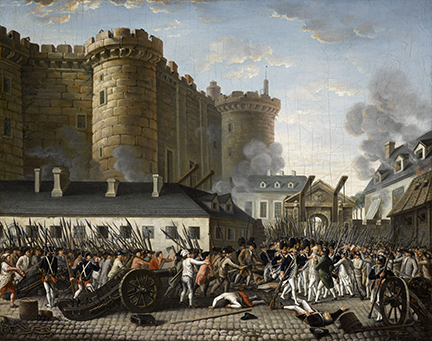
Storming of the Bastille, a flash point of the French Revolution, 1789
The consolidation stage of revolutions follows the chaos of the liberal stage and the severe repression of the radical stage.26 The surviving leadership steps back from the harsh measures of their predecessors, striving to restore the rule of law while preserving some of the accomplishments of the revolution and continuing to celebrate it. According to Chirot, this stage is beset by “corruption,” but it can also be described in less loaded terms. A lot of backsliding occurs. Revolutionary measures aiming at egalitarianism are reduced or undone. The revolutionary survivors form the basis of a new elite that becomes a new aristocracy. The revolution comes full circle, never reproducing the regime it replaced exactly but nonetheless creating a classism that begins gradually to resemble the old classism. This is summed up in the final words of George Orwell’s Animal Farm, when the revolution of the animals against the humans has only led to an aristocracy of the pigs over the other animals: “The creatures outside looked from pig to man, and from man to pig, and from pig to man again; but already it was impossible to say which was which.”27 That is, the aristocracy of the pigs had become indistinguishable from that of the humans.
Of all the possible criticisms of revolutions and revolutionism, this is the harshest. No matter how bloody and destructive a revolution has been, it is always possible to argue that the good outweighs the bad—if it furthers ideological aims, for example. But if a revolution produces a new elite indistinguishable from the old elite, then it has truly accomplished nothing, and all its sins come back to haunt it. When we examine the four revolutions, we see their outcomes are rather different. But in each case, while they never reproduced the old regime exactly, each nonetheless exhibited a new domination with a new elite.
In France, the consolidation stage is represented by the Thermidorian Reaction of 1794, which led to the bourgeois regime of the Directory (1795–99). But that didn’t last long, owing to the establishment of the Consulate (1799–1804) and First French Empire (1804–14, 1815) of Napoleon, which represented a brief era of new aristocracy and greater stability undermined by Napoleon’s attempt to conquer Europe. The failure of that project led to the forced restoration of the old regime, with two of Louis XVI’s brothers as kings (1815–30), an attempt to put everything back as it had been before the revolution. The brief Bourbon Restoration was the closest any consolidation period came in any of the revolutions we are examining here to restoring the old regime. The Bourbon Restoration, in turn, produced a new revolution with a Bourbon cousin as king (1830–48), then yet another revolution of the Second Republic (1848–52), followed by the Second Empire of Napoleon’s supposed nephew (1852–70), then still another revolution that included the bloody episode of the Paris Commune (1870–71), then the Third Republic (1870–1940), a kind of longer-lasting constitutional arrangement that could finally be seen as a kind of consolidation. The rest of France’s history comprises the dictatorial state of Vichy France under Nazi German occupation (1940–44) and then, after the Allied liberation of France, the Fourth Republic (1946–58), which was to some extent a continuation of the Third Republic. After yet another revolution, Charles de Gaulle brought into being the more presidential Fifth Republic, which persists today, although it suffered one further revolutionary tremor in 1968. All of that history does not seem to express a great deal of political stability, though France’s gradual incorporation into the North Atlantic Treaty Organization (NATO) may also have constrained freedom of action for political movements. Yet the French state did stabilize, so the later revolutions had much less impact than the great one that peaked in 1792–94, and the later French state did not differ much from regimes in the other European countries under the capitalist dispensation with a considerably classist societal arrangement. This history calls into question exactly how much difference the original revolution of 1789–99 made, as the emergent elites in the various stages of French history have remained quite above the rest of the people.
Mexico likewise underwent a gradual stabilization after its era of revolutionary excess, which reached a bloody crescendo in the chaotic civil wars of 1914–20. Consolidation was achieved by the restoration of an orderly presidential succession after 1920, although one punctuated by some continuing assassinations, revolts, and political repression. Stability was sealed by the establishment of a one-party state dominated by the appropriately named Institutional Revolutionary Party (PRI), which ruled under several different names from 1929 to 2000, a remarkable seventy-one-year period of rule paralleling the French Third Republic in length of domination. While President Lázaro Cárdenas (r. 1934–40) supported socialist measures introduced during the revolution, his successors gradually fell away into neoliberalism, supporting classist exploitation, and thereby validating the corruption thesis of Chirot. By 1968, when the PRI-led government committed the huge massacre of Tlatelolco in Mexico City against students protesting the Olympic Games being held there, matters had come full circle, with the supposedly revolutionary government killing its own citizens on behalf of an international capitalist venture that benefited the people not at all.28
Russia’s consolidation resembled Mexico’s more than it did France’s (although there is some parallel between Stalin and Napoleon, the strongman emerging after the intense revolutionary period).29 The Communist Party eventually succeeded in stamping out all revolts and political opposition. The revolution ate its own in the notorious purges of the Great Terror of 1937–38 carried out by the Stalin regime (r. 1928–53). Persisting from 1917 to 1991, a period of seventy-four years (similar in length to the domination in Mexico of the PRI), the Communist regime succeeded in producing a new favored elite called the nomenklatura. While the economic arrangements, including state ownership of industries and farms, remained different from those of the preceding tsarist era, there was nevertheless a slippage away from equality and an increase in profiteering by those who learned to game the system. And in the end, when the Soviet Union collapsed in 1991, the successor regimes all had their elites in place, ready to exploit the situation for their own benefit.
Like Mexico and Russia, Iran enjoyed a considerable period of stability, despite being besieged by sanctions imposed by the United States and its allies, largely on behalf of Israel, which always urged unremitting enmity toward Iran. While having elections like France and Mexico complete with opposition parties and candidates after Khomeini, in a period labeled by Ervand Abrahamian as “Thermidor,” referring to the consolidating period of 1794–99 in France, the revolutionary state and its partly clerical new elite remained very much in charge, provoking various protest movements.30
In considering the consolidation stage of each revolution, down to the present, it is also necessary to remember an external factor affecting the politics of each case: the rise and growth of the capitalist juggernaut extending its tentacles into all corners of the world. France succumbed to this early, losing much of its financial independence due to its First World War debt and becoming substantially a satellite of the United States after 1944. Mexico tried and still tries to some extent to maintain its independence, but it was severely compromised by the North American Free Trade Agreement (NAFTA) of 1994. Russia was drawn into the capitalist world with the collapse of the Soviet Union in 1991 and thereafter entered a period of economic privation and weakness, but it was constrained to reassert its independence, albeit under a classist and capitalist system, because of the relentless hostility of the United States to every attempt by the Russians to integrate, a hostility mainly born of Russia’s parity in nuclear weapons, a situation the US foreign policy elite found intolerable. Iran, likewise, has faced a continuous economic siege based on US foreign policy, a major factor in describing its situation.
Thus, the situation today perhaps resembles that of Greece in the fifth century BCE, as described by Thucydides, with many separate city-states under the hegemony of one or another dominant state. The centralizing power of a globalist capitalism, based in the US, struggles to clinch world domination everywhere by stamping out, overthrowing, or subverting the remaining independentist states. But this is a quixotic project wholly nullified by the proliferation of nuclear weapons, especially by resistant states such as Russia, China, and North Korea, rendering aggression against them impossible. Meanwhile, growing inequality replete with hunger and increasing homelessness threatens to create a dissatisfaction that is truly worldwide. Therefore, one cannot say that revolutionism is over or finished. Rather, it must be seen as a continuing phenomenon that wracks various places at various times, just like storms and hurricanes that come and go for complex reasons. But now the stakes are higher and the situation perhaps more dangerous because of the unification of the earth through technology. Indeed, if nothing is done to redress the inequities of the present, revolutionism may engulf the whole planet, a development hardly to be welcomed, given the histories of the revolutions we have studied here.
Renovatio is free to read online, but you can support our work by buying the print edition or making a donation.
Browse and Buy