
Juan Cole
Juan Cole is Richard P. Mitchell Collegiate Professor of History at the University of Michigan.
More About this Author
Juan Cole is Richard P. Mitchell Collegiate Professor of History at the University of Michigan.
More About this Author
Juan Cole is Richard P. Mitchell Collegiate Professor of History at the University of Michigan.
More About this AuthorWilliam Morris was a nineteenth-century artist, poet, designer, craftsman, and socialist who reacted against the squalor of Britain under industrialization and took the side of put-upon workers against the new class of industrialists. Ironically, he came from a well-off family that had invested in copper and tin mines. Born in Walthamstow, near London, he attended Oxford and joined the avant-garde Pre-Raphaelite movement of poets and artists as an undergraduate. Eclectic in his tastes and open to the wide world into which Victorian Britain insistently inserted itself for trade and colonialism, he encountered, and was enamored by, Islamic arts, alongside his fascination with Vikings for which he is better known. Above all, Morris was a peaceful rebel, using his art and craftsmanship to mount a powerful protest against the miseries of Victorian factory regimentation, the brutality of colonialism, and the easy bigotry of an elite that condemned other cultures as barbarous and unworthy of the notice of a superior race.
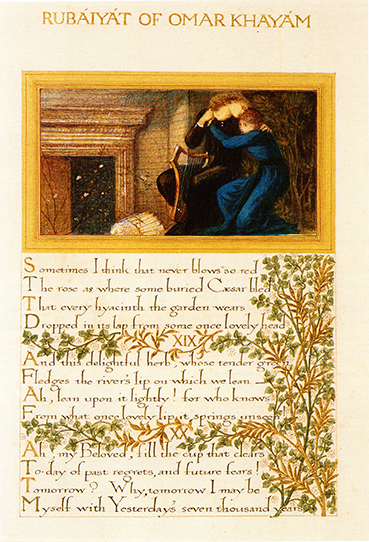
Page from an illuminated manuscript of the Rubáiyát of Omar Khayyám, with William Morris’s calligraphy and ornamentation, and illustration by Edward Burne-Jones
Although Victorian Orientalism is rightly denounced for its supercilious sense of superiority and negative depictions of the Middle East and Asia, Morris found genuine elements of beauty in those cultures and acknowledged classical Persian design as his master. Revolting against a soulless modernity, he exemplifies a different motivation for the appropriation of Eastern culture, what English novelist George Eliot referred to as the enlargement of the self through travel. In her journal of her trip to Italy in 1860, she wrote that she had looked forward to the journey “rather with the hope of the new elements it would bring to my culture, than with the hope of immediate pleasure.” The toil of travel, she added, would be “a disappointment if the main object is not the enlargement of one’s general life.”1 She spoke of the “double consciousness” experienced in the presence of great works of art, both of the physical act of seeing and of the later act of imagination in remembering details not immediately noticed.
English poet and painter Dante Gabriel Rossetti founded the Pre-Raphaelite Brotherhood in the late 1840s as a movement of artists and painters rebelling against what they viewed as the glib and sterile style favored by Renaissance and later artists and exemplified by Raphael. In the 1840s, art historians were discovering late medieval artists, including Giotto and Fra Angelico in Italy, whose work the Pre-Raphaelites found dynamic, vigorous, and idiosyncratic. They also loved Dante, the Arthurian legends, and the tales of The Arabian Nights, also known as The Thousand and One Nights.2 Though the Pre-Raphaelite Brotherhood fell apart by the mid-1850s, its themes were taken up by a looser movement of artists under Rossetti’s spell. Ultimately, the Pre-Raphaelites were not medieval romanticists. They did not wish to go back to a medieval world but to use what they saw as the unpretentious honesty of medieval poetry and art to counter and confront the dreary world of manufacturing plants and railroads, even while the Royal Society of Arts supported artists who painted mediocre landscapes and cartoonish mythological scenes that sidestepped the ways in which nature and the industrial world were “red in tooth and claw,” in Tennyson’s phrase.
When the Oxford Student Union commissioned Rossetti to paint murals with Arthurian themes, he enlisted the young William Morris and Edward “Ned” Jones (later Burne-Jones) in the endeavor. Morris, squat, square-jawed, and muscular, sometimes sat as a model for his friend Edward Jones, who thought Morris “always had a head for Lancelot or Tristram.”3 His friends called him “Topsy.” In the bohemian demimonde of the artists that he met, it was common for men to employ working-class women as models. Morris thus met Jane “Janey” Burden, daughter of a stableman, who modeled for Rossetti and for him. A brunette with an aquiline nose, she was in Rossetti’s parlance a “stunner,” embodying the standards of beauty idolized by the Pre-Raphaelites. Morris married her, but it was not to be a happy union.
In the late 1850s, Morris’s dear friend Edward Jones was engaged to Georgiana “Georgie” MacDonald, a daughter of a Methodist clergyman. She was also an embroiderer and wood engraver in her own right. He wooed her with gifts of books and glimpses into his artistic circles. He gave The Arabian Nights to her sister Aggie as a gift to the entire family, which they often read aloud. Georgie recalled her introduction to the world of art: “I felt in the presence of a new religion. Their love of beauty did not seem to me unbalanced, but as if it included the whole world, and raised the point from which they regarded everything.”4 She fell away from her family’s Wesleyanism, favoring a personal spirituality over organized religion.5
After he graduated, Morris, who was independently wealthy, established a design company in London. Both Edward and Georgiana Burne-Jones, née MacDonald, worked there. Morris and others crafted household decorations, furniture, stained glass windows, and other products by hand in a refutation of the rush to cookie-cutter industrially made goods of the time. Following its founding in 1861, Morris broadened the enterprise, establishing a retail outlet and display room on Oxford Street in 1877, opening another shop in Manchester, and appointing representatives throughout Europe, Australia, Canada, and the United States. In 1881, Morris transferred the manufacturing operations to the former silk-weaving halls at Merton Abbey in southwest London. These dramatically larger facilities allowed the company to branch out into additional goods and methods, including tapestry work, carpet production, and the natural dyeing of yarns. He also founded the Kelmscott Press. The firm’s output of hundreds of designs across various media, including textiles, wallpaper, and books, indicates a significant, though not industrial-scale, operation.6 Morris viewed the division of labor processes in factory production as separating the worker from the joy of crafting well-made, whole products. He later advised the public: “Have nothing in your houses that you do not know to be useful or believe to be beautiful.”7 Morris became a major figure in the British Arts and Crafts movement that gained significant influence and contributed to the revival of British art forms.
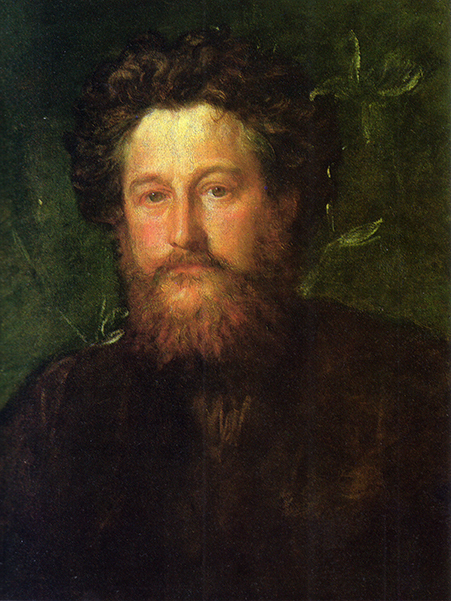
William Morris, portrait by George Frederic Watts, 1870
Morris’s knowledge of Middle Eastern arts came especially through the South Kensington Museum, founded in 1852, now known as the Victoria and Albert Museum. Its curators had a special interest in India and the Middle East, and opened an exhibition in 1876, the Persian Court, which displayed 1,889 specimens, many of them collected in Tehran by Robert Murdoch Smith (d. 1900). Morris had already begun collecting Iranian art in the 1860s, and he was among the more avid visitors to the South Kensington Museum throughout his life.8 In his own work, he produced patterns such as Peacock and Dragon in woven wool and Wild Strawberry, a block print for wallpaper, drawing on motifs he saw in Islamic art, including Persian textiles and plates, as well as in the glazed ceramic plates and pottery produced in İznik during the Ottoman period.9
As a socialist, Morris despised the British Empire and advocated home rule for Ireland. The Socialist League, which he founded in the 1880s, was a small minority in political life, but influenced the labor movement. Though he was relatively silent about India as a political issue, he did acknowledge late in life that “we are a hated garrison in India and hold it by means of force and fraud for the advantage of the robber class in England.”10 He derided the negative impact of British industrialization on Indian arts and crafts, seeing the art of the subcontinent as “beautiful, worthy of imitation and superior to most Western mass-produced equivalents.”11 He was especially attracted to Indo-Persian arts and crafts.
Like most Victorians, Morris held Iranian (Persian) culture and arts in high regard. By the early 1880s, Iranian and Japanese objets d’art held the most cachet at London auctions.12 The key role of Persian literature at the Mughal court likely contributed to this mystique, since the Victorians often imagined themselves successors to the Mughal Empire, the polity displaced beginning in 1764 by the East India Company (EIC) as it gobbled up India. Generations of British men served as administrators and soldiers in the EIC, where they learned Persian as well as Indian languages, and returned home, often wealthy, to play the role of tastemakers on matters Eastern. In 1858, Queen Victoria assumed the title Qaysar-i-Hind, “Caesar of India,” when London took direct control of British India after the failed war of independence against the EIC.
Morris seems to have imagined Persia as the font of art in the Middle East and South Asia. He said, “To us pattern-designers, Persia has become a holy land, for there in the process of time our art was perfected, and thence above all places it spread to cover for a while the world, east and west.”13 These patterns, he thought, were not mere decorations but rather imbued with mystic significance: “I believe the Persians have preserved and handed down to later ages certain forms of ornament which, above all, must be considered parts of pattern-designing, and which have clung to that art with singular tenacity. These forms are variations of the mystic symbols of the Holy Tree, and the Holy Fire.”14
On another occasion, he wrote, “Persian Art spread all over the Mussulman East, producing everywhere an architecture of nearly complete unity of style.”15 He became especially interested in Persian carpets of the early modern period as exemplars of the craft, writing in 1877, “Meantime much may be done in carpets: I saw yesterday a piece of ancient Persian, time of Shah Abbas (our Elizabeth’s time), that fairly threw me on my back: I had no idea that such wonders could be done in carpets.”16
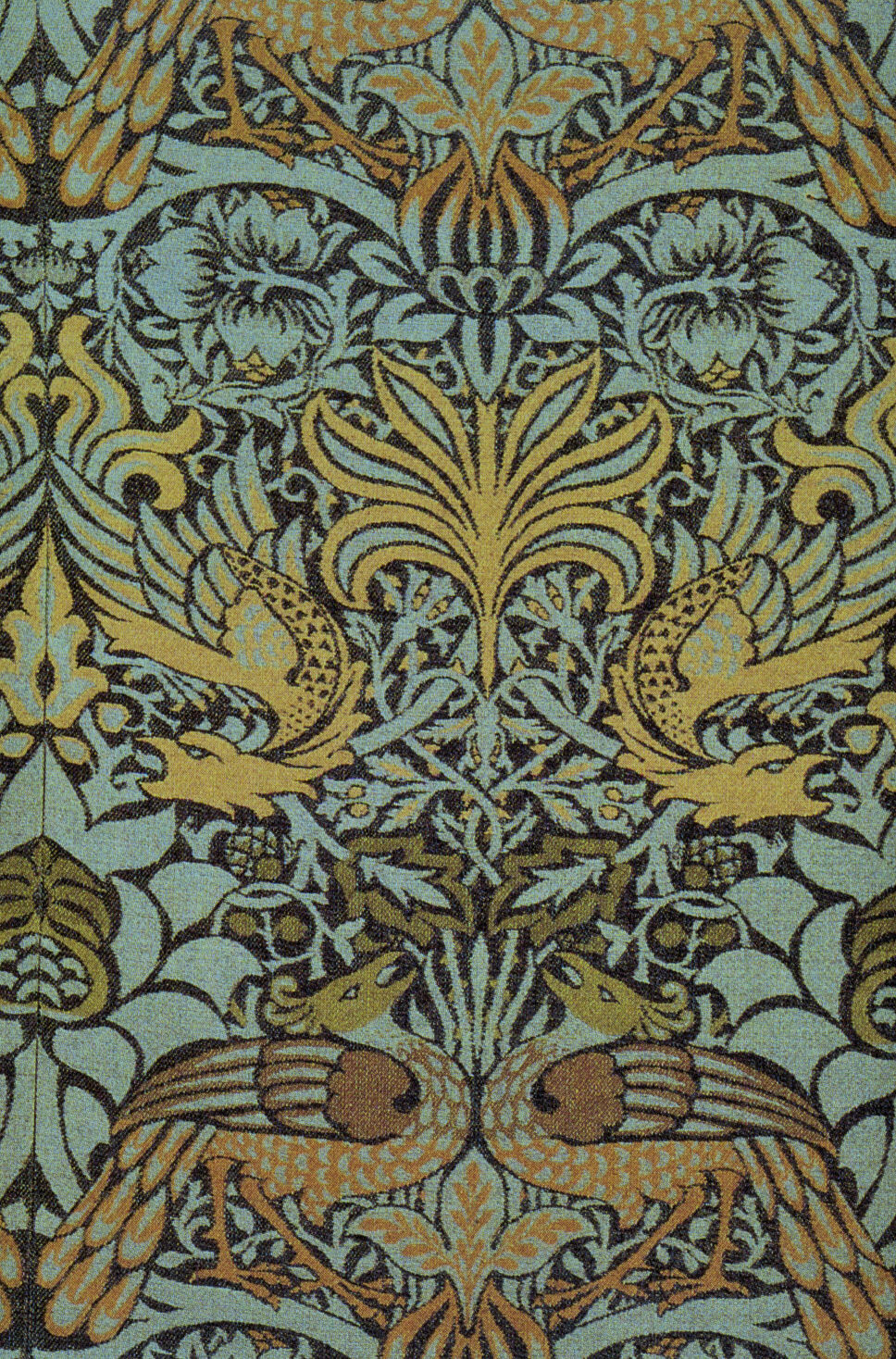
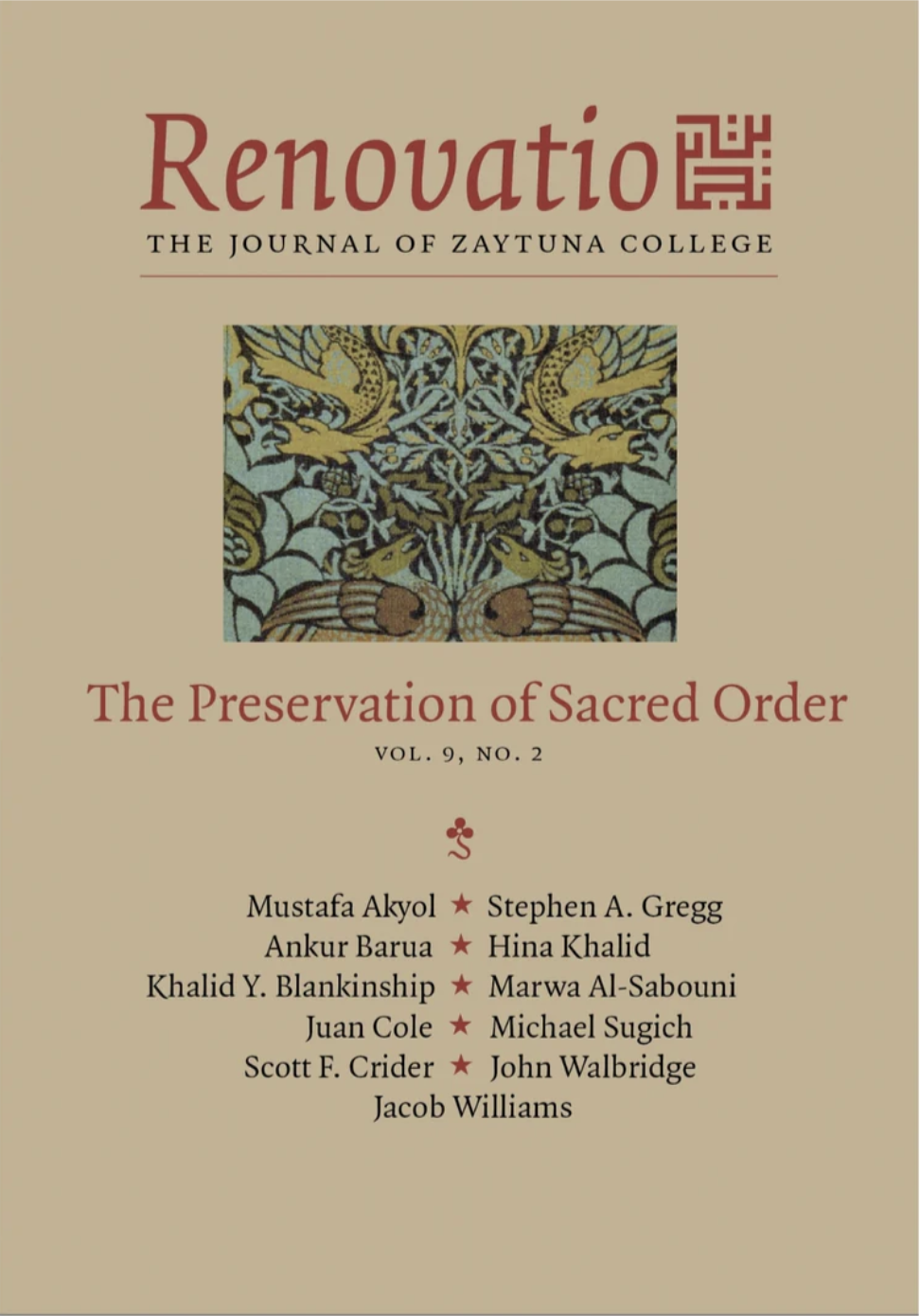
Peacock and Dragon, woven wool fabric designed by William Morris
The Thousand and One Nights, or, as it was known in Victorian Britain, The Arabian Nights, provided Morris with several themes in his four-volume book of verse, The Earthly Paradise, which established him as a major poet.17 For instance, “The Man Who Never Laughed Again” was Morris’s British reworking of the similarly titled tale in The Arabian Nights. The original, “The Story of the Man Who Never Laughed during the Rest of His Days,” revolves around a young man who inherits his father’s vast fortune and then fritters it away on excesses. He at length falls into poverty and is forced to work as a servant for ten dour, elderly men who live in an opulent, cryptic house. The men are mourning, yet they prohibit him from asking why. The house has a mysterious door that they warn him not to open lest he become like them.
The young man serves the old men faithfully for many years, and when the last of them dies, he inherits the house and its contents. Despite the men’s warnings, his curiosity leads him to open the forbidden door, which reveals a passage to a distant island. A bird swoops down on the beach and bears him away. He is taken aboard a ship and treated as royalty by Amazon-like women who govern a kingdom where men perform physical labor while women rule and serve in the military. The queen eventually takes the young man as her husband. She, too, has a forbidden door in her palace that she forbids him to open.
His curiosity again gets the better of him; he opens the door only to face the same bird that had carried him to the island. The bird condemns him and casts him back to the shore where he first landed. All the wealth, power, and joy he had experienced are lost, and he returns to the old men’s house, realizing that they mourned because they had met the same fate that befell him. Consumed with grief and regret, he never laughs again until his death, upon which he is buried beside the elderly men he once served.
Morris reimagined this tale for The Earthly Paradise and set the story on “the Indian Sea” rather than in an Arab city, named the wayward young man Bharam (he meant Bahram), and named the old man who invites him to the dolorous house Firuz. Both are Persian names. The wastrel son of the wealthy man explains,
For even as with gifts contempt I bought
So knowledge buys disease, power loneliness,
And honour fear, and pleasure pains unsought,
And friendship anxious days of great distress,
And love the hate of what we used to bless—
Ah, I am wise, and wiser soon shall grow,
And know the most that wise dead men can know.18
Firuz takes Bharam to the home of the gloomy old men, who die one by one, leaving him heir to the house. He goes through the forbidden door to find himself on a golden ship, wooed by the princess of a lush, mystic land. He becomes her prince consort and she wins him over to her vision of happiness:
The days passed—growing sweeter as the year
Declined through autumn into winter-tide;
Perchance, for though no day could be so dear
As that whereon he first had seen his bride,
Yet still no less did love with him abide,
Tempered with quiet days and restfulness;
Desire fulfilled, renewed, his life did bless.19
Unlike in the original tale, in Morris’s version, the Amazon kingdom is attacked by enemies and Bharam goes to war for his princess (in The Arabian Nights, men performed manual labor but did not fight as soldiers). His love for his spouse motivates him to become a warrior, whereas he was unwilling to make sacrifices for a cause greater than himself in his previous life as a spendthrift.
In Morris’s poem, Bharam’s wife is not the ultimate authority in the land; a figure more powerful than she is orders her to absent herself for a hundred days. She leaves him behind with instructions not to enter her chambers. Inconsolable in her absence, he seeks her out and enters her bedroom, where he finds a tablet with instructions to drink from a goblet on the nightstand. He downs the liquid and falls into a troubled sleep. He wakes up back in his homeland, where the sumptuous mansion he had inherited has become a ruined shell, having lost its roof. He is as sad as the old men he had once served, but now is worse off than they were, having nowhere to lay his head.
But now and then men saw him on the quays,
Gazing on busy scenes he heeded nought,
Or passing through the crowd on festal days,
Or in some net of merry children caught,
And when they saw his dreamy eyes distraught,
His changeless face drawn with that hidden pain,
They said, “THE MAN WHO NE’ER SHALL LAUGH AGAIN.”20
It has been observed that Morris’s Bharam is a more admirable figure than the profligate son in the tale in The Arabian Nights, since he is motivated by a search for love. He drinks the potion in the forbidden chamber not because of idle curiosity but because he cannot bear to be apart from his beloved even for a hundred days.21
It is hard not to see Morris’s poem as a Pre-Raphaelite rejection of the travails of industrial civilization, with the original loveless setting born of greed and consumerism in sharp contrast to the joyful life of commitment to love and loyalty in a picturesque palace filled with things of beauty. That is, Morris’s Orientalism avoids the negative stereotyping that Edward Said skillfully analyzed and instead makes it part and parcel of his admiration for preindustrial ways of life and arts across the board.
Along with the finely crafted works of art, carpets, and tiles that Morris admired in Persianate culture and his clearly profound encounter with The Arabian Nights, he engaged deeply with an English translation of the famous Persian poem The Rubā‘iyāt of Omar Khayyām. We have every reason to think that the engagement grew out of more than aesthetic appreciation and originated in his own personal crises. Although he and Jane had two daughters together, they grew apart emotionally. His friends, at least, saw her as emotionally unavailable. She and Rossetti also developed a fascination with each other. Morris couldn’t have been happy about these developments, but took them in stride, and some have speculated that as an early feminist, he believed he should give Jane her head in her friendships.
The Pre-Raphaelites encountered Eastern literary and spiritual themes not only through the tales of The Arabian Nights, which they incorporated into their own work, but also through the Rubáiyát of Omar Khayyám, a loose translation into English by gentleman scholar Edward FitzGerald from 1859. FitzGerald’s interpreted translation of the Persian quatrains differed from most Victorian verse of the day in that it did not center on a character and had little narrative structure—features that reflected the Persian original. A great modern scholar of Iranian culture, Ehsan Yarshater, observed that Persian poetry differed from early Arabic verse in dealing primarily with stylized ideas, images, and types rather than personalities. The poet, he said, “shuns portraiture and eschews imparting life to the specific.” He cautioned, “Therefore, whether it is ‘the beloved,’ ‘the patron,’ ‘the rival,’ ‘the carefree drinker,’ or ‘the false preacher,’ to mention a few of the stock characters of Persian poetry, we are always dealing with types rather than individuals.”22 This feature of Persian poetry appealed to Western modernists in later decades who sought to decenter literature and to capture the fractured character of the personality in their era.
Early in 1859, FitzGerald sent his translation of the Rubā‘iyāt off to Piccadilly publisher Bernard Quaritch (d. 1899) and later paid him to place some notices in prominent weeklies. The book made an initial splash, although a review from later in 1859 in the Literary Gazette lambasted it as a “Gospel of Despair.”23 While it was known among a small circle of enthusiasts of what was then called “Oriental literature,” it leaped beyond that clique in 1861, when barrister Whitley Stokes and translator John “Jack” Ormsby bought copies after Quaritch put it out as a remainder. Seeing its virtues, they passed it on to friends in the Pre-Raphaelite movement, who then created a buzz about the find.24 Georgiana Burne-Jones recalled, “The copy of the first edition that [Algernon] Swinburne gave to Edward has always been one of our precious possessions, and before the book was reprinted became worn with frequent reading and transcribing.”25 The Rubáiyát derided conventional religion and its dogmas in favor of a personal authenticity, and some stanzas suggested that an Epicurean style of life and the pursuit of love were the only reasonable response to the shortness and misery of human life.
In Persian and Arabic literature, a rubā‘ī is a quatrain, a poem of four lines. The quatrain was quite popular in medieval Persian literature, being relatively easy to grasp, and often contained a haiku-like twist in the third line. Throughout the reign of the Seljuk Empire (1037–1194), poets produced quatrains on a variety of themes, including romantic love, the cruelties of fate, the saving beauty of nature, the attractions of wine, and the path of mystical insight. Some Sufi poets such as Farīd al-Dīn ‘Aţţār (d. 1221) produced entire volumes of rubā‘iyāt to express transcendent wisdom. Other quatrains were more secular or even ribald in orientation. Stanzas expressing sentiments of which the establishment of the time might disapprove were often released anonymously or attributed to some past figure.
Poets composed dozens of skeptical and libertine quatrains during the Mongol period in Persia from the 1220s to the early 1300s, when Buddhists ruled and Muslim orthodoxy fell by the wayside. A handful began being attributed to eleventh-century astronomer and mathematician Omar Khayyam (d. 1131), but there is no evidence that he wrote Persian poetry. He was probably chosen as a frame author because scientists had a reputation as religious skeptics.26 In the mid-fifteenth century, anthologists began creating entire books full of these unconventional stanzas that they gathered from numerous manuscripts and attributed to Omar Khayyam. In 1460, one Maĥmūd Yerbūdāqī of Shiraz produced a celebrated such manuscript for rebel Turkoman prince Pir Budāq of the Qara Qoyunlu dynasty. The convention spread like wildfire. Soon thereafter, an even bigger collection appeared in Tabriz, the Qara Qoyunlu capital. By 1506, an illustrated manuscript of the Rubā‘iyāt of Omar Khayyām was published in Lahore.27 Throughout the medieval period, calligraphers wrote out such manuscripts, adding more quatrains on various themes. In India, the court chronicler of Mughal emperor Akbar (r. 1556–1605) wrote that Akbar expressed the opinion that “one should write out a quatrain of Omar Khayyam, after reading an ode of Hafez, otherwise the latter is like drinking wine without a relish.”28 When lithograph printing came to British India in the 1820s, a copy of the Rubā‘iyāt of Omar Khayyām, containing nearly five hundred quatrains, was one of the first books to be published. It featured prominently in literature omnibuses lithographed in India and Iran throughout the nineteenth century, showing its popularity among Persian speakers.
Morris, a member of the Pre-Raphaelite circle, encountered FitzGerald’s Rubáiyát, and in the late 1860s, it became supremely meaningful to him as he faced a crisis in his marriage with Jane Burden. With a working-class background, she was a favorite model for the Pre-Raphaelite painters, and that preference, it has been suggested, changed the popular image of the angel from blond to brunette: “Her distinctive features, the abundant dark hair, the long neck, the large and open eyes, the well-formed lips, the straight nose became instantly recognizable.”29 Arguably, this apotheosis of the brunette gained a further impetus when the Rubáiyát began being illustrated, with black-haired beauties portraying heavenly virgins, or houris.
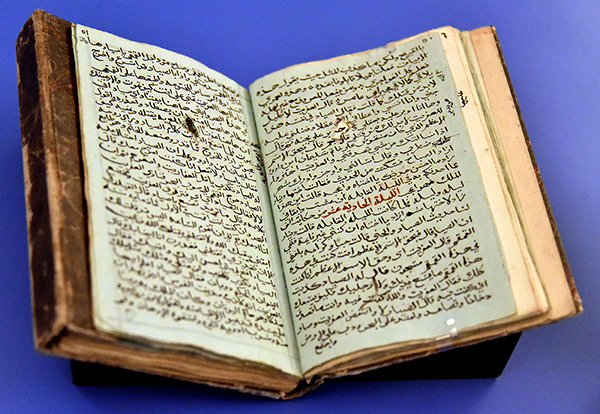
Arabic manuscript of parts of The Arabian Nights, 1900s
Jane Burden learned French and Italian once she entered Morris’s circle of bohemian artists, many of them Oxbridge-educated rebels from well-off families. She may have been the model in the early 1900s for Eliza Doolittle, the protagonist of George Bernard Shaw’s Pygmalion, which inspired the later play and film My Fair Lady. Her lack of warmth tortured Morris when she fell out of love with him in the late 1860s. She instead spent time with Rossetti at the art world’s social functions, and Rossetti was wild for her.30 At painter Ford Madox Brown’s parties, Rossetti and “Mrs. Morris” could be seen “sitting side by side in state, being worshipped.”31 On other public occasions, Rossetti sat with her in a corner, feeding her strawberries.
Morris allowed Rossetti to move in with them in 1871, and went off on a voyage to Iceland, suggesting to some that he felt women should have the same sexual liberty as men.32 Or perhaps he was assured that his wife was safe with Rossetti, given the older man’s obesity and health problems. Morris sought solace with Georgiana Burne-Jones, the wife of his friend, painter Edward Burne-Jones, who had become embroiled in a scandal when his mistress committed suicide in 1869, an episode that may have emboldened Georgiana to develop a romantic friendship with Morris. Both remained with their spouses for the rest of their lives. Victorians destroyed many of the papers of their parents or aunts and uncles when they died, making it impossible to know whether many relationships were platonic or more intimate. We can, however, gain some insight into their emotional lives.
In the early 1870s, Morris used FitzGerald’s Rubáiyát to express his romantic and spiritual dilemmas, making a copy with his own designs and calligraphy for Georgiana. He also produced four manuscripts of various works that he dedicated to her. The first was his own poetry, titled “A Book of Verse,” referring to the famous quatrain of the Rubáiyát (in its first version):
Here with a Loaf of Bread beneath the Bough,
A Flask of Wine, a Book of Verse—and Thou
Beside me singing in the Wilderness—
And Wilderness is Paradise enow.33
He also did the calligraphy and illustrations for an entire manuscript from the first edition of the Rubáiyát for her, finishing it in 1872.34 She recalled, “Morris, to do the poem honour, had borrowed the copy that [Algernon] Swinburne gave to Edward, and glorified it by twice writing out the whole in an exquisite hand upon fine vellum, illuminated with flowers and gold and colour fit for the words. One of these versions was also painted by Edward throughout with pictures.”35 Its margins are rich in foliage that evoke the Garden in the quatrains, and there are figures of girls playing instruments. Victorians seeking to heal the self in moments of sharp disappointment and contradictory passions could turn to FitzGerald’s Rubáiyát for its keen sense of moral ambiguity and human frailty, encouraged at the same time by its insistence on the redemptive and transcendent potential of romantic love. Morris produced three other manuscripts of the Rubáiyát, the last incorporating both floral designs and images of maidens. Some were done in collaboration with Edward Burne-Jones, showing that the two men remained close. It is not impossible that Morris’s love of the Rubáiyát influenced his study of “Oriental” design elements and culture. One critic, speaking of Morris’s new approach to design, noted that in his workshop, “bordered Eastern rugs and fringed Axminster carpets, on plain or stained boards, or India matting, took the place of the stuffy planned carpet.”36
The floral designs Morris provided for the borders of these manuscripts, in the words of one scholar, show a tendency toward “organic growth…. The plants grow, sometimes winding themselves up a staff… with individual branches pushing between the lines.”37 In some of the manuscripts, female musicians appear as well as with the women’s heads swathed in turbans.
The appeal of FitzGerald’s Rubáiyát for the Pre-Raphaelites was wrought up with their dissatisfaction with conventional religion and mores, which was twinned with a search for forms of secular transcendence. As Ayşe Çelikkol put it, the vision of the secular in the poem is not the dry discourse of the triumph of reason or superficial remarks on the fulfillment of wealth or sensuality: “FitzGerald invents a remarkable strategy for maintaining a sense of unfathomable vastness in the modern world: he relocates the central tenet of religious transcendence—the invocation of what is beyond our experience—to the act of reaching out to an Other separated from the self by centuries and continents.” This form of Orientalism, she argues, “opens the self up to an outside that is neither fully knowable nor immediately present, all the while grounding both the self and the embodiment of otherness in a material world.” This journey into the reality of another culture beyond the parochial British is part of what Victorians such as George Eliot framed as enlarging the self.
The high value that the Pre-Raphaelites put on the exquisite objects created by preindustrial artisans and craftsmen nuanced their Orientalism, opening them to an acknowledgment of Persian and other achievements as masterful. Morris’s socialism led him to decry the grubby theft of India by the empire and to urge the rapid relinquishment of its colonies like Ireland. The wisdom of the tales in The Arabian Nights, those that deprecated greed and sordid materialism of the sort that pervaded Britain under industrialization, set him to making poetry inspired by it. Persia became Morris’s “holy land” for the superlative pattern-making its artists perfected, putting the whole world, even Victorian Britain, under their tutelage. As a designer and artist seeking means of expressing the self in a soulless age, of creating distinctive and original works of art that defied drab factory processes, Morris fell in love with the designs and techniques of Persian craftsmen who produced the magnificent carpets of the Safavid period (1501–1722). He admitted, too, that these patterns deployed ancient “mystic symbols of the Holy Tree, and the Holy Fire.” At his workshop, he painstakingly crafted fine designs in woven wool and silk that evoked themes found in medieval Islamic art such as peacocks, dragons, and phoenixes, making things of idiosyncratic and spiritual beauty and striking a blow at the uninspired, materialist uniformity of his modern society. The wounds in Morris’s soul caused by his loveless marriage also found a salve in the Rubáiyát’s vision of infinite love away from quotidian reality, out where a strip of herbage divided the “desert from the sown,” in lush gardens of Morris’s design that grew from the margins of his manuscripts into the Persian verses that reaffirmed transcendence even as they celebrated this-worldly splendor.
Renovatio is free to read online, but you can support our work by buying the print edition or making a donation.
Browse and Buy