Read Time
|
Seyyed Hossein Nasr
The George Washington University
Seyyed Hossein Nasr is a renowned scholar of Islam and professor of religion.
More About this Author
Munjed M. Murad
United Theological Seminary of the Twin Cities
Dr. Munjed M. Murad is the assistant professor of world religions and intercultural studies at United Theological Seminary of the Twin Cities.
More About this Author
Salient Features of an Islamic Framework for Environmental Sustainability

Bromo Tengger Semeru National Park, East Java, Indonesia
The environmental crisis is not the result of only material causes, since it is also rooted in a spiritual crisis that arose first in the modern West, although few realize this truth.1 In the midst of much discourse and concern about environmental degradation today, most people in the West, and many in the Islamic world, believe that the solution to the environmental crisis lies simply in a wise and correct application of modern science and technology and a wise and correct practice of modern economics. The environmental crisis, however, is not only a natural and material crisis; it is grounded in a spiritual and intellectual crisis that began with modernism itself.2 This crisis began in the West and has now spread to the whole globe, including the Islamic world, which is not only a passive recipient of environmental pollution but is also itself a transgressor against nature, having actively adopted modernist modes of thought, action, and production. To create an Islamic environmental program on any level, Muslims must pay attention not only to material and social elements, but above all to the spiritually and intellectually false understanding of nature as a secular entity rather than God’s creation, and they must revive authentic Islamic teachings concerning God’s creation and man’s relation to it.3
For Muslims a lasting solution to the environmental crisis depends on the intellectual rediscovery and practical application of the teachings of the Islamic tradition. The Islamic tradition has theological and ethical teachings as well as metaphysical and cosmological knowledge, and it created a civilization that applied principles concerning the created order to every aspect of life, from architecture to agriculture. The metaphysical underpinnings and legal boundaries of the framework of Islamic civilization ensured a harmonious relationship between man and his natural environment for well over a millennium. These principles, however, have been peripheralized today in many circles of the Islamic world and have been replaced by ideas drawn from the secular modernist framework that was imported from the West. A lasting environmental solution, therefore, also necessitates that Muslims gain an in-depth understanding of modernism’s secularization of nature, not only in its external manifestations, which are directly responsible for the crisis we see around us, but also in its philosophical suppositions concerning the nature of reality both cosmic and human. Similarly, for humanity at large, an effective solution to the environmental crisis entails critical engagement with modernism and a rediscovery of the great religious and spiritual traditions of mankind, which are being neglected to a large extent when it comes to their environmental wisdom.
God and Creation
Unto God belongs whatsoever is in the heavens and whatsoever is on the earth, and God encompasses all things. (4:126)
Central to the traditional Islamic vision of the Universe is God’s transcendence—the truth that the world is “utterly nothing” without Him and that all that exists depends on God at every moment. This basic truth cannot be ignored or peripheralized in any authentic Islamic framework. God created the world; His many Names include al-Khāliq (the Creator). This is a basic belief held by Muslims around the world, but not all Muslims pay attention to teachings that assert that the world relies on God’s creative Act not just in that one single moment of creation at its origin but continuously, at every moment of its existence. Not only does nothing exist without God’s Will, but the Divine Will dominates every moment and every act of the created order. In the Islamic tradition God, Who at each moment is al-Khāliq and also al-Muqīt (the Sustainer), is not the deistic clockmaker who creates the Universe as a clock that then runs on its own. The cosmos does not operate independently of Him; rather, “Every day He is upon a task” (55:29), and, “No leaf falls but that He knows it” (6:59).4 Traditional Islamic cosmological teachings have explained that the cosmos is renewed at every moment (tajdīd al-khalq fī kull al-ānāt). God’s creative Act is to be identified not only with a past event but also with the present reality, in which His Being is central to the very existence and operation of His creation and to our relation with that creation.
The world relies on both the Nature and the Will of God. Unlike modern scientific theories that try to explain nature without recourse to God, traditional Islamic sciences both expounded and were themselves rooted in a view of a cosmos that is the constant recipient of Divine effusions, a cosmos that reveals Divine wisdom, which traditional sciences have sought to make known. Any authentic Islamic view of nature cannot but be centered on God. Therefore, any successful Islamic environmentalism must depend on awareness of this central reality. Our environmental thinking and acting cannot overcome the environmental crisis without awareness of the continuous dependence of the cosmos on God, Whose many Names include al-Khāliq and al-Muqīt.
Vicegerency
He it is Who appointed you vicegerents upon the earth and raised some of you by degrees above others, that He may try you in that which He has given you. Truly thy Lord is Swift in retribution, and truly He is Forgiving, Merciful. (6:165)
Man (al-insān) is the vicegerent (khalīfah) of God on earth. Although God is al-Wāsi‘, the All-Encompassing, the act of creation necessitates the world’s separation and distancing from God. This truth must be understood, moreover, in light of the Islamic teaching that both the East and the West belong to God Who is the Sovereign, al-Malik. In the distancing and separation of this world from God, the Sovereign, man has been appointed by Him as His vicegerent. While vicegerency (khilāfah) entails the power of domination over this world, this prerogative is conditioned fully by man’s acceptance of his servanthood (‘ubūdiyyah) to God. The devastating effects modern man has wrought upon the natural environment are the result of his wanting to be a vicegerent of God (khalīfatu’Llāh) without being His servant (‘abdu’Llāh), which means, in reality, wanting to play the role of God on earth. But man is not God; man’s errors and passions result in the destruction of the environment and the order of nature, which were created by God, have been and are sustained by Him, and bear witness to His Reality, Power, and Wisdom.
And when thy Lord said to the angels, “I am placing a vicegerent upon the earth,” they said, “Wilt Thou place therein one who will work corruption therein, and shed blood, while we hymn Thy praise and call Thee Holy?” He said, “Truly I know what you know not.” (2:30)
As a result of his attempt at playing God on earth, and in confirmation of angelic foresight, man has worked “corruption therein,” causing the extinction of species, the pollution of natural habitats, and so much more environmental devastation. Not conforming his lordly character to the service of God, man has upset the balance that he was meant to keep, has pillaged the lands that he was meant to steward, and has betrayed the trust given unto him by God. By rebelling against God and compromising the balance between himself and Heaven, man has destroyed the balance on earth. Man cannot reject Heaven without corrupting the earth.
In the midst of such corruption on the earth and the bloodshed of both human and nonhuman life, there remains, however, a positive possibility latent in the creation of both the first vicegerent, Adam, and his progeny, the whole of humanity. That possibility is the existence of saints (awliyā’)—those whose souls have conformed to God in utter ‘ubūdiyyah, such that their lordship over the earth is not that of fallen, egotistical man but that of primordial man. Having returned to his fiţrah (primordiality) and having realized the truth that khuliqa’l-insān ‘alā śūrat al-Raĥmān (man has been created in the image of the All-Merciful), the saint thinks and acts in constant remembrance of the sacred (al-dhikr al-dā’im). The relationship of such a vicegerent with the cosmos is not confined to his personal life and his immediate surroundings but has an active benefit beyond him as well. Islamic teachings on al-insān al-kāmil (the Universal Man) expound how the vicegerent of God is a channel of grace for the whole cosmos simply by being who he is, in addition to spreading his barakah through his compassionate and good actions. Despite the surprise of the angels at the creation of human beings who would enact so much wrong, great good comes about in the creation of human beings who remember God on earth and who, by virtue of their servanthood toward God, fulfill the function of vicegerency on the earth to the benefit not just of themselves but of the whole cosmos.
There is no true khalīfah who is not utterly an ‘abd (servant). Without conformity to Heaven by the vicegerent on the earth, the destruction of the earth is inevitable. Deformed by a secular view of the Universe, modern man utilizes the prerogatives of vicegerency without conforming to heavenly teachings, thereby rebelling against Heaven at the cost of both himself and the earth with which he has been entrusted. Ultimately, the earth herself shall “convey her chronicles” (99:4) and bear witness to the deeds of man.
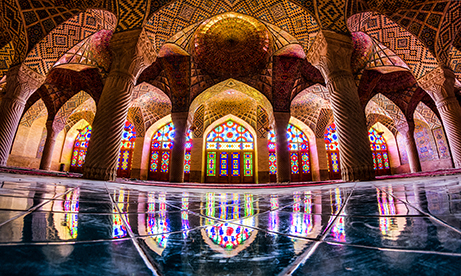
Nasir al-Mulk Mosque, Shiraz, Iran
The Qur’an and Nature
We shall show them Our signs upon the horizons and within themselves till it becomes clear to them that it is the truth. Does it not suffice that thy Lord is Witness over all things? (41:53)
Nature has a thematic presence in the Qur’an, so much so that, among the scriptures of the world’s religions, the Qur’an and the Tao Te Ching mention the natural world the most. In a deep sense the Islamic revelation is revealed not only to man but also to the cosmos. It is not only man to whom God has given existence and of whom God has required prayer; He has made prayer in the deepest sense a part of the very existence of His creatures, as described in various verses of the Qu’ran, such as “And there is no thing, save that it hymns His praise” (17:44). Traditional Islamic metaphysical and cosmological doctrines teach that all creatures follow their respective revelatory laws. This reality is implicit in the response of creation to the primordial call to all creatures contained in the cosmogonic statement “Be!” (kun).5
Many episodes in the life of the Prophet ﷺ demonstrate the devotion of creatures to God as well as to His Prophet ﷺ. Among the many examples, trees and pebbles bear witness to the veracity of the Prophet ﷺ, animals complain to the Prophet ﷺ of the misdeeds of human beings, and the moaning stump weeps out of nostalgia for the remembrance of God that took place by its side.
Many of the Qur’anic chapters themselves bear the names of creatures and natural phenomena, including “The Cow,” “The Ants,” “The Spider,” “The Sand Dunes,” “The Thunder,” and “The Constellations.” In the Qur’an God even takes as witness and swears by natural phenomena, both large and small—not only the Sun and the Moon but also the fig and the olive—proving that no part of nature is spiritually and religiously insignificant. God has “neglected nothing in the Book,” according to which “there is no creature that crawls upon the earth, nor bird that flies upon its wings, but that they are communities like yourselves,” who “shall be gathered unto their Lord in the end” (6:38). Not only do each of these creatures belong to a religious community (ummah), but “each indeed knows its prayer and its glorification” (24:41). Every creature within “the heavens and on the earth submits to Him” (3:83). Glorifying, prostrating, submitting willingly or unwillingly, obeying devoutly, praying and hymning His praise, the creatures of the cosmos constitute the congregation of innumerable worshippers, both human and nonhuman.6
In the Qur’an Muslims are often invited to contemplate the cosmos and God’s signs “upon the horizons.” Again and again, natural phenomena, such as the succession of night and day, rain, clouds, and the changing of seasons, are mentioned as signs from God for those who are religiously aware. Qur’anic miracles include not only Moses’s parting of the sea or Jesus’s blowing of life into clay by the leave of God, but also natural phenomena themselves, ranging from “the earth” that He has “laid down for creatures” to the coming forth of “pearls and coral stones” from the sea (55:10–22), all of which have been taken as proofs of God’s bountiful Reality. Qur’anically, it is as much a miracle that the Sun rises from the east every day as it would be if it were to one day rise from the west. Islamically, not only is the Qur’an a holy book of revelation among other scriptures revealed in sacred history, but so too is the cosmos a revelatory book. Just as Qur’anic verses themselves are called āyāt (signs), reference is made to natural phenomena in the Qur’an as āyāt. In parallel to the description of the Qur’an as al-kitāb al-masţūr (the lined book) and al-Qur’ān al-tadwīnī (the written Qur’an), the cosmos has been called al-kitāb al-manżūr (the observed book) and al-Qur’ān al-takwīnī (the cosmic Qur’an). Nature is itself scripture.
The Ĥadīth—that is, the canonical collection of the sayings of the Prophet of Islam ﷺ—includes reference to the earth as a masjid (mosque), pointing to its status as the primordial mosque of which humanly built mosques are an extension. All prophetic teachings, including this spiritual truth concerning the status of the earth as a mosque, are contained in the polyvalence of Qur’anic teachings, the Prophet’s character being the Qur’an manifest, and his wont to apply Qur’anic teachings in the world of action and behavior. It is important in this context to remember that the Qur’an begins every one of its chapters save one with the invocation of the Divine Names of Mercy and Compassion, and the Prophet’s attitude toward nature has been one of mercy and compassion. The Prophet ﷺ, for example, gives glad tidings of rewards for planting trees, to the extent that the planter would benefit soteriologically with each animal’s respective benefit from the tree. Islam is a religion of mercy and compassion to be lived according to the wont of the Prophet ﷺ, who is a mercy unto all beings. Such cardinal virtues govern the relationship between man and nature in all cases, including the treatment of domesticated animals, ethics concerning wild animals and their young, the use of water even when abundant, and even animal sacrifice, which should inflict no more than minimal pain upon the sacrificial animal. The examples of the Prophet’s care for animals and living beings in general are numerous.
Now, in an age in which the sky and the earth, firm mountains and expansive seas, have been polluted and compromised by humanity’s misdeeds, we need to apply the teachings of Islam to the human treatment not only of animals, trees, rivers, and other relatively vulnerable creatures but of the whole natural world. Tradition is not simply of historical interest; it is a living reality that responds to real problems, whether old or new, through recourse to timeless principles. Today, by virtue of our function of vicegerency and for the sake of life itself, we need to contemplate what living according to the wont of the Prophet ﷺ means when the sky and the earth are directly and negatively affected by the actions of man.
Any authentically Islamic environmental philosophy or program must take into consideration scriptural and traditional teachings concerning the environment. It is useless and inefficacious to have a so-called Islamic environmental program that is not based on this essential reality. If this reality is not taken into consideration, to call such a program Islamic is to use a name without content.
There is no creature that crawls upon the earth, nor bird that flies upon its wings, but that they are communities like yourselves—We have neglected nothing in the Book—and they shall be gathered unto their Lord in the end. (6:38)
Tradition
Every human thought, action, and deed issues forth from a center, whether it be the real center of one’s being or a center of the psyche mistaken for it. The Islamic world today needs to rediscover its authentic traditional center if it wishes to respond seriously and in an Islamic way to the problems of the modern world that Islam now faces, such as environmental degradation. Within religion it is tradition that connects the moment of the advent of revelation, the continuous application of revealed teachings, and the present moment. Tradition itself is a living reality in the ever-present moment, responding to contemporary issues through recourse to timeless principles revealed within a particular religious universe and passed down, realized, applied, and expounded through intergenerational transmission. For Muslims rooted in the Islamic revelation tradition provides and manifests the principles and teachings of revelation to create a civilization in which every aspect of life is centered on the sacred. The results of this process include the creation of traditional science, art, and architecture, as well as dress, language (especially poetry), manners, and much more, all of which extend the effusions of the sacred center of Islam into all facets of Muslims’ everyday life, art, and thought.
Underlying all of these aspects of tradition are Islamic metaphysics and gnosis, which expound traditional principles that concern God, man, and the cosmos. Muslims today need to rediscover metaphysics, its principles, and its applications should they wish to reestablish a harmonious relationship with the environment within an Islamic context. The environment in this analysis includes architecture, city planning, sciences, arts, and various technologies, all of which are rooted in traditional Islamic principles authentically, not simply by attaching the word Islamic to them. By carrying out such a task, Muslims today can respond authentically, from an Islamic center as opposed to a secular modernist center, notwithstanding the possibility of incorporating what is good in a non-Islamic framework into a traditional Islamic one. To deal seriously with the environment from the Islamic point of view, first of all, Muslims must rediscover the traditional Islamic understanding of the natural environment and its relation to God, to man, to his society, and to various parts of the natural order itself.
In addition to providing sacred knowledge of nature, the Islamic tradition accounts for the responsibility that man has toward creation. Although the Islamic world has inevitably seen transgressions against nature, which were also transgressions against Islamic Law, historically they were local exceptions rather than the norm. In Islamic traditional history the Sharī‘ah was the norm, and it provided a religious and legal framework that by and large ensured conformity to Divine Law, with profoundly positive consequences for the natural environment. Animals, rivers, and trees were protected so long as the Sharī‘ah was applied fully. While Muslims today know that God is al-Ĥaqq (the Real or the Truth), they often pay less attention to the traditional teaching that each creature by virtue of its very existence has ĥuqūq (rights), the word ĥuqūq itself being derived in Arabic from the word al-ĥaqq. Metaphysically, the truth or the reality that God bestows upon an entity determines not only our method of perceiving it—such as the nose for a flower’s perfume and eyes for its color—but also the respective form of adab (manners) for interacting with it, which demands of us certain responsibilities. Moreover, adab toward creation entails adab not only toward individual creatures but also toward their Creator. Ultimately, God’s vicegerent cannot act appropriately unless he is aware of the laws of God and the reality and rights He has bestowed on those creatures under the trust of man. To accept God as al-Ĥaqq requires that man recognize and respect the ĥuqūq of all His creation and be responsible to the extent that the ĥuqūq of creatures involve man and his responsibilities toward them, especially when he makes use of them for human purposes.
The traditional application of these teachings affected the study and application of cosmological sciences and profoundly shaped various institutions concerned with them. Traditional teachings on the sanctity of nature in the Islamic world, for example, led to the establishment centuries ago of institutions similar to present-day national parks in certain Islamic lands. As an extension of their Islamic metaphysical axioms, cosmological sciences sought to expound the unicity of the created order that reflects Divine Oneness (tawĥīd), and they recognized implicitly the Qur’anic statement that the cosmos was created in truth (bi’l-ĥaqq) and that each creature has its ĥuqūq. Not only metaphysics and cosmology but also the Sharī‘ah, when approached traditionally, have always encouraged human care for the natural environment. And so, we see in the example of traditional Islam a civilization whose philosophies, sciences, technologies, and crafts maintained a balance with nature that did not transgress or endanger the natural world’s integrity and resilience. Within a traditional Islamic framework, all human activity—from science itself to applications of its laws to technology and even quotidian acts such as food consumption—must conform to religious teachings, which then ensure paradigmatically a harmonious relationship with the natural world.
The Critical Study of Modernism
The pervasive presence of modernism today, even in much of the Islamic world, makes it impossible to formulate a genuinely Islamic view of nature without a deep critical study of the advance of modernism and its intrinsically secularist worldview.7 The secular denial, or at best ignorance, of the sacred is inherently incompatible with and even opposed to the Islamic view of reality, according to which the Divine Nature and Will are the sources of all things. Tawĥīd, or the realization of the oneness of God, not only means a doctrinal assertion that God is One, but also the realization that all is utterly dependent on the one God, so much so that to divorce the natural environment from the Divine is a theological sin and is incomprehensible and fallacious according to traditional Islamic criteria. If the purpose of human life is the remembrance of God, then the secularism of the modern world is utterly incompatible with Islamic teachings.
To ignore the secularist nature of modernism, moreover, is to misunderstand modernism, akin to ignoring and misunderstanding the sacred center from which emanates the sacred character of traditional Islamic art and architecture, sciences, philosophy, and civilization itself. It is the secularism of modernism that has desacralized the cosmos to such an extent as to regard it as a machine and nature as only a repository of resources, as modern technology and economics reveal so plainly. In modern society little attention is paid to the cosmos as a repository of the signs of God or as a congregation of worshippers, even in most science and philosophy classes in the Islamic world. Rather, in the more secularized part of Islamic society, nature has been taken implicitly as a secularized, and thus desanctified, material domain and studied in the same way that it is in the modern West in an effort to keep up with the so-called developed world. This implicit understanding of nature is pervasive today in the Islamic world, necessitating deep critical study of modernism and secularism everywhere in dār al-islām where modern science and technology as well as modern social and philosophical ideas are taught.
To criticize modernism theologically and ethically is important, but it is not sufficient. Any thoroughly successful Islamic environmental program today must also cultivate awareness of the pernicious, destructive, and even sacrilegious attitude of modernism toward the natural world. Even modernist philosophies that attempt to recognize the inherent integrity of nature and the need for biodiversity and clean air ultimately fall short of the Islamic standard of seeing the sacred not simply subjectively but also objectively in the natural world. It is not enough to see nature for its intrinsic worth according to humanly constructed philosophies. Rather, we need the vision of the source-light of the sacred that illumines not only the outer realities of things but also their inner realities, producing holistic philosophies and sciences of nature.
To this end modern science’s monopoly over the study of nature must be confronted and criticized to make space for traditional sciences of nature that are no less rigorous, as proven by the long and productive history of Islamic traditional sciences and technologies, which also maintained a harmony between man and nature. This task entails recourse to Islamic metaphysics, cosmology, philosophy, and sciences, as well as to Islamic applications of knowledge in fields as varied as agricultural technology and visual art. One cannot accept modern Western science blindly without destroying the wholeness and integrity of the Islamic worldview, which embraces not only theology and religious ethics but also the whole of the created order and our relation to it.
It is not accidental that reference in the Qur’an to God’s creatures occupies such a central role. We cannot simply pay attention to verses that concern human morality or theologically correct assertions concerning the nature of the oneness of God and overlook the status of God’s creation. Nature is not only a part of God’s plan for humanity and a backdrop to or resource for human life. Creatures have been given their intrinsic rights and integrity by God, are witnesses to the presence of His Wisdom and Will in the created order, and have been entrusted to His vicegerent, man. The witness of nature to the Divine Presence—as creatures worship God and hymn His praise—cannot be ignored by Muslims for the sake of conformity to the developments of a secular paradigm.
There is ultimately no way to rediscover the authentic Islamic relationship to the natural environment without first clearing the ground of prevalent errors through a deep critical study of the tenets of modernism and postmodernism. Efforts at reviving traditional Islamic views of nature in the modern world without awareness of the secularism of modernism are bound to fail. The ithbāt (affirmation) of Islamic views of nature in our time necessitates the inkār (negation) of the secularism of modernist philosophies, especially as they pertain to nature, but also to God and humanity. Through the traditional perspective, we can recognize creatures for their value not simply in the eyes of man but as created and sustained by God.
Literature
Every traditional civilization today needs didactic exposition of its traditional sacred views, both in themselves and in response to the topics and problems of the day. This is especially true of the Islamic world. The Qur’an teaches that it is a virtue to seek knowledge, including knowledge of the cosmos, which through Divine Wisdom is made available to those who seek and reflect. The Islamic world is home to long-standing traditions of expounding the issues—metaphysical, philosophical, theological, legal, and otherwise—of concern to each generation. These expositions revive the tradition continually, apply timeless principles to new circumstances, and draw from and build upon what has been inherited. Today, the environmental crisis calls for a fresh yet authentic formulation of traditional expositions of the Islamic view of the cosmos, its pertinence, and its application to contemporary Muslim life and thought.
Over the years, some literature has been developed concerning the Islamic view of the environment, but there is still much to be done in this field. Unlike the Christian tradition, which has said much less historically about nature but is much more prolific on this topic today than its Islamic counterpart, the Islamic tradition over centuries has provided much metaphysical and cosmological exposition of the sacred nature and profundity of the natural world, especially but not only in Sufism. The Islamic tradition was also the first to respond to the environmental crisis, but it soon fell behind due to, among other factors, the general apathy of present-day Islamic political authorities to the modern threat to the natural environment, the secularization of knowledge in the Islamic world, and the sense of inferiority so many Muslims feel vis-à-vis the West, which has led to the abandonment of traditional Islamic sciences of nature in favor of secular modern science.8
In order to produce contemporary literature on the environmental crisis Muslims should draw upon the great wealth of their Islamic inheritance, ranging from Persian Sufi poetry to treatments of the traditional sciences of nature in Arabic, Persian, and other languages of the Islamic world, and so much in between. The sources are countless. For example, the Sufi ‘Azīz al-Dīn al-Nasafī writes of the natural world as a cosmic revelation with its own chapters, verses, and diacritical marks, Jalāl al-Dīn Rūmī explains many Qur’anic teachings on the environment in metaphysical poetry, Muĥyī al-Dīn ibn ‘Arabī expounds the different levels of the created order prolifically, and the Ikhwān al-Śafā (Brethren of Purity) and al-‘Izz ibn ‘Abd al-Salām describe the rights of animals. Life is unsustainable in a world of amplified human power, practically insatiable human desires, and ignorance of the spiritual value of the natural world. In an age marked by a cataclysmic and life-threatening environmental crisis, the pertinence of sacred knowledge of the environment can hardly be overemphasized.
Muslims also need literature that brings greater awareness of the pressing issues of the modern environmental crisis, not only by repeating what has been said already, but by expanding and adapting it with the contemporary Islamic situation in mind, as well as by adding more of the inexhaustible spiritual teachings of Islam concerning the relation of God, man, and the cosmos. Such literature could also treat contemporary and even local issues, ranging from the pollution of rivers to the extinction of endemic species to the revival of local traditional technologies that facilitate a harmonious relationship between man and his natural environment. Thoroughly successful exposition of the Islamic view of nature today would not only draw from Islam’s own rich tradition, but would also bear in mind both modern-day issues and contemporarily traditional possibilities.
In order to apply the Islamic view of the cosmos to all realms of Muslim life that concern the environment, the Islamic world also needs to produce literature on the practical applications of Islamic teachings to the contemporary situation. This literature would have to treat both the public and private lives of Muslims, from means of production to those of consumption, from environmentally sustainable engineering, for which the traditional world offers so many examples, to adab toward animals and other creatures, from a war ethics that accounts for environmental well-being to methods of raising younger generations with a vision of the glory and beauty of God’s creation.
Aside from the immediately practical benefit of theoretical knowledge, traditional theoretical teachings have proven applicable and very practical, leading to the crystallization of cosmological teachings even in the structures of traditional architecture, in patterns on fabrics and carpets, and in the empty spaces and the geometric patterns of mosques. All of these realities help Muslims’ spirituality in various aspects of their lives, especially for worship and prayer. When applied concretely, Islamic metaphysical and cosmological teachings can produce an ambience that facilitates the remembrance of God and that also extends Islamic teachings on the environment into quotidian life.
To teach and apply Islamic environmental views effectively in the modern world, such literature would also have to critique what would be considered traditionally as unsound views and practices. Efforts to modernize Islamic teachings have paid little attention to Islamic orthodoxy in the universal sense, despite the emphasis given to it throughout Islamic tradition, even among opposing traditional views. As a result, they have practically equated the value of traditional Islamic teachings with secular modern ones, producing conclusions that are at once pseudoreligious and pseudoscientific. To preserve the integrity of the revival of Islamic teachings on the environment, their revivers and practitioners need to bear in mind the rigorous objectivity that every science and sound body of knowledge necessarily entails. This means that they also need to create literature on traditional Islamic views of nature that is not shy of critiquing what appears erroneous from the traditional Islamic perspective, while still allowing for a diversity of perspectives and openness to scholarly debate. Similarly, they must critique environmentally unsound practices carried out in both the public and the private spheres of Muslim life if there is to be any hope for success in implementing environmental programs in the Islamic world. Such literature needs to be founded upon revelation and sacred tradition, rigorously objective in the discourses it engages, contemporary in its language and concerns, and fully aware of existing conditions.

Dandelion seeds
Traditional Sciences and the Crafts
A thorough response to the environmental crisis would entail not only producing literature on the relevant sciences but also applying their teachings to the various sectors of human life. This task would necessitate the rediscovery of traditional crafts and sciences that have been created over the centuries throughout the Islamic world in conformity to Islamic principles as well as the traditional adaptation of these crafts and sciences to present contexts. The Islamic tradition does not limit the manifestations of the sacred to only one category of life; it extends the sacred beyond the private sphere of belief, morality, and prayer to encompass the whole of life. As a result of the all-encompassing message of Islamic revelation, the Islamic tradition applies revelatory principles to all facets of human life, from ethics to art to medicine and all in between.
Sciences and technologies developed in traditional Islamic civilization are based on the realization and preservation of the harmony that God created among man, nature, and His own Knowledge and Will. These sciences encompass not just al-‘ulūm al-naqliyyah (the transmitted sciences) but also al-‘ulūm al-‘aqliyyah (the intellectual sciences). Moreover, the intellect is central to all aspects of the Islamic civilization. Man needs to respond to his present circumstances; he therefore needs sciences that can operate both nimbly and with foundations grounded in a sacred center—such is the arboreal shape of tradition itself, grounded firmly in the rich soil of revelation and responding flexibly as it both grows into and shapes its particular environment. Such grounding would help to maintain the sacred harmony among God, man, and nature that is embedded within revelation and maintained through tradition, and such nimbleness would ensure that a living tradition responds to the diverse issues faced by each generation.
The Islamic traditional sciences are bodies of knowledge plunged in the awareness of the oneness of God and the interrelatedness of His creation, all of which contribute in one way or another to the supreme purpose of human life—that is, to the remembrance of God—while tending to different aspects of human life and the cosmos. By virtue of their rootedness in Islamic metaphysical expositions of reality and of their operation within the boundaries of an Islamic framework, traditional sciences maintain a sacred balance as they respond to the needs and wants of Islamic societies. Such a framework does not stifle possibilities, except for those that would transgress a heavenly balance and that would lead to unfavorable ends in the Afterlife (al-ākhirah) as well as in this lower world (al-dunyā). Sufficient proof of this truth can be seen in the fact that the traditional Islamic world produced so many sciences—mathematics, medicine, astronomy, and pharmacology, among many others—without causing an environmental crisis in any part of the vast Islamic world, even as these sciences spread widely.
The Islamic world is home both to vast bodies of knowledge of nature and to applications of this knowledge to human life. As with traditional sciences, traditional crafts and technologies operate within an Islamic framework that has been determined by both metaphysical and legal knowledge of the harmonious relationship among God, man, and nature. Traditional guilds and crafts, such as those dealing with wood and stone work, architecture, brass work, and textiles, channel heavenly grace into everyday life by virtue of their conformity to sacred principles. Such guilds and crafts have a sacred traditional origin and maintain both grace and harmony in a way that the machinery and methods of modern technology and crafts cannot. A carriage moving on a path through a forest cannot compare in its environmental impact to even an electrically powered car on a highway. There are certainly compromises in that traditional technologies clearly limit human power, while modern technology—putting aside its enslaving nature—amplifies it, but this intensification of human capability comes ultimately at the cost of great harm to both nature and humanity. While the traditional Islamic world did build certain types of factories, as well as cultivated forestry and other disciplines that affected nature, the proportions set a priori by the Islamic framework limited systematically the negative effects of such factories and disciplines. It took the substitution of traditional crafts with modern technologies to place the Islamic world among the leading polluters of nature today.
Fortunately, a few steps have been taken in the last few decades to reverse this direction, including the revival here and there of Islamic architecture and many of the crafts, as well as Islamic medicine and psychology, but much still needs to be done. As the environmental crisis shows all too clearly, how we learn, build, make, and operate as a human collectivity bears profound consequences for the natural world. A comprehensive Islamic environmental framework needs methods of architecture, scientific study, engineering, art, and craftsmanship that respect what it truly means to be human—a creature that echoes eternity in the temporal order and not a creature who curtails the blessings of tomorrow for the sake of his unbridled desires today. We need to revive ways of living and being that work in extension and not in spite of the human function as the vicegerent of God on earth.
What Is Required
All the points mentioned above require that we remove the inferiority complex that is so prevalent in many Islamic circles today. They require trust and pride in the positive sense in 1,400 years of the Islamic intellectual tradition, which encompasses a rich treasury of thought accompanied by manifold applications in the form of sciences, crafts, and technologies developed in conformity with the sacred principles of the Islamic religion. They necessitate that we see the Islamic tradition as a living reality whose tenets can be applied to any new circumstances, including the ones in which we live today.
Further Reading
Osman Bakar, Qur’anic Pictures of the Universe: The Scriptural Foundations of Islamic Cosmology (Selangor, Malaysia: Islamic Book Trust, 2018) • Waleed El-Ansary, “Can Our Science and Economics Honor Nature?,” Renovatio 1, no. 1 (Spring 2017): 5–18 • Muhammad U. Faruque, The Interconnected Universe: Sufism, Climate Change, and Ecological Living (unpublished manuscript) • Richard C. Foltz, Frederick M. Denny, and Azizan Baharuddin, eds., Islam and Ecology: A Bestowed Trust (Cambridge, MA: Harvard University Press, 2003) • Fazlun M. Khalid, Signs on the Earth: Islam, Modernity and the Climate Crisis (Leicestershire, UK: Kube Publishing, 2019) • Charles Le Gai Eaton, “The Earth’s Complaint,” Sophia 3, no. 1 (Summer 1997): 39–55 • Munjed M. Murad, “Sufi Views of Nature,” in Handbook of Sufi Studies, vol. 2, Sufi Cosmology, ed. Christian Lange and Alexander Knysh (Leiden: Brill, 2022), 189–204 • Murad, “Vicegerency and Nature: Ibn ‘Arabī on Humanity’s Existential Protection of the World,” in Voices of Three Generations: Essays in Honor of Seyyed Hossein Nasr, ed. Mohammad H. Faghfoory and Katherine O’Brien (Chicago: Kazi Publications, 2019), 299–314 • Tarik M. Quadir, Traditional Islamic Environmentalism: The Vision of Seyyed Hossein Nasr (Lanham, MD: University Press of America, 2013) • Mohammed Rustom, “Islam and the Density of Man,” Sacred Web 46 (Winter 2020): 56–76 • Rustom, “The Great Chain of Consciousness: Do All Things Possess Awareness?,” Renovatio 1, no. 1 (Spring 2017): 49–60. See also, by Seyyed Hossein Nasr: “The Ecological Problem in the Light of Sufism: The Conquest of Nature and the Teachings of Eastern Science,” in Sufi Essays, 3rd ed. (Chicago: Kazi Publications, 1999), 152–63 • “Ecology,” in A Companion to Muslim Ethics, ed. Amyn B. Sajoo (London: I.B. Tauris, 2010), 79–90 • An Introduction to Islamic Cosmological Doctrines, rev. ed. (Albany: State University of New York Press, 1993) • Knowledge and the Sacred (Albany: State University of New York Press, 1989) • The Need for a Sacred Science (Albany: State University of New York Press, 1993) • The Other View of the Universe: Essays in Islamic Cosmology and Science (Albany: State University of New York Press, forthcoming) • What Is Metaphysics? Ruminations on Principial Knowledge and Some of Its Applications (Sheffield, UK: Equinox Publishing, 2025). See as well the works by Murad and Nasr cited in the Notes to this essay.