
Stephen A. Gregg
Stephen A. Gregg is a monk of the Cistercian Abbey of Our Lady of Dallas, in Texas.
More About this Author
Stephen A. Gregg is a monk of the Cistercian Abbey of Our Lady of Dallas, in Texas.
More About this Author
Stephen A. Gregg is a monk of the Cistercian Abbey of Our Lady of Dallas, in Texas.
More About this Author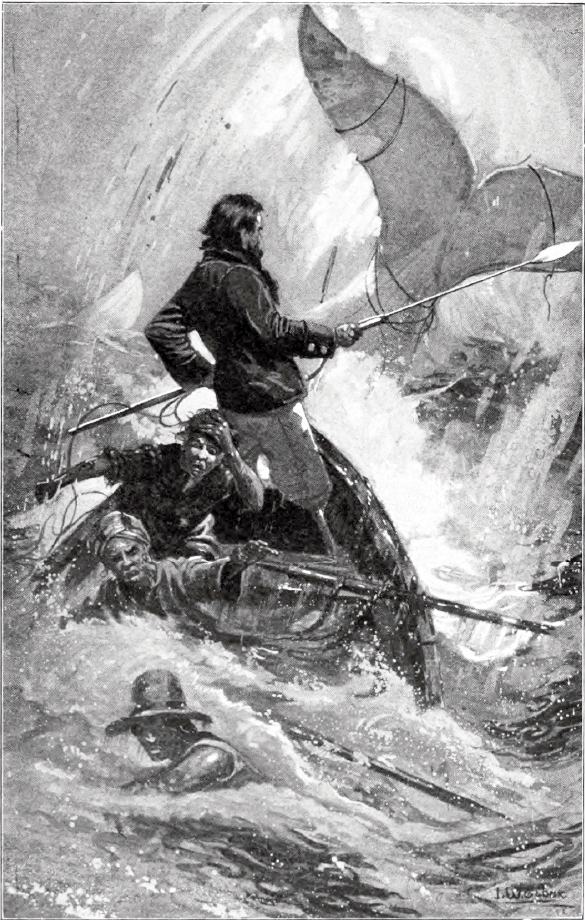
The final chase of Moby-Dick, showing Ahab harpooning the white whale
No one who considers the study of literature important for life can long avoid Moby-Dick; or, The Whale. Yet its author said of it, “I have written a wicked book, and feel spotless as the lamb.”1 Can we become spotless lambs reading this wicked book? What authority can we grant to imaginative fiction in our real lives?
This is a question to be asked of all “profane” literature by those whose lives are informed by sacred texts and religious practice. So, to better understand the place of fiction in our religious quest, we need to return to the heart. We can be awoken to fascination with reality and a sense of responsibility by the impulses of bodily action and by intellectual formation, but we must always also attend to the tangle the heart is in, its interplay of hope, desire, anger, and fear. It will often be the enchantment of stories that brings urgent questions to life in us, that reveals us to ourselves.2 Sacred texts have their literary forms and their literary enchantments (to say the least); intellectual puzzles have their magic; engaged life drives us directly into human fascination and responsibility. Nonetheless, the heart achieves the clarity it needs by encountering another human heart in the structured link of reader and author, by the formulated and free heart-to-heart encounter that faces us in a great book, even a “wicked” one. We must look in charity for the spotless heart that seeks to speak us some good, even in such a wild novel as Moby-Dick. For, by exposing us to the urges of Ishmael and the fire that drives Ahab, the novel directs us to the basic conditions of religion, from the roots of unease toward the possibilities of diabolic resistance or ecstatic wonder. It promises no easy order, but a fiery hunt that begins with a personal request.
“Call me Ishmael.”
When we hear that opening, we identify in some way with the figure who speaks to us, who tells us to call him Ishmael, or to rename our “me” Ishmael, which for the Christian reader resounds like this: Ishmael, not Isaac; the son of Hagar, not the son of Sarah; “the son of the slave” who was “born according to the flesh,” not the “son of the free woman” who was “born through the promise” (see Paul in Galatians 4:21–31).3 The narrator steps back from “the promise” and says, “Call me the other guy,” as many of us who are religious might have stepped back within our souls from that original American rhetoric of Pilgrim Fathers, a new promised land, a “city on a hill,” and begun rather with an admission, not of sin or such, but simply of not yet belonging, of being for now disconnected from the promised inheritance, with an admission that the community, the church, the covenant, whatever it will be, is something we are moving toward, not starting from or finding happily provided. The hierarchy of the world seems unclear or unjust; we feel broken off in a compartmentalized reality, with the spiritual concerns in a space we can’t access and the worldly concerns exhausting and unsatisfying, and thus we are tempted to mistake prosperous moments for providence and purpose. That divided experience is the “damp, drizzly November” of the soul that Ishmael says he feels on the first page of the story. But like Ishmael, we have, and sense among ourselves, the capacity for work, for joy, for love, for hope. We often feel grim and out of place, but ours is a youthful, energetic state at heart: “Why is almost every robust healthy boy with a robust healthy soul in him, at some time or other crazy to go to sea? Why upon your first voyage as a passenger, did you yourself feel such a mystical vibration, when first told that you and your ship were now out of sight of land?… It is the image of the ungraspable phantom of life; and this is the key to it all.”4 To feel we have left all life behind or to be on the verge of grasping life’s ungraspable phantom, for us in these highly charged days, the feeling may be almost one and the same. The stakes of our ventures seem very high, that we might lose all or gain all, and we become “crazy to go to sea.”
Ishmael is sensitive to these “mystical vibrations” that mean the ungraspable is coming within reach, so he takes up with a doomed ship, the Pequod. He is so open with his trials and hopes that we feel invited to come along, though the danger is palpable: What order will he find in the chaos of the sea, in that jolly, composite ship lorded over by its strange captain? To return with understanding to what our friend Ishmael has to offer us in his account, we must first consider that dark figure of Ahab, who looms over the journey’s horizons.
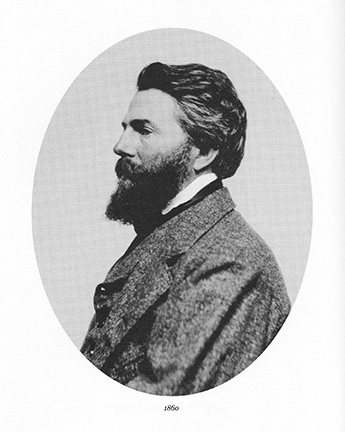
Herman Melville
The novel’s fire sparks from the Pequod’s monomaniacal captain, Ahab, and we must face him to understand that “wicked” energy within us that works against the divine, against our hope to respond well to what good authority or order we find.
Ahab disturbs us with his maniacal fervor to commandeer the journey for his personal revenge, with his demagogic effectiveness in converting the whole crew over to his madness (overwhelming, in a sense, even the resiliently reasonable Starbuck), with his openly diabolical character, as, for example, when he consecrates his harpoon in pagan blood in a blasphemous baptism. When he finally appears after much premonition and prophecy, in chapter 28, he is called in fear and awe “supreme lord and dictator.”5 Ahab, however, is also oddly appealing, sad and human. The shipowner, Captain Peleg, says of him to Ishmael at the end of chapter 16, “Wrong not Captain Ahab, because he happens to have a wicked name. Besides, my boy, he has a wife—not three voyages wedded—a sweet, resigned girl. Think of that; by that sweet girl that old man has a child: hold ye then there can be any utter, hopeless harm in Ahab? No, no, my lad; stricken, blasted, if he be, Ahab has his humanities!”6 Ahab’s grief and power are frightening, but also familiar and convincing to others—his “harm” is not “utter, hopeless.”
For example, as the voyage reaches its fated conclusion, Ahab seems to adopt the young Black boy Pip, who has escaped from Alabama. Pip has more or less lost his mind after a period of abandonment at sea and is a liability on the ship, so Ahab confines him to the captain’s cabin. Perhaps a core desire for that child back home is still alive in Ahab, or perhaps it is a re-enslaving instinct and an instinct for tyranny, or perhaps the madman feels a kinship with the lunatic, and it’s something pathetic we see here. In chapter 129, Ahab sends Pip away, speaking of himself in reflective terms: “The hour is coming when Ahab would not scare thee from him, yet would not have thee by him. There is that in thee, poor lad, which I feel too curing to my malady. Like cures like; and for this hunt, my malady becomes my most desired health.”7 When the captain takes the boy’s hand before walking off, our frightful blasphemer blesses him, “True art thou, lad, as the circumference to its centre. So: God for ever bless thee; and if it come to that,—God for ever save thee, let what will befall.”8 Ahab consciously rejects the boy’s healing influence, but rather than merely closing himself off, he gives the boy his place, tells him to listen for his steps on the boards above, prays for his preservation, recognizes the link of center to circumference—though in that, Ahab still seems to make himself the center, an authority to himself in all.
So Ahab captivates. But when, in chapter 36, he hammers a gold coin to the mainmast as a prize for the first to “raise” the white whale and announces that his goal is not commercial whaling but to avenge himself on the specific whale that bit off his leg, he proclaims something more deeply frightening about his focus. For Ahab is not simply an atheist but a kind of devil, one who does not simply deny but actively pursues and attacks the transcendent as closely as he can. What this wicked portrait offers us is a chance to recognize a similar energy of blasphemy at work within ourselves, a chosen darkness and resistance that to some degree we all share and must continue to face down. Ahab clearly defines his programmatic assault when the first mate, Starbuck, challenges the newly announced quest to hunt the white whale, asking how it is reasonable rather than blasphemous to seek revenge against a brute animal that was acting in self-defense. The first mate’s rational challenge to the forceful hierarchy is answered and quelled by Ahab’s lightning and thunder:
All visible objects, man, are but as pasteboard masks. But in each event—in the living act, the undoubted deed—there, some unknown but still reasoning thing puts forth the mouldings of its features from behind the unreasoning mask. If man will strike, strike through the mask! How can the prisoner reach outside except by thrusting through the wall? To me, the white whale is that wall, shoved near to me. Sometimes I think there’s naught beyond. But ’tis enough. He tasks me; he heaps me; I see in him outrageous strength, with an inscrutable malice sinewing it. That inscrutable thing is chiefly what I hate; and be the white whale agent, or be the white whale principal, I will wreak that hate upon him. Talk not to me of blasphemy, man; I’d strike the sun if it insulted me. For could the sun do that, then could I do the other; since there is ever a sort of fair play herein, jealousy presiding over all creations. But not my master, man, is even that fair play. Who’s over me? Truth hath no confines.9
For the crew and for the reader, Ahab redefines reality as a hierarchy (principal/agent) inimical to truth: this visible world is only a mask without real reason, behind which an “unknown but still reasoning thing” hides, which Ahab’s experience of having his leg chomped off has shown to be malicious. Ahab’s goal, his picture of the way to live, is to strike back—not at the mask but through the mask to this inscrutable other. He aims to avenge not merely the physical damage done to his body but a metaphysical imprisoning effected by this inscrutable other, effected even if, as Ahab sometimes suspects, there is “naught beyond”: even that nothing, if hidden there, would be “enough” to call for attack. Ahab’s concern is not some issue about faith and credibility and reason and history, nor is it one of resistance to moral instruction or to the call of a divine being. The pattern of transcendent meaning itself, the fact that the mask covers over a metaphysical space from which inscrutable agency pours forth, that pattern to him implies malice, even if founded on nothing; it forms a prison around Ahab, closes him in unjustly, and must be punched through. No such confinement of self can be allowed, for “truth hath no confines.” The inscrutable is inherently malicious, and hence there can be no obedience, or hierarchy, but only “fair play”—and even that rule is not allowed as a master.
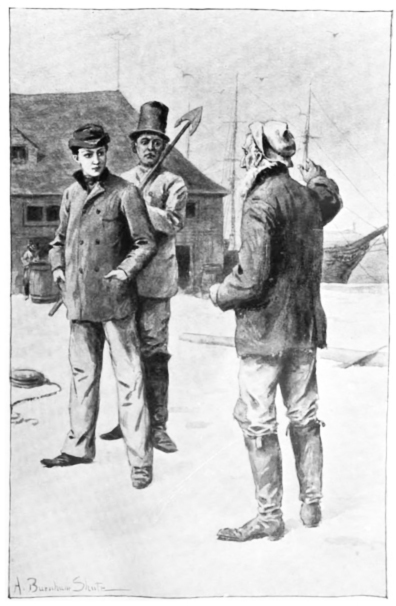
Ishmael and Queequeg are directed to the Pequod
Here we find the heart of what is “wicked” in this book, and Melville gives no easy escape from it: Starbuck’s reasonable, principled effort to rise against this tyranny, to bring Ahab back to simple duty and action responsible to the commercial mission of the ship, cannot possibly find room in such a mind.10 Some greater gift than Starbuck’s will be needed, for this attitude of Ahab’s, though dark, has its magnetic pull on our hearts. There is a drive for authenticity here, and a keen sensitivity, far from neutral, to the presence of the inscrutable reasoner behind the visible world. Say what we will about Ahab and his blasphemy, but this majestic statement does liberate in some simple, worldly sense: as Nicholas Boyle reads it, we break out of the destructive commercial framework “through [Ahab’s] imposition on [the voyage] of the purpose of profitless killing,” which transforms the voyage “into a quest for what lies beyond having and risking, what lies beyond the existence that has wounded him.” The “venture-capitalist existence of having and risking in order to have more” is set aside by Ahab, and the crew (except Starbuck) gleefully follow along.11 A “quest for what lies beyond having and risking” is blasphemous in the sense of Ahab’s wanting to strike at this object, but it is liberating in another sense: the attack on the inscrutable mind is much more powerfully human to us than what Ahab calls, in the same passage, the “little lower layer” of getting our business contracts fulfilled. Ahab hunts for metaphysical profit, not just for spermaceti to sell—and we all want to escape commercial hierarchy and join such a real adventure too.
A critique of whaling as a capitalist venture might seem trivial compared with Ahab’s mad quest, but we should remember that Ishmael felt grim on the first page precisely in the commercial world: “Your insular city of the Manhattoes, belted round by wharves as Indian isles by coral reefs—commerce surrounds it with her surf.”12 Ahab’s blasphemous anti-religious quest, his desire to strike as closely at the inscrutable as possible, and Ishmael’s quest to abandon the land and go whaling have less to do with whales and vengeance and more to do with escaping the gravity of that little lower layer, that calculating, unimaginative submission to the commercial world.
I don’t think we should theorize too generally about this, as if every religious quest necessitates a moment or more of seemingly insane self-assertion, as if we all start not just as an Ishmael but also as an Ahab. But something of this bursting free, of striking through the mask, a kind of iconoclasm and rebellion, is certainly present in many religious people’s experience. This turn is more than frustrated young lovers fleeing into the woods of Athens or Huck Finn ducking away to avoid getting “sivilized” by Aunt Sally. When Clare of Assisi’s family came to drag her back home after she ran away to Francis and his companions, she stunned them by unveiling her head to show that she had already sheared off her hair; her fierce dedication disarmed them by manifesting some vast other power at play, something Clare had grabbed hold of and would not release. On the other hand, before taking up religion, Dorothy Day was already a rather skilled and dedicated rebel; then she was urged toward faith by pregnancy and the birth of her daughter—not self-assertion but receiving that gift of another life gave rise to the real revolution in her. These were people not in flight but on the hunt; they may not be Ahab stabbing with his harpoon “from hell’s heart,” but they certainly rejected the little lower layer. Ahab’s version of the hunt, because of its radical self-exaltation, is doomed to destruction and leads others to destruction; one hardly says it is to be admired. But one does feel the pull, and we must recognize that alongside our need for transformation and renewal is the danger of incipient fanaticism of one kind or another within ourselves. We are not reasonable Starbucks needing to be guided to profit, but stricken, blasted Ahabs needing to be returned to our humanities.
In his fascination with and fear of Ahab, Ishmael draws us to consider the fire that drives him as one reaction to the ungraspable mystery, represented by the whale. At the end of chapter 42, he reflects on the whiteness of Ahab’s foe and how it impels him to the hunt:
Is it that by its indefiniteness it shadows forth the heartless voids and immensities of the universe, and thus stabs us from behind with the thought of annihilation, when beholding the white depths of the milky way? Or is it, that as in essence whiteness is not so much a color as the visible absence of color, and at the same time the concrete of all colors; is it for these reasons that there is such a dumb blankness, full of meaning, in a wide landscape of snows—a colorless, all-color of atheism from which we shrink? And when we consider that other theory of the natural philosophers, that all other earthly hues—every stately or lovely emblazoning—the sweet tinges of sunset skies and woods; yea, and the gilded velvets of butterflies, and the butterfly cheeks of young girls; all these are but subtile deceits, not actually inherent in substances, but only laid on from without; so that all deified Nature absolutely paints like the harlot, whose allurements cover nothing but the charnel-house within; and when we proceed further, and consider that the mystical cosmetic which produces every one of her hues, the great principle of light, for ever remains white or colorless in itself, and if operating without medium upon matter, would touch all objects, even tulips and roses, with its own blank tinge—pondering all this, the palsied universe lies before us a leper; and like wilful travellers in Lapland, who refuse to wear colored and coloring glasses upon their eyes, so the wretched infidel gazes himself blind at the monumental white shroud that wraps all the prospect around him. And of all these things the Albino whale was the symbol. Wonder ye then at the fiery hunt?13
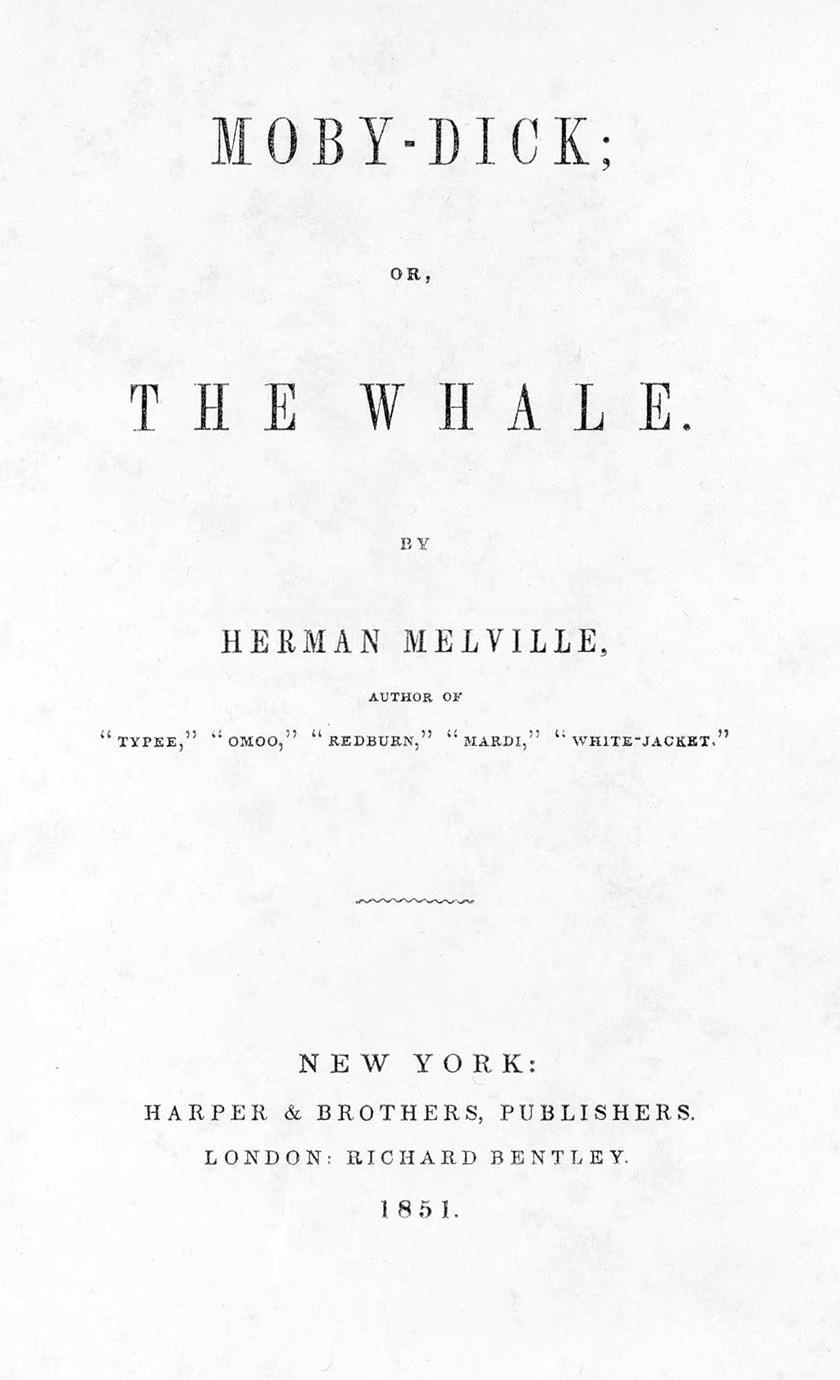
Title page of the first edition of Moby-Dick, 1851
Although Ishmael finds himself participating in Ahab’s fiery hunt and trapped in what it stands for, his journey out returns him to humanity and toward a loving relationship with the transcendent—the two somehow not separable, in spite of the best efforts of stricken, blasted Ahab. Rather than grasping the ungraspable phantom in attack, Ishmael unites with it by becoming more slippery himself.
The first move for Ishmael is to depart from a world in which he does not fit. But this angry, frustrated attitude dissolves before he even gets aboard the Pequod because by no plan of his own, he finds himself intimately teamed up with the “pagan” harpooner Queequeg. Queequeg’s openness to share his bed, his pipe, his god, his fate with Ishmael cures Ishmael of his grimness: “No more my splintered heart and maddened hand were turned against the wolfish world. This soothing savage had redeemed it.… I’ll try a pagan friend, thought I, since Christian kindness has proved but hollow courtesy.”14 In an idolatrous act, Presbyterian Ishmael even burns wood chips to Queequeg’s little statue; but this idolatry, he reasons, is doing the will of God, since it follows the golden rule—unlike, we might add, the blasphemous baptism by Ahab that uses Queequeg’s blood to temper the harpoon.15
Melville creates a character who leaves not only the land but also the Christian culture of America, a man of surprising open-mindedness, surprising to himself and to us.16 We, with Ishmael, should admire the faith of Queequeg, who “cherished Yojo [his idol] with considerable esteem, as a rather good sort of god, who perhaps meant well enough upon the whole, but in all cases did not succeed in his benevolent designs.”17 This position of Ishmael’s, however, is not a settled and steady position, a carefree agnosticism. Consider how Ishmael concludes a meditation on the whale’s spouting:
And how nobly it raises our conceit of the mighty, misty monster, to behold him solemnly sailing through a calm tropical sea; his vast, mild head overhung by a canopy of vapor, engendered by his incommunicable contemplations, and that vapor—as you will sometimes see it—glorified by a rainbow, as if Heaven itself had put its seal upon his thoughts. For, d’ye see, rainbows do not visit the clear air; they only irradiate vapor. And so, through all the thick mists of the dim doubts in my mind, divine intuitions now and then shoot, enkindling my fog with a heavenly ray. And for this I thank God; for all have doubts; many deny; but doubts or denials, few along with them, have intuitions. Doubts of all things earthly, and intuitions of some things heavenly; this combination makes neither believer nor infidel, but makes a man who regards them both with equal eye.18
This equal-eyed position is that divine intuitions do arrive, but often like the rainbow, within the foggy mist of the mind. The doubt Ishmael kindles is doubt of all things earthly; he proposes, for the few, moments of divine intuition, and he thanks God for his being one of those few. He is not a dogmatic believer—for whom he thinks divine intuitions appear in the clear of day, perhaps?—nor an infidel whose mind is closed to faith’s light. But this attitude is not a stoic agnosticism; it is brightly colored and full of a mystical energy, the energy of dynamic “intuitions” rather than static dogma, leaning more toward the light of the clear sky than the darkness where no rainbows appear. In fact, this inscrutability unites man and the divine for Ishmael. In chapter 79, when he considers pseudoscientific ways of “reading” the whale, he concludes with hieroglyphics:
Champollion deciphered the wrinkled granite hieroglyphics. But there is no Champollion to decipher the Egypt of every man’s and every being’s face. Physiognomy, like every other human science, is but a passing fable. If then, Sir William Jones, who read in thirty languages, could not read the simplest peasant’s face in its profounder and more subtle meanings, how may unlettered Ishmael hope to read the awful Chaldee of the Sperm Whale’s brow? I but put that brow before you. Read it if you can.19
The whale’s face is inscrutable, but so is the simplest peasant’s. The conclusion from this challenge is not resignation but energy: “I try all things; I achieve what I can,” he begins the chapter20—and he ends, “Read it if you can.”
Ishmael’s generosity is founded not on an agnostic position, exactly, but on human solidarity of a very radical kind and an intuition about divine solidarity that transcends the religious boundaries he is aware of. Ishmael has several experiences of blending with others, particularly with Queequeg,21 but the most radical comes in chapter 94, when the crew is tasked with squeezing globules of coagulated spermaceti back into liquid before heating them pure. Ishmael finds himself with the others around a huge tub of the stuff, and he offers this reflection:
Squeeze! squeeze! squeeze! all the morning long; I squeezed that sperm till I myself almost melted into it; I squeezed that sperm till a strange sort of insanity came over me; and I found myself unwittingly squeezing my co-laborers’ hands in it, mistaking their hands for the gentle globules. Such an abounding, affectionate, friendly, loving feeling did this avocation beget; that at last I was continually squeezing their hands, and looking up into their eyes sentimentally; as much as to say,—Oh! my dear fellow beings, why should we longer cherish any social acerbities, or know the slightest ill-humor or envy! Come; let us squeeze hands all round; nay, let us all squeeze ourselves into each other; let us squeeze ourselves universally into the very milk and sperm of kindness.
Would that I could keep squeezing that sperm for ever! For now, since by many prolonged, repeated experiences, I have perceived that in all cases man must eventually lower, or at least shift, his conceit of attainable felicity; not placing it anywhere in the intellect or the fancy; but in the wife, the heart, the bed, the table, the saddle, the fire-side, the country; now that I have perceived all this, I am ready to squeeze case eternally. In thoughts of the visions of the night, I saw long rows of angels in paradise, each with his hands in a jar of spermaceti.22
This vision of human solidarity, or better, liquidity, of an interpenetrability of persons by which the physical and social and personal and spiritual fuse, this experience with his fellow men that in Ishmael converts over to a vision of angels in paradise, is not a staid, respectable democracy but a kind of erotic exclamation, a “strange sort of insanity” that hints at a lasting harmony of all. The survivor who narrates this moment is not an Ahab who finds any pattern of transcendence threatening, not one who demands “fair play”: rather, it is one who is eager to lose himself in others. But he is also now a man of “many prolonged, repeated experiences” that teach him “that in all cases man must eventually lower, or at least shift, his conceit of attainable felicity.” On the one hand, that perception shows that he knows such experiences are not the basic pattern of life but high moments from which we sink back down, but on the other hand, what must eventually happen “in all cases” makes him ready to “squeeze case eternally”—that is, the “cases” of life’s incidents become the sperm whale’s “case” of spermaceti that blends us into each other for eternity. The perception that unites these two sides of life is that we do not have to “lower” our “conceit of attainable felicity” but can “shift” it, “not placing it anywhere in the intellect or the fancy; but in the wife, the heart, the bed, the table, the saddle, the fire-side, the country.” This shift is not a sad, resigned reduction. Rather, the concept (“conceit”) of attainable happiness must be grounded in order to become the eternal squeeze of the hand, grounded not in mere thought or imagination but in something real, imaged here as matters of life on the land, from wife to country.
For Ishmael, what hides behind the “pasteboard mask” is not a malicious face to be struck at but a mysterious, inscrutable beauty that we are called to melt into with each other. It is not that Ishmael is simply skeptical about the transcendent and therefore generous to those who are “other”; he is passionately drawn by the transcendent to become truly one beyond any otherness, as a matter not of thinking or wishing but of living and experiencing. The object of his desire—is it crazier than Ahab’s?—is not unreachable but mysterious, hidden, in a way that troubles, excites, yet is not malicious. But Ishmael, like Job with whom he identifies, suffers and rejoices in this palpable mystery and rushes back from disaster to tell us.23 His epilogue is marked by the refrain from the first chapter of Job: “And I only am escaped alone to tell thee.”24 He has touched the mystery, escaped the whirlpool, and, having survived, rushes to connect with us.
Ishmael escapes alone, and the reader in this blustery world can escape with this novel too—escape not in idle cetological amusement but by considering the “wicked” approach to reality and finding the way to a “spotless” grasping at the mystery. There are limits, of course, to the “wickedness” to which we would expose ourselves, as also to the innocence we can expect to attain in reading secular writings. Yet as I hope this reading of Moby-Dick has shown, great secular works serve an important role in our human situation. In his book Sacred and Secular Scriptures, Nicholas Boyle writes of Moby-Dick as one of those books whose “horizon is provided by the name of the Unnameable God” but which “mark themselves off as secular by incorporating, in different ways, an acknowledgment that they cannot speak with the authority of the Law.”25 Such books are not sacred—they do not reveal to us the divine command and gift lodged within and leading beyond the world and our life—but their authors know these limit conditions, and they thus help us delineate the sacred and understand our position with regard to it. Boyle’s distinctly Catholic approach will be helpful for others too:
We can therefore incorporate secular literature into our lives as commentary on the sacred Scriptures that give us the Law, for such secular scriptures show us the world to which those sacred Scriptures apply, show it as under the Law, as fallen and forgiven. Secular literature therefore articulates the world for us, puts it into words, as the material of our prayer—as the place in need of redemption, as the place that has received redemption, and as the place that our own lives are called to cooperate in redeeming.26
Books like Moby-Dick show us not the law of God itself but the world that is allowed, for all its faults and flaws, to continue living under that law. This valuable contribution to our self-understanding is not merely negative, an indication of where not to look for God. Rather, the world that the author lovingly and laboriously “articulates” for us is the “material” of our prayer and our work. Such an approach to secular literature
will therefore be alert not only to a written work’s attempt to reach the boundary beyond which lies the unutterable “Thou shalt,” the original divine command; nor will it only be alert to the extent to which the work embodies the reconciling and forgiving belief that what it represents is worth representing. A Catholic approach to a literary work will also involve asking: How far and how well does this work represent worthwhileness as shared, as a feature of many faces gathered by the Spirit into social institutions, specifically, into the church?27
Without claiming false authority and dictating an order to our lives and our world, the great work of art nonetheless summons us to seek the worthwhile life and frees us to reorient ourselves and one another toward it. The great author—like Melville, who feels “spotless as the lamb” with his “wicked book” in his hands—not only demarcates the boundary between finite world and infinite command to be and do, not only encourages by his strenuous attention our awareness of how worthy the world is of representation in its dynamic relationship to the transcendent, but, best of all, guides our experience of that “worthwhileness” toward something communal.28
Renovatio is free to read online, but you can support our work by buying the print edition or making a donation.
Browse and Buy