Print Edition

Q&As

|

Nov 26, 2025

The Purpose of Pain—and Pleasure

Read Time
|

Nasrin Rouzati

Nasrin Rouzati

Nasrin Rouzati is associate professor of religious studies at Manhattan College, New York.

More About this Author
HamzaYusuf

Hamza Yusuf

Zaytuna College

Hamza Yusuf is a leading proponent of classical learning in Islam and president of Zaytuna College, a Muslim liberal arts college in Berkeley, California.

More About this Author

The Purpose of Pain—and Pleasure

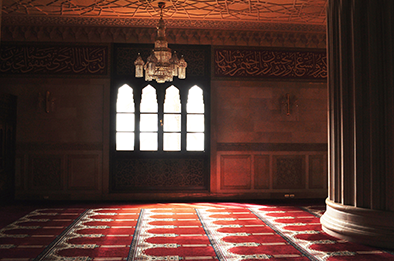
Shy Rouzati Photo 2 06 22 25

A Sanctuary, Lebanon, Askia Bilal

Nasrin Rouzati’s book, titled Trial and Tribulation in the Qur’an: A Mystical Theodicy, examines Qur’anic teachings on the providential purpose of suffering in our lives on earth, something the prophets experienced more than most. This conversation with the author, recorded during Ramadan 2024 as part of the First Command Book Club series, was hosted by Hamza Yusuf and included Zaytuna College vice president Aisha Subhani. It has been edited for length and clarity.

Hamza Yusuf: Our scholars give seven reasons for writing a book, and one of them is that it hasn’t been written. This book, as far as I can tell, wasn’t written before you wrote it. It’s a profound reflection on something central to the Qur’anic narrative, and surprisingly, many people seem to completely miss it. I want to begin by asking you, What compelled you to write this book?

Nasrin Rouzati: The driving force behind my research and writing was this existential question that I always had. As human beings, we all go through different experiences. Some experiences bring us delight and happiness, even though they may be short- lived, and other experiences bring us sadness, despair, suffering, and anxiety. When everything is nice in our lives, we take everything for granted and think that is how it’s supposed to be. Then, when we are afflicted with, say, a disease, a loved one going through a hard time, the loss of a loved one, or the sight of calamities engulfing our communities, we try to eliminate the situation as quickly as possible. “How do I solve this issue? How do I get rid of the problem?” We get lost in this process, and we don’t understand the why behind it.

Most of us experience hardship without benefiting from the spiritual lesson embedded in that experience. I have had my share of suffering, various hardships and afflictions here and there, some harder than others. I always wondered whether the answer could be found in the Qur’an, which has always been my comfort zone. Then I was in Mecca, in front of the Kaaba and just pondering life, and I decided to investigate the Qur’an to find the answer.

I don’t claim that we can always have the answer, because we are limited, and we have to accept with epistemic humility that we do not understand everything around us. As students of the Qur’an, the more we are in dialogue with the Qur’an, the better understanding we have of various conditions of life. Doing the research and writing about this topic gave me the answers I had been searching for.

HY: One remarkable aspect of your book is its unveiling of the cohesion of the Qur’anic narrative on this subject. Many Westerners are accustomed to linear narratives—the Bible is a linear revelation that begins with Genesis, goes through the history of a tribe, and for Christians, leads to a culmination. The Gospels are linear. Whereas when you come to the Qur’an, the initial experience is very dizzying: there’s a vertiginous experience that the Qur’an evokes in a person.

The Qur’an might have first-person, second-person, and third-person subjects all within a few lines. You use deconstruction a little bit at the end of your book—I’m not a big fan of that methodology, but it often uncovers the deep contradictions within a text that outwardly appears very coherent. I think the exact opposite happens with the Qur’an. It has an outward incoherence in the initial experience of it, and one doesn’t see the cohesion, but the deeper you go, the more cohesive it gets. Could you talk about some of the categories you found in the balā’ (afflictions) narrative in the Qur’an?

NR: As you know, the problem of evil is an umbrella term used in Western scholarship to refer to the cause of human suffering. I think it’s the most debated question in the philosophy of religion. Coming at this topic from the Islamic perspective, I didn’t want to engage in philosophical or theological discussions or even mystical discussions, which is my preference. I wanted the Qur’an to lead the research. I didn’t want to assume anything. I just wanted to enter the Qur’an with an open heart. I had no idea what I was going to get. I did not know whether I was going to be able to categorize these narratives of trial and tribulation. I have the appendix at the end of the book, which shows all of the narratives, all the relevant verses.

The categories you mentioned actually came up after that initial research, and they have some overlaps between them, but for the most part, they are distinct. The first category shows the cluster of narratives in the Qur’an that point to the creational structure of the universe—the creation of the heavens and the earth and God’s providing this earthly stage for human beings to go through trials. The goal of the Qur’an in this narrative, in my view, is our growth as human beings, our stepping onto the spiritual ladder and going through these challenging experiences to find God.

God doesn’t need to test us, but we do need this stage: we need to go through these experiences to willingly submit and become who we really are in our essence. We have the purpose of the creation in Sura al-Mulk—“God created death and life to test which of you is best in behavior” (67:2)—and in other verses. So this first category shows that balā’ and ibtilā’ (afflictions and trials) are the main pillars in the creational structure of the universe. That was the most fascinating finding.

I’m from Iran, but I’ve been in the United States since I was seventeen, and our culture here talks about balā’ as something undesirable, unwanted. It has this really negative connotation. In the Qur’an, by contrast, I found everything about it was so positive. In Sura al-Balad, God says, “We have indeed made man in distress” (90:4), in a suffering or in a trial—this cannot be negative. This must have a positive connotation because it’s purposeful; it’s the very purpose of the creation. These various narratives in the Qur’an that complete the balā’ and ibtilā’ narratives are beautiful, moving, and so positive that it’s beyond explanation.

Then we have the category of prophets. I mention about twenty-five prophets that are named in the Qur’an. If afflictions and trials are negative, then why do they happen to the best people? Prophets are the most blessed human beings on earth. Yet they have been through a lot of suffering, a lot of difficult times and hardship. This cannot be negative. If prophets are not exempt from suffering, then we should all embrace and try to learn from those experiences. I really cannot express the excitement that I felt as I went through the Qur’an to understand this.

HY: Yes, it’s something to get excited about because it’s profound and wonderful.

NR: One of the main points is to show that if the prophets are not exempted, and if they are role models for us—uswatun ĥasanah (an excellent exemplar), as the Qur’an calls the Prophet Muhammad ﷺ and the other prophets, peace be upon all of them—then trials must be good for us, and they must have a purpose.

I was presenting at a conference in Germany right before the pandemic, and a well-known Jewish philosopher, who had earlier presented on the problem of evil from the Jewish perspective, heard me saying that this is not a problem and rose from his chair to say, “Are you serious? This is not a problem?” I said, “This is not a problem to be solved—it’s how we reflect upon this situation that can create the problem.”

HY: I think that may be related to the Holocaust. One of the victims of the Holocaust was Edith Stein, who had converted to Catholicism, and while she was in a Carmelite monastery, she would go out into the cold to prepare for what was coming, because she had these premonitions about the Holocaust and that she would be killed. She was taken to a concentration camp in the Netherlands and was blessed only to be there for a week before she was killed. The witnesses at the camp said that she spent that week comforting the children. She was somebody who was in a complete state of submission.

I think that’s where the difference comes. The meaning of Israel, of struggling with God, is very different, I think, from the Islamic understanding of submission to God. What you’re pointing out is fascinating because I don’t think the problem of evil has ever really been a problem for the Islamic civilization.

NR: Right. This scholar said, “The problem of evil goes back to struggling to show that there’s an inconsistency between the existence of an all-powerful, good God and the fact that evil exists.” In a nutshell, in just one sentence, that’s the whole topic of theodicy in Western scholarship: how to justify the existence of an all-good, all-powerful God in light of the fact that evil exists. In the Islamic tradition, this was never a question of inconsistency because all Muslim scholars—Ash‘arite, Mu‘tazilite, Sunni, Shia—agree that those divine attributes are uncompromisable.

Among kalam scholastics, the discussion was different. Moral evil was caused by the free will of human beings. Between the Mu‘tazilites and the Ash‘arites, the discussion really crystallized. The Mu‘tazilites emphasized the justice of God. From their perspective, human beings have free will and, of course, can choose to do evil acts. When the Mu‘tazilites were asked, “What about disease and natural disasters?” they answered, “It looks bad, or it looks like suffering, but at its essence, nothing bad is happening from the good God.” The Ash‘arites, led by Abū al-Ĥasan al-Ash‘arī, basically formed a new group, which believed that if you attribute so much freedom of will to human beings, you limit the all-powerful God. So the question fell between the justice of God and the omnipotence of God. It’s amazing how these things are still being talked about.

Overall, I think this was the issue in the Islamic tradition: how we can acknowledge human free will and still attribute omnipotence to God.

Aisha Subhani: I want to say that this is my second time reading your book, and this time, I found it to be a great healing. It’s a very hopeful text. I feel like it gives you a very encompassing view of balā’, which, as you said, is definitely looked upon as a negative thing in our culture. You make a very interesting point in the text that prosperity is also a balā’ and ibtilā’. It’s not just suffering; even when you have lots of blessings, if you’re not careful about how you respond to or view blessings, they can be a source of balā’ or ibtilā’ for you as well. I thought that was an excellent point. Perhaps you can elaborate a bit on that?

NR: Absolutely. Another major finding of this research is that the Qur’an paints a very different portrait. It informs its readers—the believers—that every second of your life, whether in well-being, in prosperity, in health, or otherwise, you are in that specific condition or situation because this is the way that you are going to grow and the way you can step up the spiritual ladder. Whether we realize it or not, every moment you’re in, you are being tested. Many suras emphasize this. Sura al-Anbiyā’ says, “And We will try you with ill and good as a test” (21:35).

From the Qur’anic perspective, we are responsible and can grow in every situation of life. Sometimes we go through the test on our own, but sometimes other people become our test. But there is a purpose for everything that happens to us. Even someone who is in despair and anxiety should always be reminded that there is a purpose. Look inside, get closer to the source of your being, and you will get calmness, even through the hardest times. There is a lesson. This too shall pass.

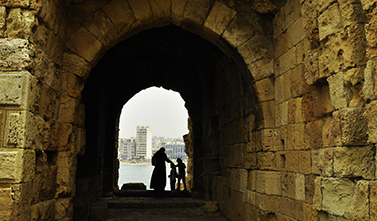
Shy Rouzati Photo 1 06 22 25

We Are Not Yet Ruins, Lebanon, Askia Bilal

HY: The book On the Consolation of Philosophy by the Roman philosopher Boethius aligns with this view. I want to read something similar regarding this idea from Imam al-Qushayrī, where he gives definitions of tribulation. He says, “Tribulation is the hallmark of sainthood. Whoever’s tribulation is perfected, his sainthood is perfected.” He also says, “Tribulation is the gift of the people that move quickly to God,” and “Tribulation is a gift from reality and a drawing nearness of the people of sincerity.” He says about balā’ that it disciplines, it removes the otherness that we’re trapped in, the distraction of otherness, and it is a way of bringing close what’s best.

As you noted, the exegetes, the mufassirūn, were looking at balā’, but they didn’t go deep into this central aspect. It was really the scholars among the mystics who did—you mention Maulana Rumi and Imam al-Ghazālī as the two central figures.

I wanted to share a couple of thoughts. One of the fascinating things in our intellectual tradition is this khilāf, difference of opinion, among the uśūlī scholars. Is the khiţāb of Allah—God’s discourse to creation, which is the basis of taklīf (legal responsibility)for the sake of imtithāl (adherence to divine command), or is it for ibtilā’? In other words, is God telling us to do these things in order that we do them? Or is this actually an ibtilā’, a test for the human being? And Ĥulūlū, who’s one of my favorite scholars from the Maliki school, says the truth (ĥaqq) is that it is ibtilā’ because the condition is not the tamakkun, your ability to do it. The taklīf is given to you whether you can do it or not. The test is in the heart: Do you want to do it if you can’t do it? Would you not do it if you could do it? The test is whether you fulfill the taklīf or don’t, or whether you want to fulfill it or don’t. Either way, the heart is being tested.

I thought your summation of the prophets was excellent, and as concise as it was, you showed us, first of all, the different stages of the Qur’an. Again, because of its nature, the Qur’an is not a linear narrative, with the exception of Sura Yūsuf (chapter 12). One interesting aspect of Sura Yūsuf—and it’s a beautiful narrative—is that God is showing us, “If I want to do a narrative, I can do a narrative. I’ve already done that. It’s called the Bible. Just to show you that I can do it.”

One thing I was wondering regarding your book is why you excluded Iblīs (Satan). You did talk about Iblīs a little bit. I think he’s so central to our story, and he really gets the big ibtilā’. I was curious about that—and also about why you didn’t put Adam in a separate chapter.

NR: I thought that Prophet Adam, because of his creation and the story of his fall and repentance, was best addressed in the context of the mystical dimension (in chapter 4), because that story tells us that we were created for this earth, not for heaven.

I’ve been asked this question a lot: “Why did we have to leave heaven?” I just smile and say, “We weren’t created for heaven. We were created to come here and to find God willfully, to truly submit, and then to find our way back to heaven.”

I don’t discuss Satan too much. From the mystical perspective, Satan is not as bad as we think. He’s really the differentiator, the line that separates our path, where we can say, “Do I go this way, or do I go that way?” Satan is actualizing a divine plan, and anything that has an instrumentality in actualizing the divine plan is not bad. Some Sufis see Satan as having a very high rank because he’s the one who separates the true believers from the people who go astray.

AS: I want to bring up something I found very interesting. You discuss the spiritual development of human beings and then reference Sura al-Tīn (chapter 95), where God says you were created aĥsan taqwīm (in the finest order), so you have this high state, then you’re brought down to asfal sāfilīn (the lowest of the low), and then those who believe and do good deeds work their way back up. And when we have a calamity, or when a life ends, we recite the Qur’anic verse “To God we belong and to God we shall return” (2:156). So the idea is that we come from this excellent state, we are brought down low, and now it’s up to us to get back to heaven. You had this nice quotation at the end from the philosopher John Hick about suffering and how it aids the soul-making process, that if we respond to the tests and trials and become better human beings, we can get back to that excellence and meet our Lord. I really appreciated that part.

NR: Yes, that’s why I say in the conclusion of the chapter that we want to become, and God wants us to become, who we are in essence—our essence is from the Divine. We have the verse in Sura al-A‘rāf about the covenant, when God asks all souls, “‘Am I not your Lord?’ They said, ‘Oh, yes! We bear witness’” (7:172). The word balā is used for “Oh, yes!” to affirm the covenant.

We go through life, and we forget the covenant. In order to submit and become who we really are in essence, we have to know ourselves. Self-knowledge should be the priority for believers to get back on the path to God.

HY: Imam al-Rāghib al-Iśfahānī said there’s never been a revelation that didn’t have a version of “Know thyself” that was central to it.

I wanted to say regarding your point about Iblīs not being so bad—it’s more of a Gnostic view. And there is a group of Sufis that holds that view as well. I prefer the view that Iblīs is resentful, that he’s an enemy of our species. That he has a purpose is undeniable. But he’s no friend of mine!

NR: I think you make a good point, and I think at the heart of what you said, that’s just how I read it: when we say evil, it really means darkness—that is, the lack of light. When the light is dim, then you have darkness, and when we are at a distance, away from our Lord, and our heart is filled up with other things, then Satan is there, whether we accept it or not.

HY: Yes, exactly. I want to ask about something in your book that generated a lot of thought in my mind. Besides the Sufis, why didn’t scholars focus on this aspect of trial and tribulation? I think one of the conclusions I came to is that the premodern world had a deeper understanding of suffering. I think modern people are so divorced from that perspective—they try to mitigate life to such a degree that they just want all suffering taken out.

We want air-conditioning; we want our food and our coffee at precisely the right temperature. Everything has to be in our comfort zone, and if anything takes us outside of our comfort zone, we collapse. A lot of the mental health issues that we’re dealing with in this country are related to this inability to grapple with discomfort; people get triggered easily. Well, life triggers us.

You quoted this verse from Sura al-Furqān, one of my favorite verses in the entire Qur’an: “We made some of you a trial for others; will you be forbearing? For your Lord is all-seeing” (25:20). In other words, you’re being tested, and God knows how we act and respond.

I think that premodern people understood and accepted that trials were a part of life. Seneca says to never trust fortune. If you’re on the top, just expect the bottom any day. I think the Prophet’s companions were very much in that mindset. They actually used to see times of laxity with a bit of trepidation because they knew they would be followed by tribulation, but when the tribulation came, they relaxed because they knew it would be followed by laxity. Maybe you could comment a bit on that.

NR: What comes to my mind is the entire Sura al-Ĥadīd (chapter 57). It should be read every single day. It puts you into this state to just be content and not complain about your situation. People complain about everything—today it’s raining here in New York, and people are complaining about the rain. Half of the world is praying for rain, and they don’t get a drop of rain. If it’s sunny, it’s too sunny—as you said, people are spoiled, unfortunately. I agree that premodern people, at least in the believing communities, understood that a dynamic Creator and Sustainer was at the forefront of their lives. Whereas in modern times, we rarely see that. God is static.

I think at the heart of the problem is not really understanding that God is the Creator, the Khāliq, but also your Rabb, your Sustainer, who is involved with every aspect of your life and existence after death.

HY: I actually experienced premodern people when I was in Mauritania in the desert back in the 1980s. These people had almost no contact with modernity. What really struck me about them is that they never complained. They just did not complain. People would sometimes come to me for medical advice, and I remember one person came to me and described the symptoms he was having, then he said, “I’m not complaining. I’m just explaining what I’m experiencing to you, but I’m not complaining. Al-ĥamdu lillāh (Praise be to God).”

These were theocentric people, and much of the Muslim world had that theocentricity, which obviously we’re losing as modernity, and postmodernity now, encroaches on the Muslim world. I think it’s a testimony to something you touched on toward the end of your book, the centrality of śabr and shukr (patience and gratitude), the attributes that were so central to traditional societies. The Qur’an refers to the signs all around for people who are constantly patient and constantly grateful.

NR: When you were talking about shukr, I just remembered Toshihiko Izutsu, who talks about the meaning of kufr (disbelief). Even though in the popular understanding, kufr means a person doesn’t believe in God, it literally means someone who covers the truth. In his Ethico-Religious Concepts in the Qur’an, Izutsu shows beautifully that a lack of gratitude puts you in the condition of kufr. Basically, not being in a grateful state is really the meaning of kufr.

HY: Good point. I really want to thank you, Dr. Nasrin, for your remarkable service in writing this book. A lot of people recite the Qur’an, but they don’t study the Qur’an. Your work reveals the richness of the Qur’an. We feel very grateful for your work.

keyboard_arrow_up