Ankur Barua
Ankur Barua is University Senior Lecturer in Hindu Studies at Cambridge University.
More About this Author
Ankur Barua is University Senior Lecturer in Hindu Studies at Cambridge University.
More About this Author
Ankur Barua is University Senior Lecturer in Hindu Studies at Cambridge University.
More About this Author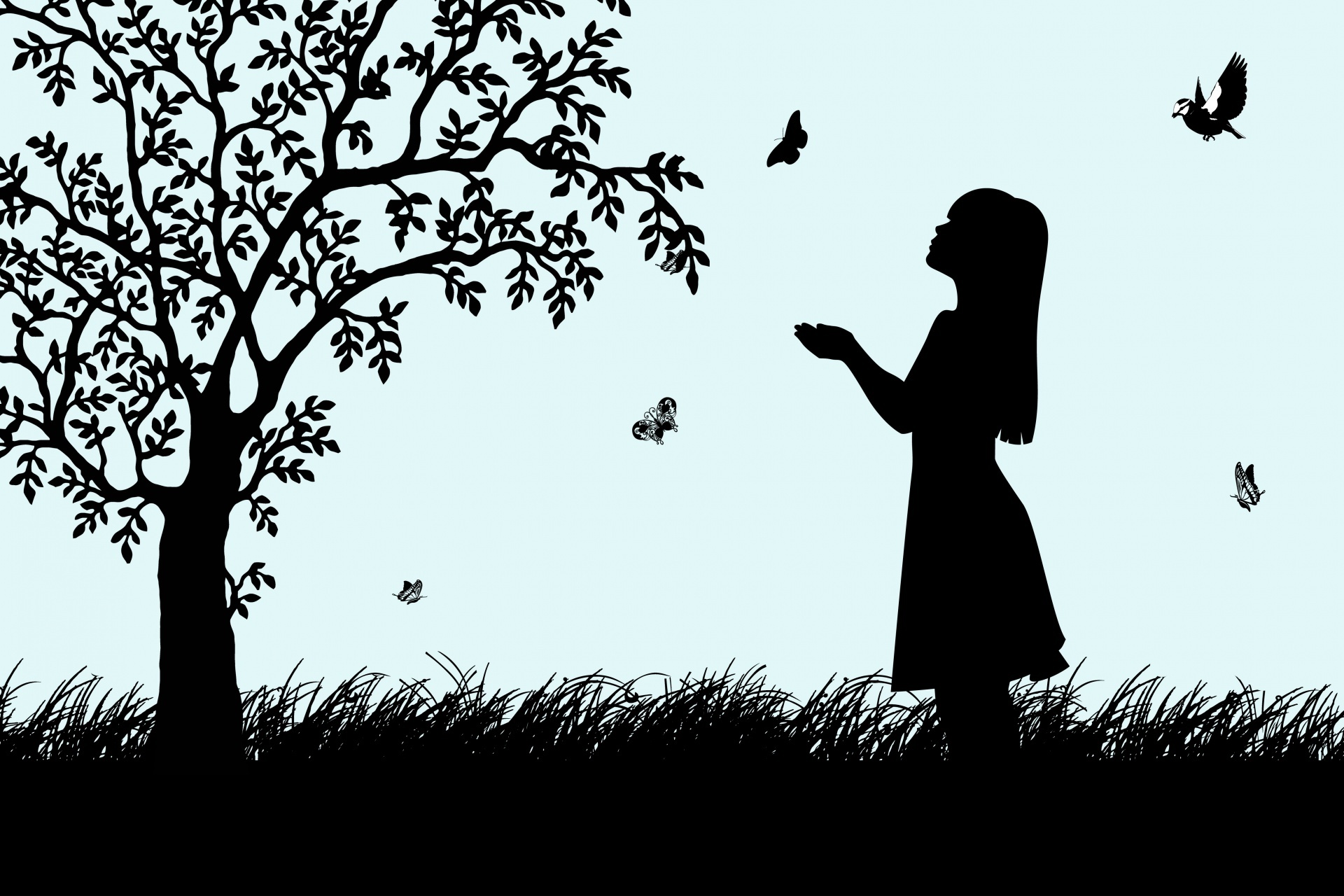
Girl, Tree, Butterfly Silhouette, Karen Arnold
In a fundamental sense, our engagements with the world are shaped by everyday necessities of survival. We seek to ascertain whether a sudden movement in the foliage is a snake or a leaf fluttering in the breeze. If we have gathered five mushrooms from the mossy riverside, we have to find a criterion to separate those that are edible from those that may be poisonous. We are socialized into such patterns of categorization from early childhood, and we may subsequently recalibrate or reweave them. Through such epistemic exercises of acquiring, classifying, and systematizing information, human beings have crafted, across three millennia or more, various dynamic maps of the world. These maps give us navigational pointers for our well-being so that we may develop certain habitual dispositions (“The burned child dreads the fire”) and project consistent courses of action into the future (“Practice makes perfect”). This mapmaking enterprise involves varying degrees of context-relative fallibility: we must constantly reevaluate the degree of fit between our conceptual maps and our real-world terrains, and we must develop ways to maintain or increase the correlation between the two.
Consider, for instance, a young girl called Eleanor who is walking to school on a sidewalk lined with trees. Eleanor has developed a keen interest in botany and can identify these trees as elms. Her mother, Isobel, does not possess Eleanor’s conceptual discernment and simply remarks, “Oh, those lovely trees!” However, Isobel happens to be a lepidopterist and can immediately classify the different types of butterflies flitting about the crocuses on the ground. In one sense, Eleanor and Isobel see the same world—this is the spatiotemporal domain of schools, sidewalks, crocuses, butterflies, elms, mothers, daughters, and innumerably many more entities. In another crucial sense, however, Eleanor and Isobel discern this shared world with distinct conceptual apparatuses. If knowledge is power, Eleanor and Isobel have different forms of agency vis-à-vis their different maps for the routes of reality.
Since the second half of the nineteenth century, the types of everyday cognition embodied by Eleanor and Isobel have been increasingly characterized as “scientific” and viewed as inconsistent with, or antagonistic to, “religious” inquiries. In this context, science occupies the privileged pedestal in an epistemic hierarchy where religion is associated with the eerie twilight of superstition or, more categorically, banished to the hinterland of nonsense. European narratives of this ascent of science and abolition of religion in various intellectual, cultural, and political domains have been extensively explored in recent decades. Diverse sociohistorical factors—such as the successful implementation of scientific idioms in technological innovations, the representation of religious cosmologies as invariably producing oppressive structures, the consolidation of the nation-state through technocratic tools, and the establishment of university disciplines such as geology, physics, chemistry, and zoology—have fostered or reinforced the widely held equivalence science = knowledge = power.
We will study some of these developments not in the heart of Europe but in the colonial crucibles of Calcutta (Kolkata), where a group of nineteenth-century Hindu intellectuals engaged with a momentous question: What types of conversation can we cultivate between Western science and ancient Vedic gnosis (or, in Sanskrit, jñāna)? These intellectuals, who wrote in Bengali as well as English, were associated with an organization called the Brahmo Samaj, which was established in Calcutta in 1828 by Ram Mohan Roy (1772–1833). Under its conceptual canopies, several writers would attempt, over the next century, forms of cross-cultural translation between the distinctive languages of European “science” and Indic “wisdom.” As the idiom of science rose to a cognitive summit across the intellectual milieus of Victorian Britain, these writers in Calcutta sought to present a Vedic vision as a truly synthesizing system of knowledge—that is, a true “science.” They creatively appropriated—along transnational trajectories running through Calcutta, London, Boston, Paris, and Heidelberg—Western scientific vocabularies and resituated them within Hindu landscapes of spiritual inquiry.
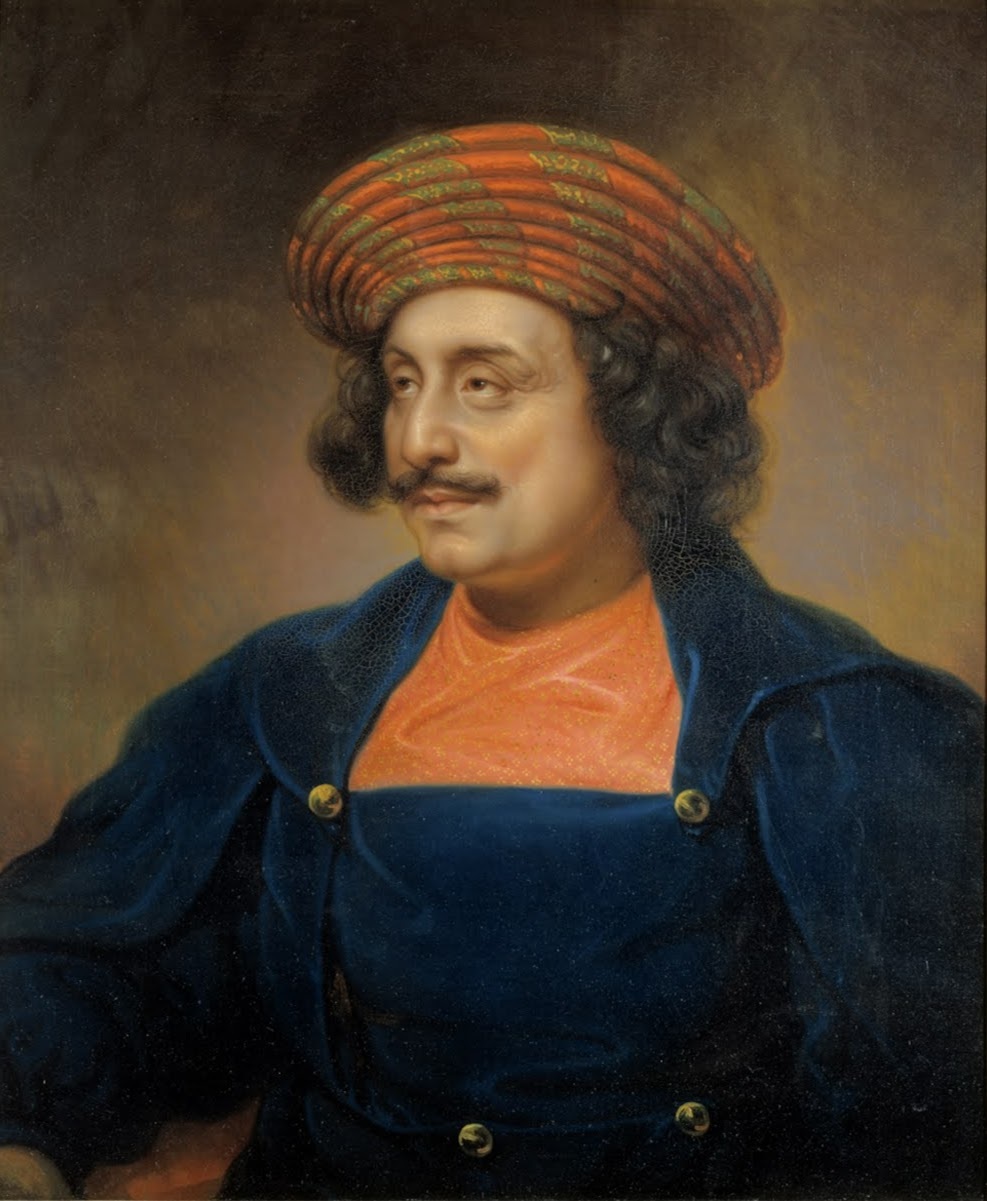
Half-portrait oil painting of Ram Mohan Roy, Rembrandt Peale, 1833
At the center of many of these translatory exercises stands the polymath poet-thinker Rabindranath Tagore (1861–1941) with his vast stream of poems, songs, novels, short stories, plays, artwork, and reflective essays. From this voluminous corpus, we will focus on his distinctive proposal for a marriage between the language of science and the language of spirituality. His proposal for a synergetic union between science and spirituality is vitally related to his overall religious vision of the relation between divine unicity and worldly multiplicity, which is itself shaped by Vedantic commentaries that began to be produced from around the eighth century CE. So, to describe Tagore’s understanding of the science/spirituality dialectic, we begin by sketching some conceptual contours of Vedantic theology.
The foundational commentarial texts that are placed under the category of Vedanta were composed by premodern thinkers who presented, in different and even divergent ways, the singular meaning of scriptures such as the Vedas (ca. 1500 BCE), the Upanishads (ca. 800–200 BCE), and the Bhagavad Gita (ca. 200 CE). So, in a straightforwardly historical sense, Vedantic commentators did not engage with our present-day category of science, with its operational parameters of verification, falsification, mathematization, quantification, and experimentation. However, their writings can give us some pointers for situating empirical inquiries about the structure of physical reality within transempirical horizons.
These pointers are shaped by two vitally significant Sanskrit words: veda and vidyā. Derived from a root that means “to understand,” veda and vidyā are taken in Vedantic commentarial literature to refer to a form of participative knowing in which knower (the “I”) and known (for instance, the laptop on which I am typing these words) are not radically disjoint but somehow interrelated in a cosmic stream of being. Conceptually analogous to sapientia in Christian doctrine and ĥikmah in Islamic theology, veda and vidyā defy straightforward translation into English—while they are usually translated as “knowledge,” it is important to note that they do not refer to simply an accumulative process of tabulating information about bits and pieces of the world. That is, vidyā is not an aggregate of (possibly quite interesting) details regarding a and b and c and d—for instance, the number of tables inside a building, the temperature on Jupiter, and a friend’s birthday. Rather, vidyā is a form of sacred knowledge charged with the power of liberating an individual from immersion in ignorance, impermanence, and suffering. In short, vidyā embodies the soteriological momentum that leads us away from our enmeshment in a world of precarity and toward the inexhaustible fullness of the ultimate reality. This transition is our liberation (moksha)—that is, the highest goal of human existence.
If I ask you a factual question—for instance, Do you know the capital of Lithuania?—you may or may not know the answer, but in either case, this kind of world-directed awareness is not directly or immediately relevant to vidyā. Instead, the core of vidyā is the proper understanding or comprehension of the relation between the spiritual self in the human person (atman) and the absolutely perfect foundation of spatiotemporal reality (brahman). Thus, there is a strong emphasis in Vedantic religious worldviews on cultivating a deep insight into the nature of atman: again and again, one hears some iteration of the exhortation “Know thyself.” Crucially, this quest for self-knowledge is correlated with brahman-knowledge—to properly know atman is to know oneself as enfolded by and grounded in brahman, and vice versa. Therefore, to return to the motif of knowledge (vidyā) as participation between knower and known, the “I” truly knows the laptop when it apprehends the laptop not as yet one more inert object but as located in the root of brahman. Likewise, by thus learning to envision the laptop as brahman-rooted, the “I” develops a more profound understanding of its own spiritual nature as atman. For folks who love the outdoors, here is an alternative, polychromatic analogy. On a breezy spring afternoon, our friend Eleanor is sitting on a blue bench in the green park and pensively gazing at the different entities that populate her visual horizon: many different species of flowers, trees, butterflies, dogs, and birds. For a few moments, she feels that there is a singular golden thread of being that unwaveringly runs through all these entities and—crucially—through her deepest self. Once again, she truly sees these entities not as mere bits and bobs floating around her but as woven in the thread, just as she apprehends her own self as interwoven with them.
These Vedantic cosmologies and symbolisms were inherited by Tagore as he began to sketch, increasingly from the turn of the twentieth century, his theo-poetic imaginations of the human self, the divine self, and the physical world. He also inherited from the Vedantic commentaries a fundamental debate about the relation between the one and its many: If brahman is the nondivisible (eka) root of spatiotemporal reality, is the everyday world of divisibility real or unreal? In terms of our analogy, if the thread of being is the seamless unity, are the diverse species of flowers, trees, butterflies, dogs, and birds real or unreal vis-à-vis this thread? There are two Vedantic answers to this question, about which rivers of commentarial ink have been spilled. According to the first (V1), unity is ultimately opposed to multiplicity—in the ultimate analysis, the thread alone is real, not the diverse species of flora and fauna. According to the second (V2), unity is hospitable to multiplicity—the diverse species are indeed real, and their spatiotemporal reality is correlated with the unifying reality of the thread.
Against this conceptual backdrop, we can now appreciate Tagore’s recalibration of Vedantic visions to configure a style of discerning the spirit in the science. Generally veering toward V2, Tagore reads Vedantic texts as teaching a middle way between what we may characterize as vacuous universalism (VU) and unmoored particularism (UP). To rework a metaphor from Bhagavad Gita 7:7, a vacuous universalism would discern the string that holds together the twenty-one pearls on a necklace but not the many shapes and colors of the individual pearls, whereas an unmoored particularist would apprehend an aggregate of polymorphic and polychromatic pearls but fail to discern the string that interconnects them as one necklace. From Tagore’s Vedantic perspective, both approaches reflect a sort of perceptual fixation—in the former, the perception of unity effaces the particulars, while in the latter, the perception of multiplicity obscures the unity. However, the apprehension of multiplicity (the twenty-one thick pearls) and the discernment of unity (the thin string) are not two competing forms of inquiry—rather, it is the latter that makes possible the former. That is, an inquiry into, say, how many laptops there are in my office (answer: two) and an inquiry into why there is some-one-thing in the first place (answer: because there is brahman) are not antagonistic but complementary.
So, on the one hand, Tagore routinely critiques styles of scientific explanation that would seek to dissolve human personality into abstractions of particles, forces, and laws. For Tagore, the spatiotemporal world—of chairs, tables, laptops, dogs, planets, and supernovas—is not just a pile of this and that lying out there; rather, it is a world for the aesthetic creativity of the human person. By tabulating details about the lengths of strings, movements of fingers, and so on, we can claim to have exhausted the reality of a sonata composed by Beethoven; however, we may forget that at the origin of these mechanical operations lies a human person, and that detailed facts about interactions between strings and fingers cannot grasp the “ultimate reality of the music.”3 This spiritual reality is apprehended through the “personal” dimension, which is the deepest core of the human being—it is free from biological necessities relating to the body and mind and beyond calculations of expediency and utility. Directly invoking the Vedantic language of atman and brahman, Tagore writes that there is “one infinite centre” to which all human personalities are related—this center of unity is the supreme person who is the supreme reality (satya), knowledge (jñāna), and joy (ānanda) that is revealed in manifold forms. It is because the voracious imperialism of nation-states has become decentered from this spiritual foundation (in a form of UP) that it has unleashed mechanized violence across the world. Under the weight of our egocentric dispositions that draw us into monadic absorption, the relational tissues that run deeply through humanity begin to strain. In his famous critiques of nationalism, Tagore is particularly critical of what would later be characterized as the military-industrial complex. When power is systematically organized with the help of science and directed toward material prosperity, it generates competitive acquisition, greed, and fear among people. Through the dissolution of social bonds, individuals in Western nations have become atomized into “gaseous particles” in a state of constant conflict.4
On the other hand, Tagore reveres science for its results and usefulness. The seriousness with which he viewed a basic education in science is evident in Viś́va-paricay (An introduction to the universe), the detailed textbook he wrote in Bengali for children on topics such as the solar system, the material constitution of the earth, atomic structure, electricity, gravitation, and galaxies. In 1928, Tagore wrote that because we had not been able to bring to the villages of India the great power that science has granted to humanity, they remained plagued by ills such as drought and disease.5 In an essay from 1925, he was even more laudatory of science. While he lamented that through the darkness of its egoistic politics, Europe had subjugated the rest of the world, he claimed that science nevertheless represented Europe’s light and its true self-expression (ātma-prakāś́).6 Human beings are not satisfied with the numerous restrictions that the natural world surrounds them with, and they instead seek the freedom to refit its parts for their own requirements—science guides them in their quest for freedom against nature’s tyranny over them. Science is an integral part of the story of human progress, for by uncovering through reason the laws of nature, human beings can transcend their confinement to biological necessities and realize moral ideals.7 When inviting the Cambridge-educated Leonard Elmhirst (1893–1974) to establish a center of rural regeneration near Santiniketan, Tagore was emphatic that education—and, in particular, a scientific temper—would infuse into the villagers of the region the spirit of experimentative thinking.
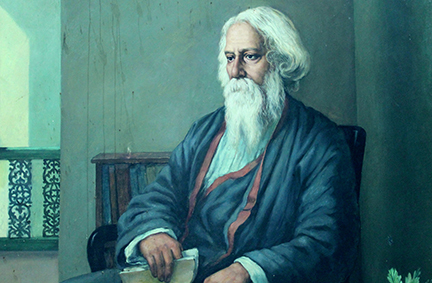
Rabindranath Tagore, Cherishsantosh
Thus, when science is rooted in a V2-shaped cosmic vision, it can become an instrument for the liberation of the human spirit. As Tagore highlighted in his celebrated dialogue with Albert Einstein in Berlin in 1930, the enterprise of science cannot be understood apart from the creative thought of the human knower. While Einstein claimed that there is a reality independent of human involvement, Tagore argued that the only conception that we can have of the universe is a human-rooted conception. The impersonal truths of physical equations are, in fact, human truths, for they are truths structured by human ideas. Even a scientist’s theoretical understanding of the world is the formulation of a human being who is a scientist. This is not to say that the scientific view is based on an individual’s subjective experience, for there is a “standard of reason and enjoyment which gives it truth, the standard of the Eternal Man.”8 So, when Einstein claims that a table continues to exist in a house even when nobody is observing the table, Tagore responds: “Yes, it remains outside the individual mind, but not outside the universal mind.”9
Thus, Tagore’s critical essays on how scientific modernity can be intermarried with the teachings of the Upanishads may speak to us as we continue to reflect on the contested relation between traditional wisdom and the idea of the West. Throughout Tagore’s life and voluminous writings, we find varied engagements with the motif that a living faith in the primordial unicity (eka) announced in the Upanishads has to become concretely expressed in the heat and dust of quotidian life. On the one hand, Tagore denounced styles of imperialistic nationalism animated by technocratic acquisitiveness, and on the other hand, he actively sought to implement scientific idioms through projects of rural reconstruction, children’s education, and so on. Decrying nationalistic egoisms, driven by science and commerce, Tagore writes that only the realization of the spiritual unity of humankind can give us peace. In possibly his most widely quoted words, Tagore tells us that modernism does not lie in European sartorial styles, or educational institutions where children are interned during lessons, or square houses, with flat walls and parallel lines for windows, where people are caged; rather, true modernism is “freedom of mind, not slavery of taste. It is independence of thought and action, not tutelage under European schoolmasters. It is science, but not its wrong application in life.”10 For Tagore, then, the human journey of acquiring knowledge consists of the ongoing discipline of synthesizing a faith-shaped wisdom (vidyā), encircled by the peace of the infinite, with a reason-driven understanding, brimming with the restlessness of the finite.
In short, Tagore’s relational ontology provides a measure of cognitive autonomy to scientific inquiries while affirming that these inquiries are charged with spiritual significance. Tagore sought to emphasize the “personal” dimension at the heart of scientific inquiry in a global context marked by T. S. Eliot’s rhetorical lament “Where is the wisdom we have lost in knowledge? Where is the knowledge we have lost in information?” This quest for a unifying focus resonates deeply with the writings of premodern Muslim philosophers and theologians—such as al-Fārābī and al-Ghazālī—for whom our empirical modes of knowledge acquisition are regulated by and conformable to our knowledge of God. God is the ultimate condition of possibility and the summative telos of these cognitive inquiries: it is for the sake of gaining a deeper knowledge of God that scientists seek a progressively more refined understanding of the operations of the world. By reenvisioning the world not as a haphazard collection of this and that but as a shimmering matrix of signs, a scientist begins to discern the relationality between a multiplicity of natural signifiers and the transcendent unicity of the signified. In this way, a fine-tuned attentiveness to the structure of physical reality can become a fallible pathway of ascent to God, who inbreathes natural phenomena with a cosmic fire.