
Scott F. Crider
Scott F. Crider has published extensively on the works of William Shakespeare and maintains the English Renaissance as one of his major research interests.
More About this Author
Scott F. Crider has published extensively on the works of William Shakespeare and maintains the English Renaissance as one of his major research interests.
More About this Author
Scott F. Crider has published extensively on the works of William Shakespeare and maintains the English Renaissance as one of his major research interests.
More About this Author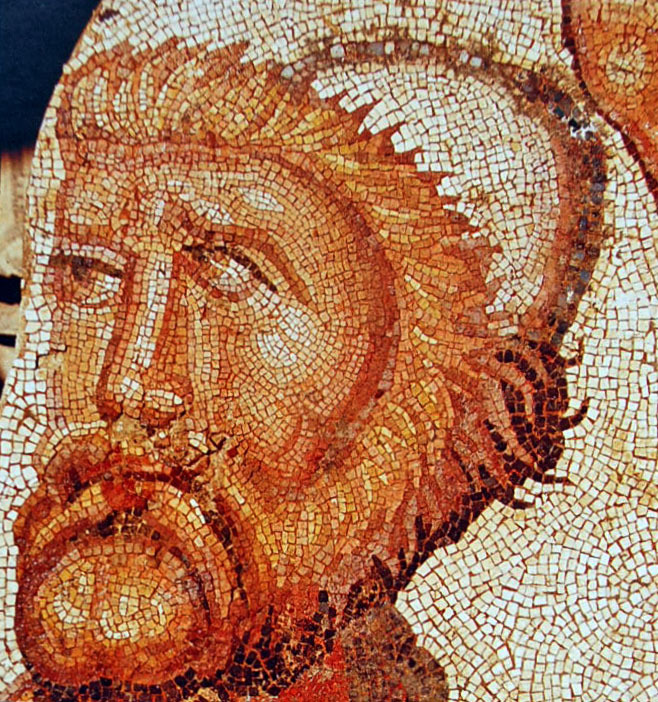
A mosaic of Odysseus from the villa of La Olmeda in Castile and León, Spain
Looking out my friend’s front door, across the street from my home, I see a dark blue sedan pull up in front of my house. Two men in US Air Force uniforms get out of the car. My mother has been dreading this possibility—that officers will approach our house and tell her they need to speak to her about her husband, and we will learn that my father has been killed in the war. He flies missions over Vietnam. I must have overheard her say so, because the sight of that sedan and those uniformed men, while my father is stationed in Thailand for reconnaissance in the skies over Vietnam, terrifies me. I watch closely as they approach… not our house, but the house next door, where another air force family lives. I feel guilty relief. Later that day, when I’m looking for my mom, my sisters direct me to the neighbors’ house, and in the smoke-filled living room full of air force wives, I experience the weight of other people’s grief. I leave as soon as I can.
My father survived the war, and he returned home. The neighbor, who was a close friend of his, did not.
I have only recently begun to understand that my love of Homer—whose Iliad and Odyssey (the one a story of war, the other of coming home after war) possessed me to study Greek and whose epics I have been teaching in translation for over thirty years—might have something to do with my father. He spoke very little about his experience during and after the war in Vietnam. My father-in-law, who served in the South Vietnamese army, also seldom discussed the war. Though both men were allies in the war, and their children married, they never, to the best of my knowledge, spoke of the war with each other.
One way to recognize a literary classic is that people keep reading it; another is that they keep remaking it. The Odyssey is having a moment. Two significant translations have been released recently, and two film adaptations will soon compete to be our era’s Odyssey.1 The film already released, Uberto Pasolini’s The Return (2024), is a brilliant and moving treatment of Homer’s epic, with Ralph Fiennes as Odysseus and Juliette Binoche as Penelope. It deserves to be seen for many reasons, but the one I want to explore here is its singular focus on the effects of war on veterans and their families.
The film begins when the epic is already halfway over: with Odysseus being washed ashore on Ithaca. There is no Telemachy, that part of Homer’s poem in which we see the son of Odysseus, Telemachus, bickering with the suitors in Ithaca (books 1–2) and visiting his father’s comrades in Pylos and Sparta (books 3–4). Telemachus is floundering without his father, whose MIA status leaves his son’s situation as prince ambiguous. Telemachus’s travels are suggested by the film but not shown. There is also no episode of Calypso’s isle, where Odysseus spends years as the goddess’s concubine (book 5), though the film does mention Odysseus’s living with a woman on an island. Nor is there any Phaeacian court to tempt Odysseus to start over elsewhere (books 6–8 and 13). There are no wanderings from a sacked Troy to Calypso’s isle, tales of which he recounts to the Phaeacians (books 9–12). And like Wolfgang Petersen’s Troy, a 2004 adaptation of the Iliad, Pasolini’s The Return simply leaves out the gods. This is an Odyssey without Athena, which for lovers of the poem is difficult to imagine.2 The Return, then, is the second half of the Odyssey, and not all of that. In the poem, with Athena’s help, Odysseus returns disguised to test everyone—family, ally, and enemy alike—slaughters the suitors, reunites with Penelope, and fights a civil war against the relatives of the dead suitors.
Instead of depicting Odysseus’s journey home, Pasolini focuses relentlessly on Odysseus’s strident unwillingness to reveal himself to his wife or his son, a reluctance born both of his grief and shame and of his inability to rejoin his community and family. Why can’t he rejoin them? Not only because his community is being tyrannized by the suitors courting Penelope (much as in Homer’s epic), but also because his grief and shame convince him he is unworthy of rejoining either his community or his family, something only hinted at in the epic but the central interest of the film. This Odysseus is a dysfunctional veteran of a forever war that he has trouble speaking about. This Penelope resents the fact that he left, took so long to return, won’t communicate, and is still so violent. This Telemachus shares his mother’s resentment, all the while abusing her. If any of this is suggested by Homer’s poem, the degree and intensity of Pasolini’s focus is distinct to the film’s vision. It is a return to the Odyssey as an indirect representation of our own moment, when so many veterans and their families have been weakened or destroyed by our own forever wars. The divorce and especially the suicide rates of veterans returning from tours in Afghanistan and Iraq have been much higher than those of the general population. The film stands as a mature reminder that our facile thank-you-for-your-service gestures are inadequate to the difficulty—even the trauma—of war and return.
Early in the film, once Odysseus (disguised as a beggar) has killed another beggar for the suitors’ amusement, Eumaeus, who recognizes Odysseus, draws out from him his grief and shame:
E: You should be pleased.
O: Pleased? Killing a man to amuse those thugs?
E: He had his chances. You can’t be blamed.
O: I will be. For all the killing I’ve done.
E: The war was many years ago and a long way off, my lord.
O: Not for me. It’s here. It’s everywhere. Everything I see and touch. A cup—the war. A door—the war. A table—the war. Everything feels like it’s waiting. Waiting for me to make it happen again.3
This scene is not in Homer, of course. Nor is a later scene of Odysseus’s anxiety, when he articulates his central fear: “I shall never be forgiven.” Purists may balk at these additions. (There is no purist, of course, like a purist who loves a piece of literature and complains about any adaptation of it that does not match their imaginary ideal.) And purists will no doubt complain about other major changes as well: the film kills off Odysseus’s father, Laertes, though he lives throughout the whole of the poem; the most sympathetic suitor in the film is Antinous, who is the central villain in the poem; and the film ends movingly with the reunion of Odysseus and Penelope, drawing to a close before the ensuing civil war Homer depicts in book 24. But adaptations of texts, I would argue, must be given license to cut, add to, rearrange, and emphasize or de-emphasize the original text to achieve their own visions. An adaptation is its own creation, and it assumes its deviations from the source text will be noted by knowledgeable audiences, who will then see how and why those differences matter.
The focus here is upon a family, a son and his parents, that is almost destroyed by the war and the return. Three distinct relationships are all but irreparable: Telemachus’s relationships with both his mother and his father, and Odysseus and Penelope’s relationship with one another. In the film, Eumaeus’s relationship with Odysseus is also strained to the breaking point, the swineherd at one point challenging Odysseus in a highly un-Homeric, but effective, scene. Only Eurycleia (the servant) and Odysseus, understanding each other as fully as they did before his journeys, faithfully reflect Homer’s telling of the story (although lovers of the poem will be glad to know that Odysseus and his dog Argos also have their reunion).
Telemachus is estranged from his mother and father to a degree nowhere suggested in the poem. Offended by Penelope’s relations with the suitors, who are forcing her to choose one of them as her new husband since Odysseus is presumed dead, and prevented from ruling because of both his youth and his inexperience, Telemachus takes his frustrations out on his mother. In one scene, Telemachus and his mother discuss her situation, with Eurycleia present:
T: Every day, every week… “Why doesn’t she choose? Why doesn’t she?” Why don’t you? Marry one of them. Anyone! Then the rest will go.
E: Your mother will never marry another man. She will never stain the honour of this island and the name of your father—
T: My father is dead! Everyone knows it! (to Penelope) Everyone except you.
P: So which one should I marry?
T: It doesn’t matter who. Your life is over. Mine can’t even get started.
P: I’m serious. Which one? Which savage shall I give you for a father?
T: There must be one you prefer. (wearily) I’ll make my peace with whoever it is. Mother—what choice do we have?
This is a difficult discussion, and Telemachus is adolescently cruel—“Your life is over.” His behavior devolves even further in a later scene, when he speaks to his mother (again in Eurycleia’s presence) after having been unable to find her the night before (she’d been wandering through the palace):
P: What are you doing here?
T: Waiting for you. Where have you been?
P: For a walk. Checking the rooms.
T: Anyone’s room in particular?
P: I don’t know what you are implying.
T: Whore.
Eurycleia (not Penelope) slaps Telemachus. He apologizes to Penelope, but the two scenes together give us a mother and son whose relationship is strained, then broken, by the absent father, which prevents both of them from appropriate and complete grieving so they can move on with their lives. Into that limbo, the suitors have rushed, occupying both the palace and the emotional lives of mother and son.
Telemachus is even harder on his father, and berates him relentlessly once he realizes that the disguised stranger in his home is Odysseus. He identifies and aggravates his father’s shame—“What happened to your men? The real Odysseus would have died rather than return alone”—and Odysseus cannot respond. Later, their exchange reveals the pitch of Telemachus’s alienation from the father he has never known:
T: I don’t know what you’re doing here, but you’re not my father. Even if you were, you’re not now.
O: Wait!
T: It’s too late to come back. You can only hurt us. Go back to your other woman.
O: If you go back to the palace now, they’ll kill you.
T: Yes, but my father is the great Odysseus—sacker of cities—look at you, a gutless wreck. My mother is going to marry one of those pigs. You’re here. What are you going to do about that? Nothing, clearly. She’s wasted the last ten years waiting for you. Twenty, counting the war. I will not be your son. I should kill you for all the suffering you caused us—
O: I am your father. And I will fight.
T: Good, I hope they kill you.
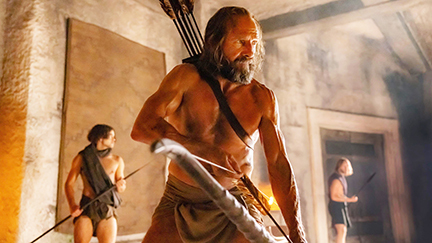
Ralph Fiennes plays Odysseus in Uberto Pasolini’s The Return
The film stages Telemachus’s estrangement from both his parents with scenes of serious verbal violence. This scene of Telemachus’s anger at his father has a patricidal tenor nowhere to be found in Homer, just as an earlier moment gives us a non-Homeric, disappointed Odysseus berating Telemachus for the state of Ithaca.
The extended recognition scene between Odysseus and Penelope in the Odyssey is one of the glories of Western literature’s portraits of marriage. The film compresses it into one remarkable scene in which it becomes clear that Penelope knows the stranger is her husband, and their exchange reveals that the long war and the protracted return have put an all but unpassable space between the two of them. Penelope asks the stranger about Odysseus, yet somewhere in the scene, imperceptibly, we sense that she knows she is speaking to him:
P: Is he alive?
O: I don’t know.
P: Well, what did the rumours say? If not alive, he must be dead.
O: Perhaps he’s afraid.
P: Of what? The man who left here would never have stayed away. From his son. His wife. His people.
O: Perhaps he’s lost.
P: Lost. You’re saying he could find a distant war but not find his way back from it?
O: For some men, war becomes their home.
P: Is that what happened to you? Did you return?
O: Yes.
P: Your wife and family had waited?
O: No. When I got home, my wife had taken another man.
P: What did you do?
O: I watched her awhile, then continued on my travels.
P: And you did this out of love? Not guilt? Not pride?
O: She loved another.
P: Maybe not. Maybe you condemned her to live with a man she didn’t love.
(He can’t reply.)
Answer me this then: Why do men go to war? Why do they burn other people’s houses? Why do they rape, why do they murder women and children? Is there pleasure in it?
(He does not answer. She looks at him.)
Did my husband rape, did he murder women and children?
(Silence. He looks away.)
This land is ruined now. And I sacrificed everything for it. Husband gone. My son hates me. Suppose he would want me to marry. Should I marry? Tell me. Put an end to it?
(Odysseus cannot answer.)
If I do marry, has all this waiting been for nothing?
She then leaves, ordering Eurycleia to bathe him. The scene is exact and moving: Penelope is horrified by her husband as a warrior; she is crushed by his failure to return for so long. Odysseus is ashamed of both. The war at Troy and the wanderings afterward have unmade this marriage. It will have to be remade.
Whatever admiration for martial excellence Homer has—and that admiration is always humanely qualified by the human cost he honestly portrays—the film does not share it. Though the slaughter of the suitors is, both in the poem and in the film, exhilarating, it is also nauseating: it may be just, but one experiences, especially in the film, only its necessity—the necessity of an ethic of kill or be killed—that is, until Telemachus beheads a sympathetic and pitiable Antinous. And then the horror of the scene becomes inescapable.
The Return ends less ambiguously than the Odyssey, the romance of the spouses’ reunion represented not in their lovemaking on the special bed (book 23) followed by civil war (book 24) but by Penelope bathing Odysseus, washing off the blood splattered on him as he slaughtered the suitors. There are still disturbances: Penelope is angered by that slaughter, especially her son’s involvement in it, and she communicates to Odysseus that she has heard of another woman; Telemachus leaves, perhaps having forgiven his father, perhaps not. Even so, the film closes with that bath scene:
P: I need to understand.
O: You will not. I cannot.
P: We will. Your past will become my past. And mine yours.
O: You don’t think it’s better to forget?
P: Better to remember together. And forgive and live together. And grow old again. Together.
Penelope cleanses Odysseus of blood, and she promises him the forgiveness he imagined he would be denied. And she opens an opportunity for him to talk about his experiences. The sun shines on their bed and their island, the film only hinting at the special construction of the bed that the poem highlights.
The film’s focus on the frayed family—unwoven by the war and the prolonged return, and then woven again as well as possible through forgiveness (figured throughout by repeated scenes of Penelope’s famous weaving and unweaving of Laertes’s burial shroud, which in the poem is recounted by a suitor, never actually shown)—is both a return to Homer and a revision of his poem. This Odysseus carries a shame only ever suggested in Homer’s epic, one cleansed by his wife only after she has prosecuted him for the acts meriting shame. There is a rare honesty here about the cost of war, an honesty seldom seen in contemporary culture, distilled from the film’s wrestling with the epic.
I have my own mild shame over my response to a more recent forever war. My son was born in 1993, and after 9/11—as a little boy, then as a young man—he wanted to join the army and become a ranger. He worshipped both his grandfathers and admired their military service. By the time he could legally enlist, though, it was clear to me that the wars in Afghanistan and Iraq were follies, and although I admired his spiritedness and would have liked to offer my encouragement, I did not want him to throw his life away on a folly, so I persuaded him not to enlist. I made sure he found stories in the New York Times about young men with brain trauma returning home to difficult lives—that is, I fought dirty. He eventually decided against enlisting, and he found a different way to serve the common good. Yet I often wonder if I failed to be as patriotic as my father, even as I may have saved my son’s life.
I was never in the military myself. No war, no return. More and more, I realize that I love Homer not only because he is the poet of poets in the West, revealing human beings in our elemental character, but also because I am trying to understand both my father, and the martial experience I never shared with him, and my mother, and the difficulty of her being there for him to return to. If he suffered any shame, if she struggled in their marriage, I never saw it: they are both gone now, but they flourished until the end of their good lives. Returning to Homer every year is somehow returning to them, reaching out to a part of them I never knew when they were alive and now understand so much more with Homer’s help—and The Return’s. Of course, it’s too late to be of any help to them now if they needed it. But it helps me and my son. We should read Homer together.4
Renovatio is free to read online, but you can support our work by buying the print edition or making a donation.
Browse and Buy