Michael Sugich
Michael Sugich studied at UCLA and the California Institute of the Arts and has also studied Sufi doctrine and practice with spiritual masters across the Muslim world.
More About this Author
Michael Sugich studied at UCLA and the California Institute of the Arts and has also studied Sufi doctrine and practice with spiritual masters across the Muslim world.
More About this Author
Michael Sugich studied at UCLA and the California Institute of the Arts and has also studied Sufi doctrine and practice with spiritual masters across the Muslim world.
More About this Author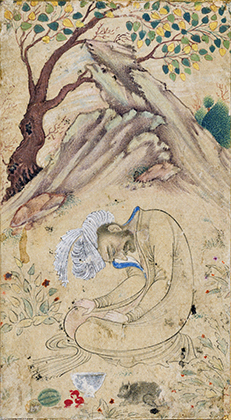
A Sufi in Ecstasy in a Landscape, Isfahan, ca. 1650
The American hierarchy was defined by the democratic ideal, as interpreted by the Founding Fathers and articulated in the Declaration of Independence: “We hold these truths to be self-evident, that all men are created equal, that they are endowed by their Creator with certain unalienable Rights, that among these are Life, Liberty and the pursuit of Happiness.” Its author, Thomas Jefferson, also subscribed to English philosopher John Locke’s assertion that “neither pagan, nor mahometan, nor jew, ought to be excluded from the civil rights of the commonwealth, because of his religion.”1 This declaration of tolerance inspired Jefferson to confirm the separation of church and state, embedded in the Bill of Rights, effectively secularizing the governance of the republic fifteen years after its creation. So religious freedom and equal rights are the foundational ideals of America. Yet the Founding Fathers were all white, all Christian, all slave owners, and they intended a government controlled exclusively by landowners—that is, themselves.
The de facto hierarchy of America was based on property, pedigree, and literacy. At first, only landowners could vote and participate in the new democracy, making property ownership the key to a place in the hierarchy. George Washington was not born into great wealth, and he “lacked the liberal education that then distinguished gentlemen, setting him apart from such illustrious peers as Jefferson, Hamilton, Adams, and Madison.”2 Washington achieved his place in pre-independence society by acquiring vast tracts of land while working as a surveyor and, by the age of eighteen, assuming the role of tobacco planter, while distinguishing himself as a soldier on the frontier. Washington was a paragon of upward mobility, his marvelous estate at Mount Vernon a proof of his attainment.
There were no kings, principalities, or feudal lords in our history or mythology. The American symbol of success was the presidency. “Honest Abe” Lincoln, born in a log cabin, symbolized the democratic ideal that was ingrained in generations of Americans through textbooks, the press, literature, and popular entertainment. The idea of upward mobility was popularized in the wildly successful young adult novels by Horatio Alger, beginning in 1867 with the Ragged Dick series, a rags-to-riches-and-respectability saga about a fourteen-year-old bootblack who escapes poverty and achieves middle-class respectability through hard work and virtuous living.
These were the antecedents of the American meritocracy: the belief that if one works hard and lives a good life, one can ascend the social, political, and economic hierarchy on merit, that anyone could become president (that is, anyone white, Anglo-Saxon, and male).

As a child in the 1950s, when upward mobility became turbocharged, I grew up watching The Little Rascals, a hugely popular series of comedy shorts about the adventures of a group of poor neighborhood children. First produced from 1922 to 1939 by Hal Roach as Our Gang short comedy films, and then by MGM from 1939 to 1944 as The Little Rascals, the series was on television every day during the 1950s, and I was one of its most devoted fans. One particular short, Readin’ and Writin’, made a big impression on my six-year-old self and lodged itself in my memory bank, where it has remained for seventy years, till today.3
Breezy Brisbane (played by Kendall Frederick McComas) is being sent off to the first day of the school year by his mother.
Ma: Mother wants you to be a very, very good boy and study very hard in school. And Mother wants you to be president.
Breezy: Well, I don’t wanna be president. I wanna be a streetcar conductor.
Ma (frowning): You’re not going to be a streetcar conductor. You’re going to be president.
Breezy: Aw, you make me sick talkin’ about president all the time.
On the way to school, Breezy stops by the blacksmith’s workshop and helps pump the bellows.
Blacksmith: Ain’t you gonna go to school?
Breezy: Oh, I suppose I’ll have to, but I sure don’t wanna.
Blacksmith (shaking his head): Dontcha wanna be president?
Breezy: Naw! I wanna be a streetcar conductor.
Blacksmith: A streetcar conductor? Why?
Breezy: Boy, do they pick up the nickels!
Blacksmith: Why, when I was a lad your age, I wanted to be president. Why, I went to school every day, and I studied hard, and I led my class from spelling to geometry. Yessir, I really wanted to be president.
Breezy (snarky): And all you turned out to be was a punk blacksmith!
Blacksmith (insulted): Say, it’s fresh kids like you that never amount to anything! (Hammers his anvil in anger.) Say, I knew a fresh kid just like you when I went to school, and they expelled him.
Breezy (intrigued): Well, what did he do to get expelled?
Blacksmith: What did he do? He did everything he could think of. He told a lot of new kids to do silly and harmful things. He put tar in the inkwell. And glued the teacher’s books together with glue. And then, to top the climax, he brought a live mule into the schoolroom. That’s what he did.
Breezy: Is that all he done?
So Breezy arrives at school and commits all the crimes and misdemeanors described by the blacksmith, intending to make enough mischief to get himself expelled, and he succeeds.
Breezy (to Teacher): You mean I’m kicked out?
Teacher: Yes, and you’ll never be president.
After being expelled, Breezy finds himself all alone, has a change of heart, and returns to school contrite:
Breezy (in tears): I’m sorry I was a naughty boy. I don’t wanna get expelled… I wanna be president too.
This short film made a deep impression on me. The idea that if I studied hard, I could become the president of the United States?—that I was supposed to aspire to this?—was astonishing to my preschool self. I remember thinking, “Is this why we go to school, to become president? What if I don’t want to be president? What if everybody wanted to be president? What would happen?”
While the Nietzschean, Shakespearean will to power is tragic and profoundly European, the mythical notion of upward mobility—the idea that an ordinary individual (Breezy Brisbane, for example) can, through effort, ambition, and force of will, ascend the ranks of the social, political, and economic order to reach the summit of power, wealth, and prestige—is comical and uniquely American.
There was even something slightly comical and uniquely American about the way the name for the leader of the newly constituted United States of America was chosen. It was the subject of a tedious and protracted debate, bordering on the absurd, between the nation’s new House of Representatives and Senate. Members of the House feared that a grand title, like king (which had been put forward by the Senate), would give the new incumbent (George Washington) and his successors grand authoritarian ideas.
“There were those who were worried that the president would turn into a despotic, all-powerful monarch,” said Dr. Kathleen Bartoloni-Tuazon, author of For Fear of an Elective King: George Washington and the Presidential Title Controversy of 1789. “But there was another group of Americans who were worried about a weak executive that would be subject to manipulation.”4 Other titles were mooted, including chief magistrate, protector of liberties of the peoples of the United States of America, elective majesty, sacred majesty, elective highness, illustrious highness, and serene highness. According to Bartoloni-Tuazon, “The Senate actually went on record as recommending, ‘His Highness, President of the United States and Protector of Their Liberties.’”5 The House countered with the least prestigious title it could come up with: just plain president. No country had yet used that term to describe its head of state. The word, which derives from French and Latin, denotes the person who presides over a meeting, equivalent to pedestrian titles like moderator, foreman, or overseer.6 The House prevailed, and George Washington became the first president of the United States of America.
The American presidency never rendered the person who occupied the position sacrosanct. Although hugely popular with the electorate, by his second term, President Washington was the object of savage attacks and vicious slander in a press campaign secretly led by his former allies, including Benjamin Franklin and future presidents Thomas Jefferson, James Madison, and James Monroe. Throughout the history of the republic, US presidents have been objects of admiration, derision, mockery, and mirth. Yet the presidency remains at the pinnacle of the American hierarchy. Or does it?
The American hierarchy shape-shifted during the nineteenth and twentieth centuries with the westward expansion, the Gold Rush, the Civil War and Reconstruction, and the industrialization of the country. The rise of bankers and robber barons ushered in the Gilded Age and a new social, economic, and political elite. Giants of the era like Cornelius Vanderbilt, John D. Rockefeller, and Andrew Carnegie defined the new order. These tycoons were self-made men who were shrewd, ruthlessly ambitious, unscrupulous, and mercenary. Yet several became major philanthropists who left an extraordinary legacy of good works. The “old money” from agriculture and trade was overtaken by the “new money” from industry, transport, infrastructure, and the emerging energy, finance, and media industries. These vast, rapidly expanding enterprises adopted the eighteenth-century corporate model used for public works. The new corporations had limited liability, which protected the personal wealth of shareholders if the business failed, making it possible to grow business nationally and internationally. With their huge fortunes, these plutocrats sired dynasties that formed the economic, social, and, to some extent, political elite of America for generations. Position and privilege were inherited, gifted, or seized—rarely earned. Thereafter, wealth shaped the American hierarchy.
At the same time, the rise of industrialization, urbanization, and emerging technologies throughout the nineteenth and early twentieth centuries transformed the mostly rural, agrarian nation into an increasingly complex metropolitan society, connected by roads, rails, telegraphy, telecommunications, and interstate laws. An expanded public education system became a pathway for immigrants and Americans from working-class families to improve their economic prospects and attain property ownership and social respectability. The practices of law, medicine, and engineering were being standardized and professionalized. Education contributed to the rise of the middle class, with literacy and civic engagement enabling many to climb the social ladder.
Corporations provided another channel for the upward mobility of the middle class. As they evolved, corporations mirrored government bureaucracies. They had a chief executive officer or president, vice presidents, and heads of departments. These officials were elected or approved by a board of directors, equivalent to a congressional committee. A young man could theoretically start his career in the mail room and finish as a corporate president, chief executive officer, or even chairman of the board.
As corporations proliferated and became increasingly complex, higher education became an essential prerequisite for the corporate workforce. By the mid-twentieth century, during the postwar years, education became recognized as the engine of upward mobility. The unprecedented growth and development of educational systems and institutions in the United States and across the industrialized world during the twentieth century was a phenomenal accomplishment.
As a child in the 1950s and a teenager in the ’60s, I witnessed upward mobility and conspicuous consumption in full swing: bigger houses, flashy cars with big fins, swimming pools, country clubs, color televisions, and all the other accessories that signaled the rising prosperity of the middle class. Our parents were living out the American dream, or trying to.
As for my generation, the (white) middle-class baby boomers, university was a foregone conclusion. Upward mobility was a birthright. We worked hard, burnished our abilities, and were somehow instilled with confidence that we would take our places in the hierarchy, whether in business, the arts, industry, sports, finance, or politics. Becoming a millionaire wasn’t the goal; it was making a mark in the world, moving from one level to the next. Without knowing it, we had been inducted into the American meritocracy.

The word meritocracy was coined in 1958 by British sociologist Michael Young in his novel The Rise of the Meritocracy. Young meant the word in a derogatory sense. He defined the invented term (an unorthodox coupling of the Latinate word merit and the Greek-derived suffix -cracy) as the rule or controlling influence of the educated and skilled. Young’s book was a satire set in 2034. A lifelong leftist (who ironically lived out his later years with a life peerage as Baron Young of Dartington), Young believed that status based on formal education created a caste system as discriminatory as the aristocratic privilege it replaced. In his introduction to the book’s 1994 edition, he wrote:
People of power and privilege were readier than ever to believe that modern society (in the language of the book) has “rule not so much by the people as by the cleverest people; not an aristocracy of birth, not a plutocracy of wealth, but a true meritocracy of talent.” The association with the aristocracy was particularly favourable. Some people like to congratulate themselves on being like aristocrats but going one better by earning power and privilege on merit. Aristocracy went wrong because so many of the people who had power simply because they inherited it from their parents were clearly unfit to exercise it. Nobody should be born with a silver spoon in his mouth, or, if he is, it should choke him.
…The belief has become established that it is wrong to allow nepotism, bribery, or inheritance any sway: individual merit should be the only test that should be applied. The coming of industry and its displacement of agriculture as the foundation of the economy is what has made the difference.7
But to many readers, this all seemed like a good egalitarian idea, and, contrary to Young’s warnings, meritocracy came to define an aspirational ideal. “This is what educators like to think they are doing, and are often actually doing, with the aid of more or less elaborate systems of testing and examination,” Young wrote.8 Higher education became the primary metric for success in society and the key to the inner sanctum of power and prestige.
In a piece published in the Guardian in 2001, less than a year before his death at the age of eighty-five, Professor Young sent up a final red flag:
A social revolution has been accomplished by harnessing schools and universities to the task of sieving people according to education’s narrow band of values.
With an amazing battery of certificates and degrees at its disposal, education has put its seal of approval on a minority, and its seal of disapproval on the many who fail to shine from the time they are relegated to the bottom streams at the age of seven or before.
The new class has the means at hand, and largely under its control, by which it reproduces itself….
The business meritocracy is in vogue. If meritocrats believe, as more and more of them are encouraged to, that their advancement comes from their own merits, they can feel they deserve whatever they can get.
They can be insufferably smug, much more so than the people who knew they had achieved advancement not on their own merit but because they were, as somebody’s son or daughter, the beneficiaries of nepotism. The newcomers can actually believe they have morality on their side.9
According to Yale law professor Daniel Markovits, meritocracy “is now a basic tenet of civil religion in all advanced societies.”10 His book The Meritocracy Trap (2019) shows how the self-image of our age is anchored in “the meritocratic ideal… that social and economic rewards should track achievement rather than breeding,” and he provides a detailed takedown of this state of affairs:
Meritocracy promises to promote equality and opportunity by opening a previously hereditary elite to outsiders, armed with nothing save their own talents and ambitions. It further promises to harmonize private advantage and public interest, by insisting that wealth and status must be earned through accomplishment. Together, these ideals aspire to unite all of society behind a shared vision of hard work, skill, and deserved reward.
But meritocracy no longer operates as promised. Today, middle-class children lose out to rich children at school, and middle-class adults lose out to elite graduates at work. Meritocracy blocks the middle class from opportunity.11
How did this happen? According to Professor Markovits, three factors lead to meritocratic accomplishment: natural ability, effort, and training. Advocates of meritocracy cite natural ability and effort in highlighting achievements, but they ignore training. In reality, though, the new elites, who have reached their positions in society through meritocratic means, understand how the system works. They invest heavily in preparing their children to matriculate at elite schools—through private tutoring, counseling, and exposure to expertise—paving the way for them to enter the workforce in positions and organizations that propel them into hierarchies of wealth, influence, and power.
I became aware of this trend in the late 1980s when I returned to the US on a visit and learned from friends that they were looking to enroll their three- or four-year-old in a special pre-preschool that taught reading, writing, math, and languages, to give the child a head start in the race to reach life’s winner’s circle. I was struck by how deeply invested my friends were in ensuring their child’s competitive advantage.
Back in the day when meritocracy seemed to be working for the middle class, in 1967, I waltzed into the University of California, Los Angeles (UCLA), with a 3.5 grade point average, some talent, and a work ethic, and I excelled, winning recognition and awards in music and theater. Two years later, I was awarded a full merit scholarship to the California Institute of the Arts (CalArts) in its inaugural year. If I remember correctly, my school fees at UCLA amounted to a grand total of $204 per year. Adjusted for inflation, this is equivalent to around $2,000 today. And my CalArts full scholarship covered tuition of $1,200 per year, which would be around $10,500 in today’s money (CalArts tuition today is more than $60,000 per year).12 Incidentals like accommodation ($90 per month for a small house), food, books, and travel were cheap as chips. Gas in the San Fernando Valley was $0.19–0.22 per gallon.
Today, my granddaughter is a top student in an elite preparatory school in California, where her mother is a teacher. She maintains a 4.1 grade point average. She is a competitive athlete and is involved in student activities. Her heart is set on attending UCLA—and she has zero chance of being admitted because UCLA is flooded with applications and has brutal (unofficial) admission standards. One reason for the school’s popularity may be that its students can earn a prestigious degree from a big-name school for less than half the cost of a degree from an elite private university.
Leaders in business, politics, law, medicine, technology, science, and academia are overwhelmingly beneficiaries of elite educational institutions. The vast majority of students at such institutions come from wealth and privilege. They are the new aristocracy, but unlike the old aristocracy, they have to work hard for their fortunes, which come from astronomical compensation packages on Wall Street, in elite law firms, and in corporations, well beyond the grasp of those with a middle-class education. Markovits points out that while the meritocracy gives unfair advantage to the elites, it also places immense strain on its beneficiaries, who now work long hours under intense pressure to maintain their status in the hierarchy and earn their staggering pay packets.

The Dhikr, depicting a Sufi ceremony; Eugène Baugnies, late 1800s
In 1976, I taught English literature at an elite private school in Cairo, which catered to the Egyptian upper classes. One day, I was called to the principal’s office and introduced to the parents of one of my students. They were beaming and oddly obsequious, with a tinge of desperation in their tone: “Mahmoud has told us about you. He really likes your class. If there is anything he needs help with, please let us know.” I couldn’t decide whether I was being offered an outright bribe or extra income from private tutoring. I said to the hovering couple, “Mahmoud is an excellent student, one of my best. He is a fine young man. Don’t worry. He doesn’t need any help.” His parents retreated happily, probably relieved that they weren’t going to have to shell out more than they already had.
Later in the semester, in the lead-up to midterms, I was in the middle of a class when Mahmoud suddenly slammed his hands on his desk and roared:
AAAAAAAAAAAAAAAAAAAAAAAAAAAAAAAAAAAAAAAAAAAH!!!!!!
It was the frightening, full-throated, guttural roar of an animal in distress. The class stopped in shocked silence. When his roar ended, Mahmoud looked up at me and made a kind of gesture to reassure me that he was okay, that he was letting off steam. After class, I asked his friends whether he really was okay and whether this had happened before. Yes, he was okay, and yes, it had happened before. This was my first encounter with a manifestation of academic stress.
A 2020 study by the American Psychological Association reveals that 87 percent of Generation Z adults in US colleges cited education as a significant source of stress.13 Anxiety, depression, substance abuse, and suicide have become associated with the intense pressures on students in the academy.
Mahmoud’s roar also illustrates the transnational impact meritocracy has had on global societies. While becoming president was an unlikely outcome for an Egyptian teenager in the 1970s, Mahmoud’s parents were surely preparing him to take his place in the hierarchy of his homeland. Clearly the stakes were high.
The psychopathology on evidence in Mahmoud’s outburst is a symptom of the secularization of learning institutions. In his seminal book Islām and Secularism, Malaysian philosopher and educator Professor Syed Muhammad Naquib al-Attas defines secularization as “the deliverance of man ‘first from religious and then from metaphysical control over his reason and his language.’”14 If divinity is eliminated from learning, and the goal of education and employment is solely to gain material advantage and accumulate wealth, prestige, position, and power, the heart and soul will eventually and inevitably reach an emotional and spiritual emergency.
Professor al-Attas reduces this condition “to a single evident crisis which I would simply call the loss of adab”:
I am here referring to the loss of discipline—the discipline of body, mind, and soul; the discipline that assures the recognition and acknowledgement of one’s proper place in relation to one’s self, society and Community; the recognition and acknowledgement of one’s proper place in relation to one’s physical, intellectual, and spiritual capacities and potentials; the recognition and acknowledgement of the fact that knowledge and being are ordered hierarchically.15
Adab is simply to see and set everything in its rightful place, and this recognition and acceptance of the hierarchical order of knowledge and being manifests itself as beautiful conduct, the usual definition of the word adab. Those who see and set everything in its rightful place recognize the existence of a metaphysical hierarchy that extends beyond human machinations, which, for believers, is the only hierarchy that counts.
When I dropped out of the meritocracy race in 1972 and, in a genuine leap of faith, entered Islam, notions of metaphysical hierarchy and loss of adab would have been completely lost on me. I was looking for peace of mind and equilibrium and was preoccupied with learning the basics of a new, unfamiliar faith and practice. It wasn’t until I found myself in the company of the followers of Sidi Muhammad ibn al-Habib in Morocco that I caught a glimpse of a metaphysical hierarchy I had never imagined. It was in this company that I first encountered the majestic power of beautiful conduct.
I had entered a world that seemed to be the mirror inversion of the world I had been raised in. I was raised to consider myself in all things. I was living out my own autobiography, tracking my moods and emotions, imaginations and life experiences, and measuring them against the approval or disapproval of others. I was, unsurprisingly, a self-conscious, nervous wreck. Now I found myself in a gathering of people singularly and collectively focused on the constant remembrance of God, without pretension or pietism. This discipline invested them with a natural stillness and poise. Yet most of them seemed remarkably unremarkable. There were taxi drivers, tinsmiths, shopkeepers, schoolteachers, scholars, office workers, wealthy landowners, rich merchants, and blind mendicants all eating from the same table, all fitting in somehow. There were young students and aged retirees, city dwellers, Amazigh mountain men, and bedouin from the Sous region. They all seemed to know their place in the scheme of things, and all appeared to be comfortable in their own skins. There was no jockeying for position that I could discern. The occasional egotistical eruption would be diffused in the collective serenity of the gathering. There was no pecking order, but there was an undeniable hierarchy, what Professor al-Attas describes as the “legitimate hierarchy in the order of creation,… the Divine Order pervading all Creation and manifesting the occurrence of justice.”16
No robes, vestments, or medals identified the elect in this rarefied community. One of the defining attributes of the truly educated is that they practice what they know. The only marks of honor and attainment are the noble qualities expressed through beautiful conduct. In this world, in which reason and language remain rooted in the religious and metaphysical, beautiful conduct emanates from beautiful character, which is the outcome of a spiritual process of emptying (takhliyah) and beautifying (taĥliyah) that leads to the disappearance of blameworthy qualities and the persistence of praiseworthy ones. The majority who have not yet reached these stations of spiritual attainment still share in beautiful conduct by emulating its exemplars.
There is a metaphysical principle that grounds our path through life to useful knowledge, elegantly articulated in a letter from the eighteenth-century Moroccan sage Moulay al-‘Arabī al-Darqāwī to one of his followers:
Surely, things are hidden in their opposites: finding in losing, giving in deprivation, honor in lowliness, wealth in poverty, strength in weakness, vastness in narrowness, elevation in depth, life in death, victory in humility, power in weakness, and so forth. In other words, if someone wishes to find, let him be content to lose; if he wishes to be given [to], let him be content with being deprived; if he wishes honor, let him be content with lowliness; if he wishes wealth, let him be content with neediness; if he wishes to be strong, let him be content with weakness; if he wishes expanse, let him be content with narrowness; if he wishes elevation, let him be content with debasement; if he wishes for life, let him be content with death; if he wishes for victory, let him be content with defeat; if he wishes for strength, let him be content with weakness—in a word, if he wishes to be free, let him be content with servanthood, as our beloved master and Prophet was content with it. Let him choose it as did our Prophet, and let him not wax proud nor be overbearing, nor seek to exceed what he essentially is—for the servant is the servant and the Lord is the Lord. The great master Tāj al-Dīn Sidi Ibn ‘Aţā’illāh says in his precious Book of Wisdom (Al-Ĥikam), “He has prohibited you from claiming for yourself, among the qualities of created beings, that which does not belong to you; so would He permit you to lay claim to His attributes who is the Lord of the Worlds?” And they have said… this path of ours only works for those who sweep the rubbish heaps with their spirits.
This seemed to me to be sanity itself and an antidote to the meritocracy mindset, which prioritizes material attainment by earning a place in the political, social, and economic hierarchy in this world. I have seen the impact of this mindset on young people today, and it breaks my heart. The extreme pressures of living up to society’s expectations and the overwhelming demands made on young people in a sink-or-swim culture—a culture in which God has become “the g-word” and one’s value is measured by money, power, status, and celebrity—are utterly corrosive to the human spirit and crushing to the soul. We come from God, and we all will return to God. Our time here is limited; life is passing. As for the seemingly insurmountable challenges our children and grandchildren are facing and will continue to face in the secularized world we inhabit, I am reminded of a beautiful and moving televised discourse, recorded in the mists of time by the late, great Egyptian scholar and orator Sheikh Metwalli al-Sha‘rawi, may God have mercy upon him:
God calls Himself Al-Wadūd, the Ever-Affectionate, the Most-Loving, the Most Kind. In the ĥadīth qudsī, which map out a road for the believers, the Almighty said, “O Son of Adam, do not fear people who exercise absolute control as long as sovereignty resides in Me, and My sovereignty will ever flourish. O Son of Adam, do not fear poverty while My treasures are full, and My treasures are ever flowing. O Son of Adam, I have created you to worship Me, so stop wasting your time. Your provision has already been decreed, so stop worrying. Don’t think that you don’t have to work. Rather, you should work knowing that your destiny has been written. I have created you for worshipping, so do not play, and I have decreed your provision, so do not tire yourself out.”17
Sheikh al-Sha‘rawi (d. 1998) was the first religious figure in the Muslim world to gain an audience in the millions through the media. He made the knowledge and wisdom of Islam immediate, vibrant, and clear in a vernacular all could understand. Revered throughout the Arabic-speaking world and beyond, he occupied a high place in the religious and social hierarchy of the time. I was friendly with several of his devoted students, wealthy businessmen from Saudi Arabia, and they told me an anecdote worth retelling here.
When Sheikh al-Sha‘rawi would come to Mecca to perform the ‘umrah, he would stay in the apartment of the scholar he considered to be his sheikh. One day, my Saudi business acquaintances arrived unannounced to pay respects to their teacher. When they came to the apartment, Sheikh al-Sha‘rawi was on his hands and knees scrubbing the floor. They exclaimed, “O Mawlānā, why are you doing the work of a housemaid? This is not dignified for a scholar of your eminence.” He carried on with his scrubbing and replied, “Yesterday I gave a discourse, and while I was speaking, I heard myself say something very eloquent, and pride took hold of my heart. I am performing this noble task to erase the pride in my heart.”
This simple act of faith, to my mind, demonstrates a profound understanding of the true nature of things and signals a place in the religious and spiritual hierarchy every bit as much as the illustrious sheikh’s deep knowledge and galvanic eloquence.
In this true hierarchy, it is “the Divine Order pervading all Creation and manifesting the occurrence of justice”—the acceptance of what is at any given moment and the quest for excellence in our work and our worship, in every breath we take and every movement we make, and in repose—that guides us and transcends the meritocracy trap that has been set for us today. The cost of tuition? In his magnificent ode on the spiritual path, the twentieth-century sage Sidi Muhammad ibn al-Habib, God have mercy upon him, reveals the price:
Make beautiful conduct your [constant]
companion in whatever you take of the Law and inner Truth.
Approaching all matters with beautiful
conduct is like mixing the Elixir into [molten] iron.
Do you not see how that transmutes the
iron in an instant into new and precious gold?
Even thus does beautiful conduct act upon
hearts and transport them into the Realm of the Unseen.
For how many a zealot is left only to his practice
and how many a humble servant through his conduct is brought near?
Beautiful conduct when looking at creation
means to witness its Creator without any other.
So you see the Creator in the created
and you see the Provider in the one He provides for.18
Renovatio is free to read online, but you can support our work by buying the print edition or making a donation.
Browse and Buy