
Jacob Williams
Jacob Williams is a PhD candidate in political theory at the University of Oxford.
More About this Author
Jacob Williams is a PhD candidate in political theory at the University of Oxford.
More About this Author
Jacob Williams is a PhD candidate in political theory at the University of Oxford.
More About this Author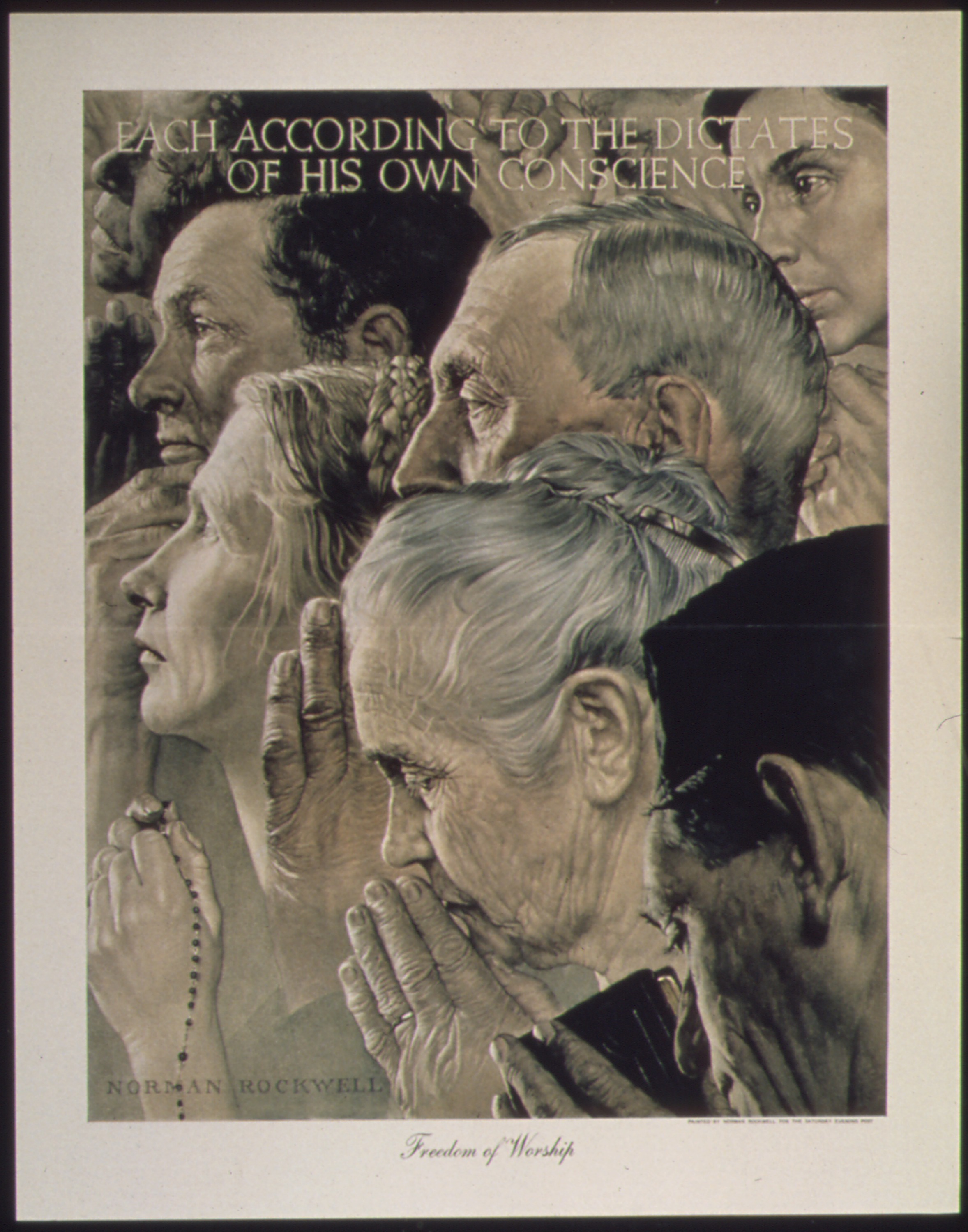
Freedom to Worship, Norman Rockwell, ca 1940
Any successful social and political order must meet certain basic human needs, needs that arise from universal human inclinations and drives. Prominent among these are the drive to find meaning and purpose through integration into larger projects, such as family and faith, and the equally strong drive to pursue these projects in one’s own way and not on the basis of a pattern coercively imposed from the outside. We might say, then, that every successful political order must meet the human needs for both virtue and freedom. For Muslims, these needs are ultimately grounded in our fiţrah, the innate and universal human inclination toward the good. Other traditions have their own anthropological frameworks, but few would deny this picture of basic human needs.
For a time, the liberal political order seemed to be meeting these needs tolerably well, protecting freedom while not undermining virtue too aggressively. But this is no longer the case. It is now plain to see that the liberal order is collapsing. Even the Economist, house organ of the bland, pro-market, pro-migration “classical” liberalism of the Davos class, now admits we are living “in a postliberal age.”1
Of course, if the world order is no longer hegemonically liberal, this does not mean liberalism is about to disappear from it. Our “woke” hyperliberalism is still a potent force in America and the rest of the Western world.2 This brand of liberalism is, in fact, so liberal it’s paradoxically illiberal: anyone who denies the dogmas of gender ideology or radical feminism is at best a suspect figure whom polite society should barely tolerate, at worst an enemy of freedom who needs a smack of firm, corrective government intervention. Hyperliberals want to force us all to be “free” by promoting bizarre speech codes and interfering in the internal affairs of families and religious congregations.3
Wokeness is often resisted by classical liberals, who seek to carve out a space for religious conservatives and hyperliberal progressives to live in peace, unmolested by one another.4 But many of today’s classical liberal thinkers, it has to be said, are getting rather long in the tooth. Anyone even marginally online will know that defenses of pluralism, tolerance, and the rule of law just aren’t the kind of thing that gets the kids excited. And more fundamentally, classical liberalism just isn’t a compelling doctrine once severed from its original religious foundations. Recent historians of liberalism have shown that early liberals based their defenses of freedom squarely on an Abrahamic vision of man as possessing innate dignity and responsibility to God.5 Cut away that foundation, or studiously avoid appealing to it, and what’s left is flat, stale, and ultimately arbitrary. As the political philosopher John Gray puts it, once the broadly theistic anthropology is gone, we’re all just “straw dogs.”6
Noting these failures, an increasing number of “postliberal” thinkers celebrate the demise of liberalism. But the alternatives they offer tend not to look terribly attractive either. Where woke progressives deny the human inclination to virtue and classical liberals think it will take care of itself without active support, some of these antiliberal thinkers wish to impose virtue down the barrel of a gun.
Catholic integralists, for instance, think the Vatican should once again give governments their marching orders—and direct them, where possible, to suppress what the Catholic Church deems heresy, schism, or blasphemy.7 As critics have plausibly argued, an integralist state could only maintain orthodoxy through “mass surveillance,” “modern heresy trials,” and “secret police,” and it may decide to “declare Black Protestant churches criminal organisations.”8 Self-proclaimed Protestant Christian nationalists think that the state should “suppress false religion” and “require people to attend church.”9 Less scholarly, but perhaps more popular, are the various strands of inchoate ethnonationalism festering online. And what would happen to religious minorities in this kind of postliberal order? “Nothing bad,” replies the prominent integralist Adrian Vermeule.10 I hope he will forgive my skepticism.
There are also things that public power can do that involve some direct regulation of conduct, which can be consistent with fusionism as long as they do not try to forcibly control people’s private lives. Governments can legitimately seek to improve society’s moral ecology—the cultural environment in which people make choices—so as to make virtue easy and vice less tempting. Restrictions on the public advertisement of, say, harmful intoxicants, pornography, or hookup apps do not try to coercively impose virtuous choices, but they do seek to reduce sources of temptation and perhaps change what people regard as socially respectable. Restrictions on selling alcohol or condoms to minors, or requiring Hollywood-style content labels on media, for example, are regulations that can make virtuous choices easier without coercively preventing adult citizens from choosing vice if they wish.
Although fusionism was developed by Christian and Jewish thinkers, prominent Muslims have also made arguments like the ones outlined above. For a recent example, the Tunisian pro-democracy leader Rached Ghannouchi argues, in a series of dialogues with the American liberal political theorist Andrew March published as On Muslim Democracy in 2023, that “the state’s mission is to make virtue easy and vice difficult but possible.”18 Why add the very deliberate “but possible” to the end of this formulation if not to acknowledge the fusionist insight that trying to make vice impossible will fail to produce genuine virtue?
Today, however, an influential section of the commentariat has deemed fusionism a “dead consensus”: an idea that they claim has been tried and found wanting.19 For these thinkers, fusionism failed to prevent today’s cultural crisis because it ceded too much ground to liberal individualism and ended up prioritizing freedom over virtue every time they appeared to be in conflict. But looking at the matter more closely, we can see that the fault was not with fusionism but with the attempt by some thinkers and activists to identify the common good too closely with the concerns of a specific religion.

Elasticity, Umberto Boccioni, 1912
Cold War America was essentially a nation of Protestants, Catholics, Jews, and a small number of nonbelievers. Today, most Western nations also contain significant numbers of Muslims and Hindus, as well as increasingly large secular populations. But as the Cold War began to draw to a close and America’s culture wars began to heat up, an important strand within the fusionist movement sought to import specifically Roman Catholic concerns into the heart of the common good that government was to promote.
This so-called Catholic moment—an era spanning the late 1980s to the early 2000s, and the title of a 1987 book by the prominent public intellectual and founder of First Things magazine Richard John Neuhaus20—saw a group of thinkers known as the “Catholic neoconservatives” exert outsize influence within the fusionist movement. (These thinkers, who included Michael Novak and George Weigel as well as Neuhaus, were called neoconservative because there was something new [neo-] about what they sought to conserve: namely, the combination of political freedom and social conservatism that they saw in the America they knew and loved.)
For these neoconservatives, Catholics would have a special role to play in developing a public philosophy for the Western world, grounded in the Catholic Church’s long tradition of reflection on the “natural” moral law that it holds to be accessible to persons of all faiths or none. The academic side of the project, therefore, involved philosophers like John Finnis developing a “new” natural law theory that would not presuppose theism or Aristotelianism (let alone Catholicism) while vindicating much of the socially conservative teaching of the Catholic Church on “natural” grounds.21 For a time, the project seemed to be working. The Catholic neoconservatives even gained the ear of the evangelical president George W. Bush, who said in 2005, of his views on abortion and stem cell research, that “Father Richard [Neuhaus] helps me articulate these things.”22
But the Catholic moment came swiftly to ruin. By the second Obama administration, not only was it obvious that faith and family were on a steep trajectory of decline, with America following Europe down its secularizing path, but woke hyperliberalism was also rushing into the public square.
I believe the cause of fusionism’s failure, then, is also the cause of the failure of the Catholic moment: the importing of too many specifically Catholic theological concerns into what was supposed to be a public philosophy accessible to persons of all faiths or none. The new natural law theorists, who provided the movement’s intellectual firepower, developed a sophisticated and nuanced theory that is worth taking seriously. But they also defended some of the Catholic Church’s most controversial and highly demanding moral teachings—the prohibition on contraception, for instance, or the absolute prohibition on divorce—as supposedly knowable through pure reason and a part of natural law accessible to non-Catholics. These thinkers at times even argued that the whole edifice of natural law would make no sense if these controversial teachings were held to be knowable only on the basis of Catholic theology or revelation.23
For non-Catholics, who understandably viewed these arguments as suspicious, this tended to discredit the wider fusionist project, which came to be seen as a sectarian attempt to import Catholic theology into a public philosophy for a plural society. Secular thinkers especially came to see the social conservatism of the project as a disreputable kind of “theoconservatism.”24
The failure of the Catholic moment is a cautionary lesson. In societies marked by deep religious pluralism, a consensual public philosophy cannot be based on controversial teachings peculiar to one specific religious tradition.
A new fusionism, then, will need to be less Catholic in that it will need to avoid trying to justify the distinctive and demanding moral teachings of Catholicism—or of any faith. In fact, I think that the best foundation for a healthy public philosophy that has a chance of commanding consensus will not even—in light of the deepening and seemingly irreversible disagreement among Americans about the very existence of God—presuppose theism.
What it will presuppose is the theistic anthropology that grounds a vision of man as in need of both freedom and virtue, inclined both to integration into the structures of family and faith and to the freedom to affirm these structures on the basis of his own judgment, rather than through coercion. This anthropology is shared by the major Abrahamic faiths but is also embraced by some citizens with no faith at all. Something like this idea has recently been articulated by the Protestant theologian Carl Trueman in his call for a public philosophy grounded in a “new humanism.”25
Trueman’s new humanism is centered on a particular vision of human dignity. In this vision, respecting human dignity requires not just the avoidance of religious coercion but also the recognition that humans are inherently embodied creatures who flourish through family relationships and the pursuit of meaning, not through mindless hedonism and self-indulgence. The intrinsic and innate value of human life provides reasons to oppose euthanasia, the embodied nature of man supplies a clear rationale for opposing transgender politics, and the understanding of human flourishing affirmed by the new humanism implies that pornography and hookup culture undermine virtuous and healthy living. Opposing such practices, of course, means not that the government should necessarily ban them—but that it has reasons to discourage them through various means.
This human dignity—which consists not just in our capacity to recognize virtue but also in our capacity to choose to recognize it—provides powerful support for the fusionist vision of government as a noncoercive custodian of the common good. Policies and public education campaigns to promote this good are a core responsibility of government, but this promotion should not involve the coercive imposition of outwardly virtuous behavior on adult citizens, for coercion destroys the very ordering of the soul that virtue aims at.
And this new humanism does not—and in my view should not—try to get us to embrace more controversial, specific, or demanding forms of social conservatism. Reasonable people will continue to disagree about divorce, contraception, and other fraught questions—just as they disagree about theology and revelation. Fusionism 2.0 will have modest, but achievable, goals.
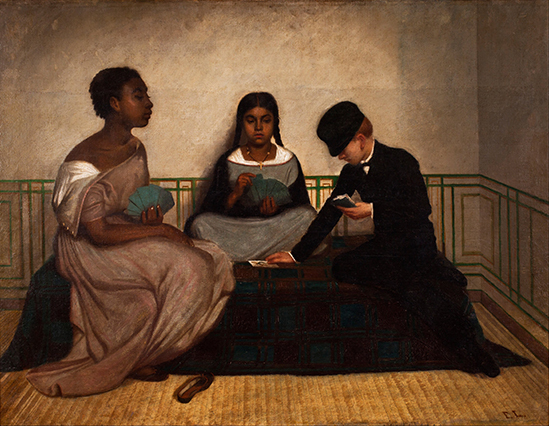
The Three Races, or Equality before the Law, Francisco Laso, 1859
It is here that Muslims can make a distinctive contribution to our nascent “Abrahamic moment.” The notion of the human fiţrah, or innate natural disposition toward the good, can help explain why—despite the diversity of religions, philosophies, and cultures in the world—we should expect to find, and continue to observe, rebellion against ideas that too radically deny the innate value of human life, our embodied natures, the dignity of human sexuality, or the importance of family. A consensus on these basic values is far more likely to be stable than an attempt to erect a social order on their denial. Because Muslims do not believe in original sin, but rather see the nature humans actually have as also the one we are supposed to have, the Islamic tradition is particularly well placed to identify this natural human disposition and articulate how it might manifest itself in the new, Abrahamic fusionism.
All just political orders involve compromise; none can give every community everything it wants. All sides in our present culture wars, then, will have to make sacrifices. Social conservatives will have to cede to progressives a space of personal freedom, even if that freedom is used in a way they regard as degrading and destructive. Religious traditionalists who want a “public square re-ordered to… the Highest Good” will have to accept that different communities and traditions will specify the details of this good in different ways.26 (America’s traditional “civil religion,” in which public life was based on a stripped-down theology shared by the country’s major religions, might provide an example of how this could work.)27 Liberals, too, will have to make a major concession: not every departure from government neutrality about the good is “illiberal.” Lumping the social conservatism of a thinker like Trueman together with the mad schemes of the Catholic integralists is a grotesque distortion. Even liberals who hold progressive views of personal morality and reject the virtues affirmed by the new humanism should at least accept that noncoercive attempts to promote these virtues do not threaten the entire liberal project.
As the West reels from the failure of a bankrupt liberalism on the one hand and the prospect of a deranged authoritarianism on the other, believers in all faith traditions, and nonbelievers who hold on to an elevated and dignified vision of humanity, should work together to articulate the new public philosophy that we so desperately need. We can learn from the failure of the Catholic moment and make this moment one that embraces the goods that are most genuinely common, promoting and preferring these goods in our public life while also recognizing that they cannot be forced upon people through coercion. The Abrahamic moment will be one that embraces the fusionist insight: that freedom and virtue go together.
Renovatio is free to read online, but you can support our work by buying the print edition or making a donation.
Browse and Buy