
Marwa Al-Sabouni
Marwa Al-Sabouni is an architect and writer based in Homs, Syria.
More About this Author
Marwa Al-Sabouni is an architect and writer based in Homs, Syria.
More About this Author
Marwa Al-Sabouni is an architect and writer based in Homs, Syria.
More About this Author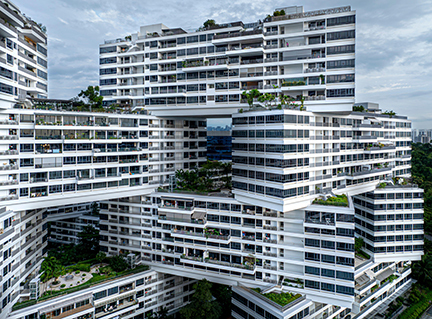
The Interlace in Singapore, a housing complex designed by Ole Scheeren, exhibits “mathematical sense without necessarily being humanly lovable.”
Progress, success, civilization. These are fundamental concepts in any argument around the validity of our architectural choices. Whether in a political campaign or in an intellectual discussion, the styles of our future buildings usually have to be justified within these terms and values, which go beyond practical requirements (such as budget, logistics, and so on) and tap into the realm of collective aspirations, as our cityscapes act as reflections of our place in the world as nations and societies.
This civic pride is a double-edged sword, though, because as much as it can be an area of consensus, it is also likely to become one of contention. Increasingly, our cities are considered places of alienation by their inhabitants. Critics often blame modern buildings, with their sheer scale and synthetic materials, for this, in that these structures sever people’s attachments to place and drive them away from cities, whether because they lead to unaffordable housing prices or through something more intangible: their lack of sensitivity to human and community needs and values. On the other hand, hankering after the styles of the past as part of preserving the traditional is usually considered pretentious, boring, and lacking ambition.
Nonetheless, in most of what is built today, the simplistic dichotomy of traditional versus modern only relies on unifying measures of merit such as performance and popularity to distinguish between the two approaches.1 Traditionalists focus more on creating gentle density: pedestrian-driven, mixed-used spaces using abstract, “stripped-down” models from past eras or styles. Modernists, on the other hand, are no longer motivated by the postwar ideology that sought to build an egalitarian new world, nor do they experiment at the crossroads of science and art like the avant-gardists they used to be. Think of architects like Lina Bo Bardi, whose architecture carried the burdens of social justice; I. M. Pei, who placed intention at the core of his design; and Jørn Utzon, who tried to remain inspired by nature and past civilizations.
Today’s modernists, however, similar to contemporary traditionalists, try to tick the boxes of “functional,” “green,” and “sustainable,” in turn diminishing architecture to a mere logical exercise. Almost like a Rubik’s Cube, buildings designed by architects such as Bjarke Ingels and Ole Scheeren are the manifestations of an overriding concern with making mathematical sense without necessarily being humanly lovable. Moreover, ticking the boxes can be used almost as a free pass for those redemption-seeking star architects such as Zaha Hadid, notorious for bombastic creations whose appeal to the wider public is diminishing as more and more people are rediscovering their intrinsic attachment to the valuable and the sensible.
There is no shortage of rigorous research on city planning and placemaking. However, the conflict between the two types of style still persists across the research field, leading to no satisfying resolution. Traditionalists claim that because they rely on “successful” idioms, they have more relevance to people’s collective aspirations, and in consequence, aesthetic choices, and so ultimately deserve their funds. Modernists, on the other hand, believe that their sweeping effect in postwar rebuilding qualifies them to hold the baton to direct what comes next. They shrug off the grievances of the public, who find themselves estranged from a world built solely for profit. Today, as we try to build in times riddled with cost-of-living and housing crises, arguments concerning beauty and moral relevance can quickly be detoured into a checklist of performance criteria, with any other values dismissed as subjective. Restricting an argument to subjectivity and technicality is an evasive approach that seeks to fill the void left by the dismantling of a unifying worldview. For instance, the New Classical idiom advanced by architects such as Léon Krier provides an elegant form, albeit devoid of meaning precisely because it is not backed up by a reinforcing worldview that expresses a collective sentiment. Instead, these forms find their relevance in the sphere of politics, where market interests make the final call. The historic centers of European cities are a perfect example of how beautiful buildings can become shells for abandoned meanings deployed to the taste of the global elite and the demands of tourism.
Again and again, we find ourselves at an impasse where we have to choose between impoverishment of our souls and impoverishment of our pocketbooks.
The key to this problem lies beyond the Western world. In the Islamic financial system, interest-bearing loans are prohibited and corporations do not have a monopoly on people’s lives. Small businesses, which are the basis for mixed-used buildings and developments, exist naturally in the absence of the mass dominance of the loan-enabled corporate system. Against the odds, Muslim societies—for example in my own country, Syria—on the whole still abide by the rule of Islam, despite the availability of interest-bearing loans from governmental institutions. Private developers as well as members of the public undertake the endeavor of building without taking on loans and instead put up palpable funds up front. This results in two things. The first is that the projects they undertake are significantly smaller than those possible through interest-bearing loans, resulting in lower building heights at better human scales and creating more diverse economies with a greater number of players. The second is that real estate transactions happen on the plot as much as on-site; for instance, contractors may sell eight floors of a ten-story building at the beginning of the building process. The funds they get as an advance from those eight floors then gradually fund the building as it goes up, with the profit going into the building of the two remaining stories.
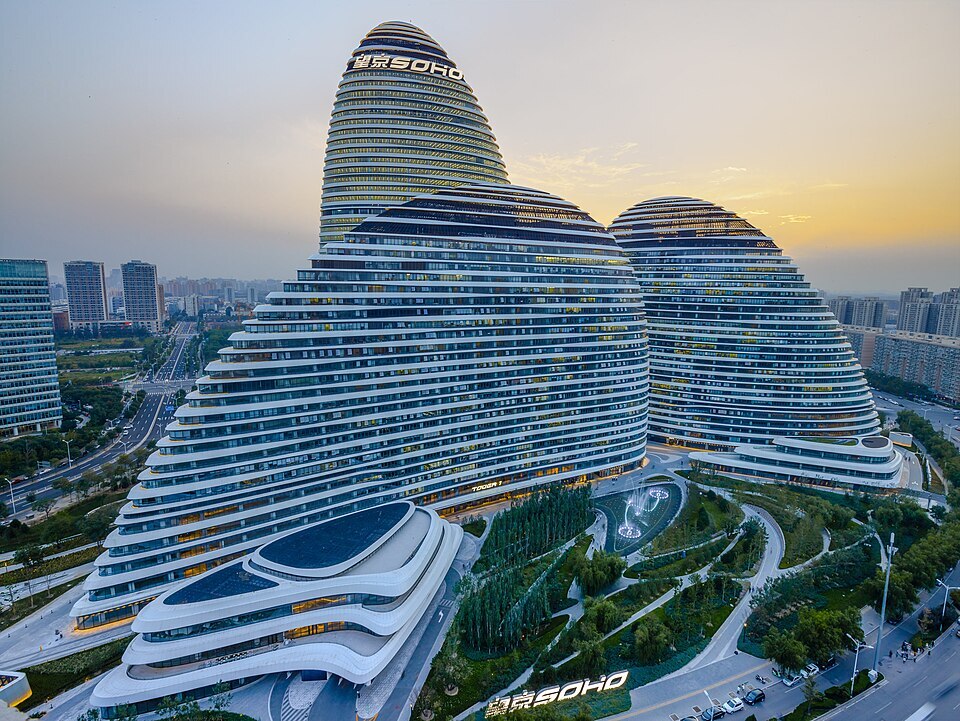
An office complex in Beijing, built by Zaha Hadid, an example of her “bombastic creations”
Let’s not focus for a minute on the lack of style in which such buildings take shape and instead see how the method possible within Islam’s interest-free system is a socially enabling power. Self-built housing, to which evidence-based research is finally awakening, is possible because the Factory hasn’t taken root in alliance with banks. The result is organic, diverse societies whose freedom is not taken away in the name of progress. This image is tarnished by the colonial legacy that systematically sought to deconstruct all the financial and social networks and structures that used to sustain an organically free and mutually collaborative model of work. It is also the reason why style is a contested matter lost along with the definition of self in post-colonial regions. Modernization was the pretense under which Islamic institutions like the waqf (charitable endowments) were deactivated to the degree that it remains only as a nominal facade of what used to be a network of charitable funding and innovative building.
The perils of modernity are not confined to its building style; they are integral parts of its structures as a system and its values as a worldview. This individualistic and utilitarian worldview, which created an architectural norm that champions disconnection and disruption in the name of creativity, has led to three main changes in the way we define good and successful architecture. First, it engendered a culture of replacement in which nothing is so valuable that it cannot be replaced. Whether a building, a tree, or now with AI, even a human being, everything and everyone is considered a means to an end. This end is always utilitarian, which means it does not go beyond itself: there is no higher purpose and no diffusion of goodness. Perpetually self-serving, our buildings, by extension, set an example for our life goals. Second, it promoted record-breaking scale as a measure of advancement; in other words, the bigger, the better. In the race for recognition, architects and city planners (backed by their clients’ funding) aspire to ostentatious quantity rather than genuine advances in quality. Beyond the damage they do to our value system, these aspirations damage our planet, deplete its resources, and leave us blind to the cost each one of us imposes on every other. In that sense, their damage is cumulative beyond their immediate footprint as they gain followers of the same wrong type of behavior. Third, modernity elevated tourism as a measure of a city’s success: the city as an objet d’art to be enjoyed by passing strangers. Here, traditionalist buildings compete in the same race as modernist creations. Both introduce the city as a place, to use Thomas C. Oden’s term, of “narcissistic hedonism” where the above-mentioned culture of replacement and architecture of records are at play.
Although modernism is a Western project, there are two main contradictions when it is discussed in relation to the Muslim world. The first is that, although modernity is a secular project that contradicts all of Islam’s values and convictions, the Muslim world fervently embraces it. This is partly because embracing modernity is seen as a prerequisite for success, something that the Muslim world has dearly missed since the fall of the Ottoman Empire. It is inescapable that the Muslim world has failed to reassemble itself in the postcolonial era that followed that defeat, instead becoming fragmented and controlled by corrupt elites who never completely escaped the colonial project.
The second contradiction appears when we consider the twelve-century history of Islamic civilization. If modernity means innovation, progress, and advancement, then Islam is perpetually modern. Any examination of Islamic architectural styles during that long and rich history will show that Islam never settled for repetition, nor were its creations disconnected from their place, time, and history. It always built on what was already there, but was never satisfied with merely copying it. Therefore, traditional style in the Western sense is not part of the history of Islamic architecture.
Furthermore, in comparison with Western modernity, Islam’s project was never individualistic; rather, it focused on creating a healthy society of individuals, tightly knit instead of isolated. This was evident in the way Muslim cities were built, allowing for clusters to form around family structures and neighborly values. To have developer-led corporations tearing down these societies and boxing them into isolated building blocks is not only a crime against beauty and the environment but also a betrayal of history and civic stability. The sad irony is that this mistaken subscription to a false idea of progress is dismantling the city and its societies in the Muslim world at a faster rate than in the West. Whether because the postcolonial political orders in the Muslim world are autocratic and malfunctioning or because the Muslim public is outcast and besieged, planners still throw modernity upon those cities and towns as a rescue rope, although it’s proving with each passing day that it is no rescue rope, but a noose. The other alternative, a return to the old and traditional, also seems to offer no satisfaction, because it not only fails to represent society’s collective aspirations and self-image but also is, like the New Classical movement, an empty shell of meaning reduced merely to the technical value of a fading worldview and dismantled structures.
Architecture has always been a field that championed humanity’s higher values as well as men’s greatest victories. In its heydays, it was able to celebrate beauty, nature, and the best in the human being, but it was also able to idealize power and enforce hegemony. History shows us that it is in the latter where the end of civilization lies, so we owe it to ourselves and to the world to fight back against the tide of materialism and ugliness, against utility and ideology, and against counterfeit and kitsch. To build is to immortalize, and it’s up to us to choose the nature of how we build.
Renovatio is free to read online, but you can support our work by buying the print edition or making a donation.
Browse and Buy